 The Market
For The Market MBA · Members Only
MEMBERS ONLY — This Market Lesson is for members of TheMarketMBA.com (in BETA). It uses Monday’s bank-outage reports to teach four ideas: concentration risk, an outage-proof checklist, the tokenization shift already underway, and how to think about positioning. Nothing here is a recommendation to buy or sell.
Summary: On Monday, Nov. 16, 2026, user reports of problems at several large U.S. banks piled up at once. JPMorgan Chase said a software bug in its own on-premise hardware slowed some of its transactions, and that other banks were affected only where they were on the other side of a Chase transaction, often through Zelle. A few huge banks and a few shared payment networks means one glitch can freeze a lot of people at the same time. This lesson covers how to outage-proof your money, and how MrFlourish sees the longer move toward tokenized assets and new financial rails.
The news: Monday’s bank-outage reports
On Monday, Nov. 16, 2026, users reported problems at Chase, Bank of America, Wells Fargo and U.S. Bank, according to outage-tracking reports cited by Reuters and WIRED.
Here is the official explanation, in the banks’ own terms. A JPMorgan spokesperson told CNBC, Reuters and WIRED that the firm had “a temporary issue related to a software bug in on-premise hardware systems,” that “there is no evidence it is cyber-related,” and that “this is not a systemic issue.” Other banks, the spokesperson said, “may have been impacted by slowness in transactions only to the extent that they were a party to a transaction with us.” JPMorgan also said customers could still access their accounts and funds, and that it was working to resolve the issue by the end of the day.
A U.S. Bank spokesperson said the company was “not directly impacted,” but that “clients attempting to send or receive Zelle payments with another financial institution may experience transaction delays” (CNBC; WIRED). A Bank of America spokesperson told WIRED its systems “have been operating normally today.” In the same report, Wells Fargo did not immediately comment. Zelle said, “Zelle is not down. Zelle is operating as it should,” while noting that people use Zelle through their banks, which hold the funds. Visa and Mastercard both said their networks were operating normally (WIRED).
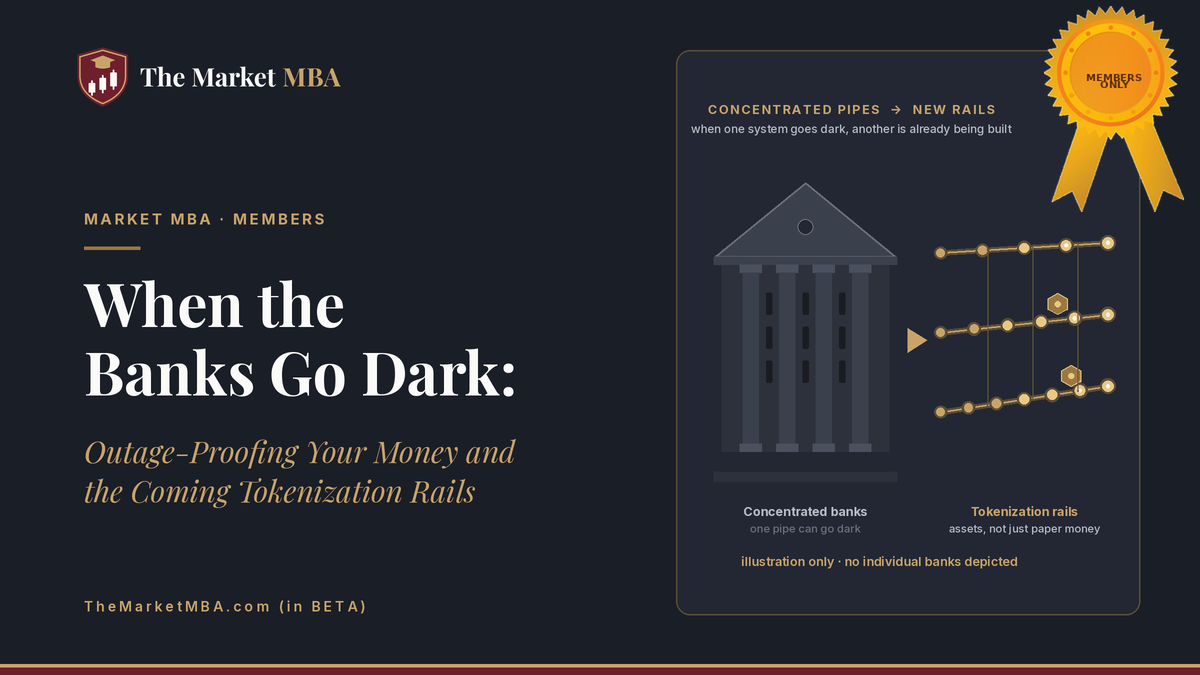
Those official statements are the public record of what happened on Monday. MrFlourish’s view is that the official explanations do not tell the whole story. About three months ago, he told people in a meeting: “the banks will be hacked to setup Tokenization and new financial rails (assets will matter, not as much paper money… digital).” That is MrFlourish’s thesis, not an established fact about Monday’s outage. This lesson does not claim a hack has been proved. It does take his longer point seriously: money is concentrated in a few institutions, and the financial system is already building new rails around tokenized assets.
Lesson 1: Concentration risk — one bug can freeze a lot of people at once
Retail banking in the United States is concentrated. WIRED noted that JPMorgan Chase is the top retail bank and holds more than 10% of all U.S. deposits. A large share of everyday payments also runs through a short list of networks: card rails such as Visa and Mastercard, and bank-to-bank apps such as Zelle.
Monday showed why that matters. Even if most of the official statements describe a bug at one bank, other institutions felt it where their transactions touched Chase, especially on Zelle. You do not have to bank at Chase to get stuck in a Chase delay. If your paycheck, rent or family transfer has to pass through a shared pipe, a problem at the other end can still leave you waiting.
This is concentration risk: too much of your daily financial life depends on one institution, or on one network that many institutions share.
The takeaway: Ask not only “is my bank up?” Ask “if this bank, or this payment app, froze for a day, what would I be unable to do?”
Lesson 2: An outage-proof checklist
You cannot prevent a bank glitch. You can make sure one glitch does not freeze your whole financial life. This is a preparedness list, not a prediction that banks will fail, and not a suggestion to pull all of your money out of the banking system.
- Keep 2 to 4 weeks of spending in cash at home, not all of your cash. Cash in hand works when an app or card network is down. It is also uninsured, can be stolen, and loses value to inflation if you hold too much of it for too long. A modest buffer is the point, not a mattress full of bills.
- Spread your money across 2 to 3 unrelated institutions. A useful mix is a large bank, a local credit union and an online bank. Then an outage at one place cannot lock up everything you need to spend.
- Have more than one way to pay. Keep a card on Visa and a card on Mastercard, plus Apple Pay or Google Pay. Do not rely on Zelle alone. Monday is the example: Zelle said its own system was operating, but transfers could still delay when a participating bank was slow, while Visa and Mastercard said their networks were running normally (WIRED).
- Stay within FDIC limits. The FDIC generally insures deposits up to $250,000 per depositor, per insured bank, for each account ownership category (FDIC). Accounts in the same category at the same bank are added together. Coverage at different insured banks is separate. Cash at home is not FDIC-insured.
- Keep your larger cash pile off one bank’s balance sheet. Treasury bills, or a government money market fund held at a brokerage, still give you a place to park cash and earn a yield. That money is not sitting as an ordinary bank deposit, so a single bank outage is less likely to freeze it. These products have their own rules and risks, including the possibility that a fund’s share price can move, so read the fund’s own documents.
The takeaway: Outage-proofing is about redundancy: a little cash, more than one institution, more than one way to pay, and insurance limits you actually stay under.
Lesson 3: The tokenization shift is already happening in the open
Tokenization means taking a real-world asset — a Treasury bill, a fund share, a bank deposit, even a stock — and representing it as a digital token on a shared ledger, often a blockchain. The token is meant to be easier to transfer, post as collateral, or settle around the clock than a paper certificate or a once-a-day fund record. The asset still has legal terms. The token is a new way of recording and moving it.
MrFlourish’s thesis is that assets will matter more than idle paper money as these new rails get built. You do not have to accept his view of Monday’s outage to see that the rails themselves are no longer theoretical. Here are examples that are already live, with sources:
- Tokenized Treasury and government money funds. BlackRock’s USD Institutional Digital Liquidity Fund, known as BUIDL, is a tokenized fund that invests in short-term Treasuries and similar holdings (BlackRock / Securitize). Franklin Templeton’s BENJI token represents shares of the Franklin OnChain U.S. Government Money Fund (FOBXX), an SEC-registered money market fund whose transfer agent records ownership on a blockchain-integrated system (Franklin Templeton).
- Regulated payment stablecoins. A stablecoin is a digital token designed to stay close to a currency, usually one dollar. The Guiding and Establishing National Innovation for U.S. Stablecoins Act, or GENIUS Act, was enacted on July 18, 2025. It creates a federal framework for “payment stablecoins” in the United States. The Office of the Comptroller of the Currency has issued a final rule to implement that law, effective Jan. 18, 2027 (OCC).
- J.P. Morgan’s blockchain rails. Kinexys, J.P. Morgan’s blockchain unit, offers JPM Coin, a USD deposit token for institutional clients, now on both Base and Ethereum. The bank says clients can use it to move money, post collateral and settle on-chain transactions, and that the Kinexys platform has processed more than $4 trillion in cumulative transactions since inception (J.P. Morgan, Oct. 19, 2026; J.P. Morgan: JPM Coin).
- DTCC’s tokenized securities and collateral plans. On Oct. 28, 2026, The Depository Trust Company, a DTCC subsidiary, launched the DTCC Tokenization Service. It creates tokenized representations of securities already custodied at DTC, so eligible participants can convert between traditional and tokenized form and move those tokens, including for collateral, more quickly (DTCC, Oct. 28, 2026). DTCC is also building a Collateral AppChain for faster, around-the-clock collateral management; in May it said that platform was expected to go live in the fourth quarter of 2026 (DTCC, May 13, 2026).
- Robinhood stock tokens in Europe. In the European Union, Robinhood offers “Classic Stock Tokens” that track U.S.-listed shares and exchange-traded products (Robinhood EU). These are over-the-counter derivative contracts with Robinhood Europe, not ownership of the underlying shares, and they do not carry shareholder rights such as voting (Robinhood EU support). That distinction is the lesson: a “stock token” is not automatically the same thing as a stock.
The takeaway: Tokenization is not a future headline. Funds, stablecoin rules, bank deposit tokens, clearinghouse infrastructure and brokerage stock tokens are already being built. The new rails still have legal terms, eligibility rules and risks. Read what you actually hold.
Lesson 4: How to think about positioning (educational only)
If MrFlourish is right that assets and the new rails will matter more than idle cash in a bank, the educational idea is not to bet the house on one prediction. It is to own a mix of real assets, and to understand the companies that build or guard the pipes, in sizes you can live with if you are wrong. This is a framework, not a buy list, and not a forecast.
- Own assets, not just idle cash. Stocks, funds, gold and, for people who accept the volatility, bitcoin and ether are examples of assets that can be held, transferred or eventually tokenized. A cash buffer still belongs in the outage-proof plan above. The point is not to go to zero cash. The point is that a large pile of uninvested deposits is the thing most exposed if the old rails hiccup, and the thing that quietly loses purchasing power to inflation.
- The infrastructure of the new rails. Brokerages and on-ramps such as HOOD and COIN are where many people will first touch tokenized or crypto products. Circle, ticker CRCL, issues the USDC stablecoin. Payment networks such as V and MA still clear a huge share of everyday spending, and Monday’s statements said those networks kept operating. Market plumbing firms such as Intercontinental Exchange (ICE), CME Group (CME) and Nasdaq Inc. (NDAQ) are the exchanges and clearinghouses tokenized markets still rely on.
- Cybersecurity. Whatever you believe caused Monday’s mess, outage and “is it a hack?” headlines tend to mean more spending on defense. Names often discussed in that group include CrowdStrike (CRWD) and Palo Alto Networks (PANW). A headline is not a thesis by itself, and these stocks can be expensive and volatile.
- Small hedge slices. Gold, bitcoin and ether sit outside an ordinary bank deposit. If you use them as hedges, the educational approach is a small slice you can hold through large swings, not a concentrated bet. Crypto can fall sharply, and gold can go sideways for years.
The takeaway: If you study this theme, write down why you own each name, keep the sizes modest, and do not treat a bank-outage headline as a trading signal by itself. None of these tickers is a recommendation.
Members takeaway
A short action list you can run this week:
- Write down every place your spending money lives, and what would happen if that app or bank were down for 24 hours.
- If more than one or two weeks of bills depend on a single bank or on Zelle alone, add a second, unrelated institution and a second payment method.
- Count your deposits at each bank against the FDIC’s $250,000 limit per ownership category.
- Decide how much cash belongs at home as a 2-to-4-week buffer, and where the rest of your cash should sit, such as T-bills or a government money market fund at a brokerage.
- If you want to work this into your own holdings, bring the checklist to your next one-on-one portfolio review with MrFlourish. Members can book a session on the portfolio review page.
Key terms
- Concentration risk: having too much of your daily money, or the system’s payments, depend on one bank or one network
- Zelle: a bank-to-bank payments service; your bank holds the funds, not a separate Zelle account
- FDIC insurance: federal deposit insurance, generally up to $250,000 per depositor, per insured bank, per ownership category
- Treasury bill (T-bill): a short-term loan to the U.S. government, often used as a cash-like holding
- Government money market fund: a fund that invests mainly in government securities and seeks to keep a stable share price, with its own rules and risks
- Tokenization: representing an asset as a digital token on a shared ledger so it can be transferred or posted as collateral more easily
- Stablecoin: a digital token designed to stay close to a currency, usually the U.S. dollar
- Deposit token: a digital token that represents a bank deposit, such as J.P. Morgan’s JPM Coin for institutional clients
Sources
- CNBC: JPMorgan Chase says temporary software bug is affecting consumer banking (Nov. 16, 2026)
- Reuters, via Investing.com: JPMorgan says software bug slows its transactions (Nov. 16, 2026)
- WIRED: The Bank Outage May Have Nothing to Do With Your Bank (Nov. 16, 2026)
- AP: bank outage coverage (Nov. 16, 2026)
- FDIC: Understanding Deposit Insurance
- BlackRock / Securitize: BUIDL, USD Institutional Digital Liquidity Fund
- Franklin Templeton: BENJI / Franklin OnChain U.S. Government Money Fund
- OCC Bulletin 2026-50: GENIUS Act regulations, final rule (effective Jan. 18, 2027)
- J.P. Morgan: Kinexys brings JPM Coin deposit token to Ethereum (Oct. 19, 2026)
- J.P. Morgan: JPM Coin product page
- DTCC: Tokenization Service goes live (Oct. 28, 2026)
- DTCC: tokenized collateral and Collateral AppChain (May 13, 2026)
- Robinhood EU: Classic Stock Tokens
- Robinhood EU: Buy and sell Stock Tokens
🌐 MrFlourishinvests.com (in BETA) – Daily market moves, stock ideas, and money flow from MrFlourish and Team.
🌐 TheMarketMBA.com (in BETA) – Plain-English lessons on how markets, investing, and money really work crafted by MrFlourish and Team.
NFA
Not financial advice. This article is for educational purposes only. Nothing here is a recommendation to buy or sell any security, cryptocurrency or other asset. Markets, yields and product rules change. Recheck live sources and your own situation before you act.
For education and entertainment only. Not financial advice.