 The Market
Opinion brief
By Clark Kent for The Market MBA
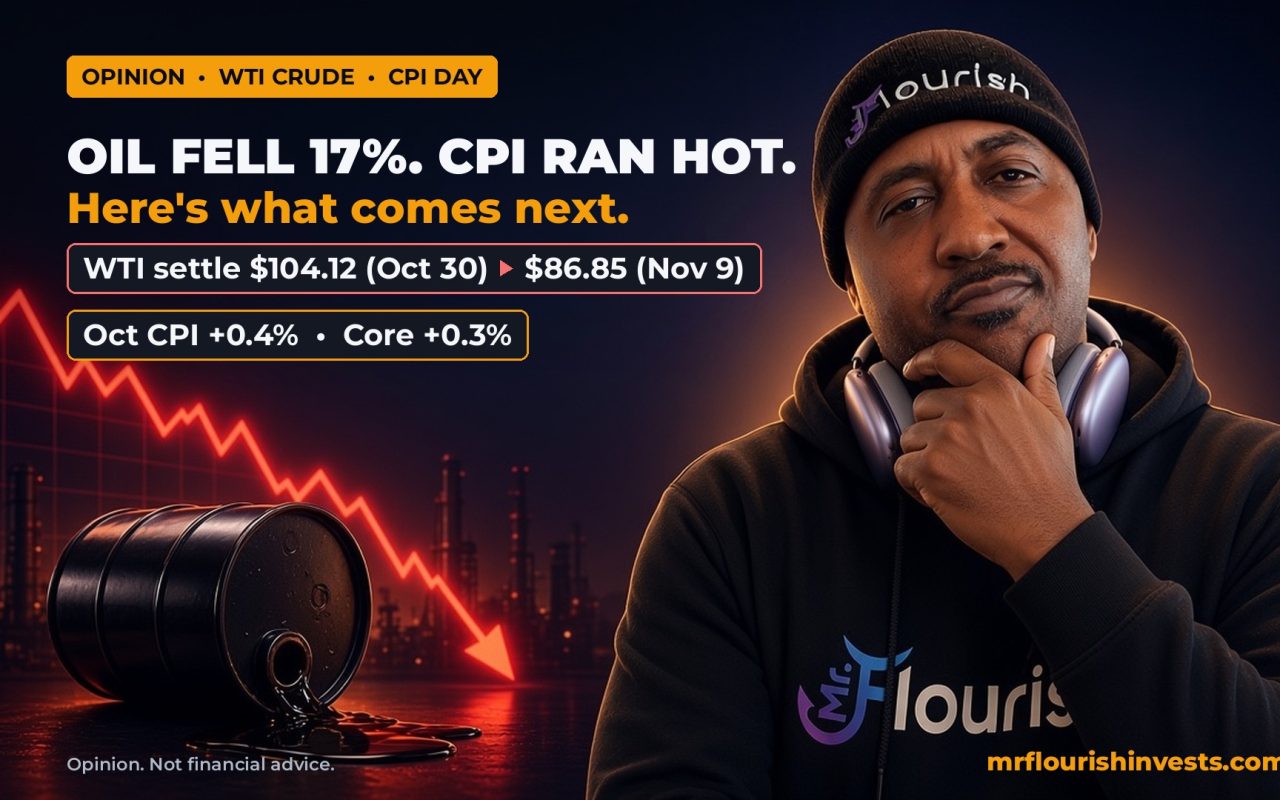
October’s consumer price index came in hot this morning. Headline CPI rose 0.4 percent for the month against 0.3 percent expected, and core rose 0.3 percent against 0.2 percent. Oil, meanwhile, has fallen about 17 percent in 10 days. Those two facts point in opposite directions, and the gap between them is the story: CPI is a look back at October’s expensive oil, while the price of crude is a look ahead.
Bull Theory posted a chart this morning that markets should take seriously. The direction is right: oil has been the swing factor in this year’s inflation, and the latest drop is large. The mistake would be treating that drop as if it had already shown up in the CPI, or as if peace headlines cannot reverse.
West Texas Intermediate futures are down about 17 percent in 10 days on official settles, from $104.12 on Oct. 30 to $86.85 on Nov. 9, per NYMEX data via Yahoo Finance, with the Nov. 9 settle confirmed by Reuters and DTN. Bull Theory called it a 20 percent crash. That only holds if you measure from the Oct. 30 intraday high of $104.99 to this morning’s low near $83.88, not settle to settle. Crude was near $85.10 around 6:45 a.m. Central.
WTI fell 7.36 percent on Nov. 2, to $96.46, after Iran’s president said the government had authority for peace talks; 8.29 percent on Nov. 4, to $88.12, after Vice President J.D. Vance said, “The reason we lost is the war”; and 4.38 percent on Nov. 9, to $86.85, after President Trump said new strikes were “highly unlikely” if talks progress and Qatar’s prime minister brought an Iranian plan to reopen Hormuz.
Oil also rose 15.2 percent in October, from $90.42 on Sept. 30 to $104.12 on Oct. 30, on the continuous front-month series. Today’s CPI, released at 7:30 a.m. Central, still covers that climb. The 10-day drop that started after Halloween is not in this number.
October CPI
The Bureau of Labor Statistics released the October consumer price index at 8:30 a.m. Eastern (7:30 a.m. Central). Headline CPI rose 0.4 percent month over month, seasonally adjusted, versus a 0.3 percent consensus (Dow Jones, Reuters and Bloomberg), after a 0.6 percent rise in September. Core CPI, excluding food and energy, rose 0.3 percent, versus 0.2 percent expected. The energy index rose 0.7 percent, after a 5.2 percent jump in September, and the gasoline index rose 1.0 percent, after 9.1 percent. Before seasonal adjustment, gasoline prices fell 0.7 percent, so pump prices actually eased in October; the seasonal adjustment turns that into a rise. Both headline and core came in a tenth above consensus, so this was a hot print.
The BLS is not publishing an official headline or core year-over-year figure this month, because it has no October 2025 base after last year’s shutdown. One exception is gasoline: the BLS shows the gasoline index up 37.4 percent from a year earlier, unadjusted. “Hot” or “cool” today means the monthly change. Unofficial annual estimates going in were about 3.8 to 3.9 percent headline and 2.7 percent core.
A hot print does not disprove the oil story. It shows that October’s expensive crude and fuel, plus a food index that rose 0.5 percent and sticky core categories, still had a hold on the report. Energy added less than in September, but it still added. The oil drop that began after Oct. 30 is not in this number, and it is the part that could cool the next reports if crude holds.
Bond traders read it the same way. In the first minutes after the release, the 10-year Treasury yield rose about 7 basis points to roughly 4.93 percent, and the 2-year yield jumped about 15 basis points to near 4.70 percent. Nasdaq 100 futures fell about 0.85 percent and S&P 500 futures about 0.3 percent. Crude barely reacted to the data itself; WTI was already down about 2 percent this morning, near $85, on the Iran headlines. That is the split that matters: oil is cooling, but a hot core reading keeps pressure on rates.
U.S. CPI rose from 2.4 percent year over year in January to 4.2 percent in May, the highest since April 2023, according to the BLS. The EIA has estimated that oil through Hormuz was about a fifth of global petroleum-liquids consumption — not all of the world’s energy. After the war began on Feb. 28, those flows were badly disrupted. Cheaper oil, if it lasts, would ease pressure on fuel, shipping and food. Bull Theory is right about that direction.
Gasoline futures are down about 16 to 17 percent over the past month on the December RBOB contract, from $3.1534 on Oct. 9 to $2.6509 on Nov. 9, and near $2.61 this morning.
Bull Theory also said Gulf oil exports were back to pre-war levels and cited a JPMorgan estimate of a 1.4 million barrel-a-day global surplus. The surplus is JPMorgan’s October estimate, up from 1.1 million in September, from a Nov. 4 note reported by Reuters and MarketWatch. The export claim does not hold. The same note said Middle East exports had recovered to about 20.7 million barrels a day from 9.8 million in March, but were still below pre-war levels.
Peace headlines can fade. WTI settled at $67.02 on Feb. 27, the last session before the war. Monday’s $86.85 settle is still about 30 percent above that level, and about 23 percent below the 2026 high settle of $112.95 on April 7. A headline is not a deal.
Stocks have started to trade the relief. On Nov. 9, the S&P 500 rose 2.35 percent to 7,549.94, its best day in seven months, and the Nasdaq 100 rose 3.40 percent. That followed a Nov. 5 drop of 4.36 percent in the S&P 500, to 7,353.73, and a 9.26 percent drop in NVDA. Nvidia still fell on Monday, closing at $178.67, down 4.27 percent.
The Fed will not treat one oil slide, or one CPI print, as the end of the rate debate. Officials will want to see whether crude holds, pump prices follow, and core inflation cools too. If oil keeps falling, the year’s biggest inflation problem gets easier. That is not the same as it being gone.
What to watch
- CPI energy and gasoline details.
- Whether WTI holds if talks stumble.
- Actual Hormuz and Middle East export flows.
- Pump prices, which feed CPI with a lag.
- Fed comments and December rate odds.
- Whether the rebound broadens, or AI names keep lagging.
This article is for education only and is not financial advice. Markets can move quickly, and past price changes do not predict future results.
For education and entertainment only. Not financial advice.