 The Market
By Chief Editor Clark for The Market MBA
This was a loud week: two hot inflation reports, a surprise CEO exit at the world’s most valuable chipmaker, a pile of AI earnings and the final stretch before Anthropic’s IPO. Yet the S&P 500 still had its best week since August. Here is the week in plain English, and the one idea that ties it together: the discount rate.
The scoreboard
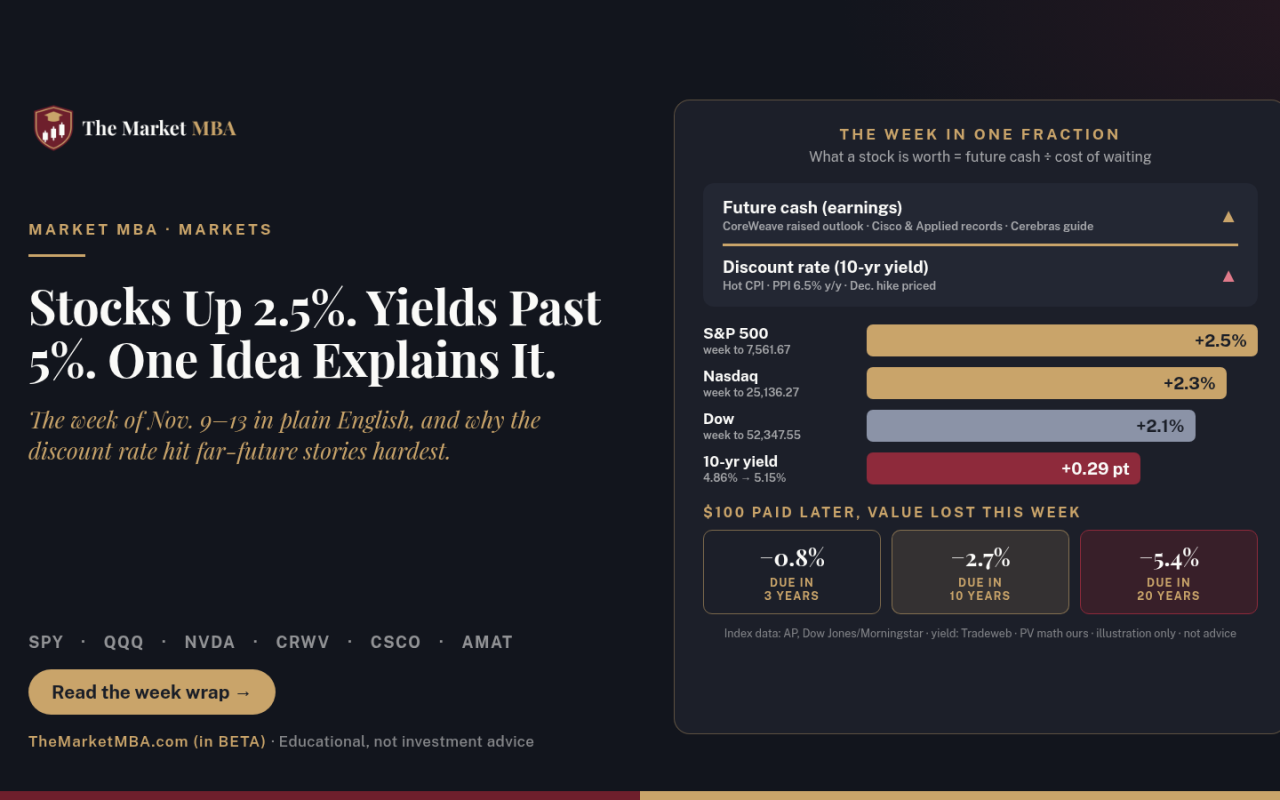
The S&P 500 rose 2.5% for the week to 7,561.67, snapping a four-week losing streak with its biggest weekly gain since the week ending Aug. 7 (Dow Jones Market Data via Morningstar). The Nasdaq gained 2.3% to 25,136.27, its first weekly gain in five weeks, and the Dow added 2.1% to 52,347.55 (AP; AP). Friday itself was red: the S&P fell 0.4% and the Nasdaq 0.9% as big AI names pulled back, while the Dow eked out a 0.1% gain (AP).
Energy was the best sector, up 5.5%, followed by industrials, up 3.8% (Morningstar). Inside chips, money moved rather than left: AMD rose about 19% for the week and Broadcom about 18%, even as Nvidia lost its CEO (Morningstar).
The number that mattered most was not a stock. The 10-year Treasury yield rose 0.294 percentage point to 5.152%, its largest weekly jump since April 2025, and touched 5.174% on Friday (Tradeweb via Morningstar; CNBC). Hold that thought.
Inflation ran hot, then a little less hot
On Tuesday, October’s consumer price index rose 0.4% and core CPI, which leaves out food and energy, rose 0.3%, each a tenth of a point above forecasts (BLS; CNBC). Core has now run 0.3% for three straight months, about a 3.7% annual pace, close to double the Fed’s 2% goal. We did the math in Wednesday’s lesson.
On Friday, producer prices rose 0.3% against 0.4% expected, a small relief. But PPI is up 6.5% from a year ago, the most since November 2022, and a cleaner core measure rose 0.5% for a second month (BLS). Markets still fully price a Fed rate hike at the Dec. 8–9 meeting (CNBC). Our PPI explainer walks through the pipeline.
Nvidia lost its founder-CEO
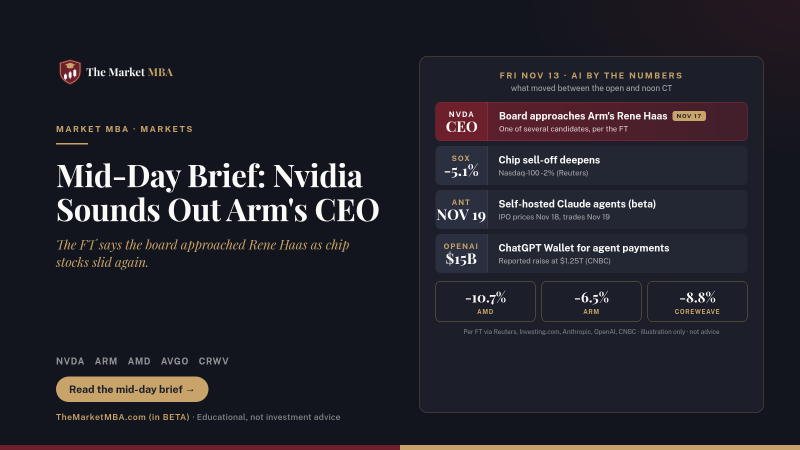
On Thursday, Nvidia (NVDA) said Jensen Huang had resigned as president, CEO and director. CFO Colette Kress is interim CEO while the board searches, and longtime director Harvey Jones became the company’s first board chair (Nvidia). The stock fell as much as 14% at Thursday’s open before recovering part of the drop. On Friday, the Financial Times reported that the board has approached Arm Holdings CEO Rene Haas as a possible successor, which Reuters could not independently confirm; Arm shares fell (Investing.com). Nvidia reports quarterly results Tuesday, Nov. 17, Kress’s first call in the top job.
The AI supply chain reported, and the market graded on quality
- CoreWeave (CRWV), Tuesday: revenue of $3.66 billion, up 168%, and a raised 2026 outlook of $13.0 billion to $13.3 billion. But interest expense of $846 million was about four times its $207 million operating profit (CoreWeave; our breakdown).
- Nebius (NBIS), Thursday: revenue of $980.8 million beat the $907.5 million estimate, yet the stock fell about 16% (CNBC). About $325 million of the quarter was one-time revenue, the lesson in our quality-of-a-beat piece.
- Cisco (CSCO), Thursday: revenue rose 24% to $18.5 billion, but adjusted gross margin slipped to 65.6% from 68.1% as lower-margin hardware grew (Cisco).
- Applied Materials (AMAT), Thursday: revenue rose 53% to $10.41 billion with record adjusted EPS of $4.16 (Applied Materials). We compared the two here.
- Cerebras (CBRS), Thursday: core revenue rose 70% to $230.9 million, and it guided the fourth quarter to $310 million to $330 million (Cerebras), above the roughly $271 million analysts expected. The stock rose Friday (CNBC).
Anthropic’s IPO entered the home stretch
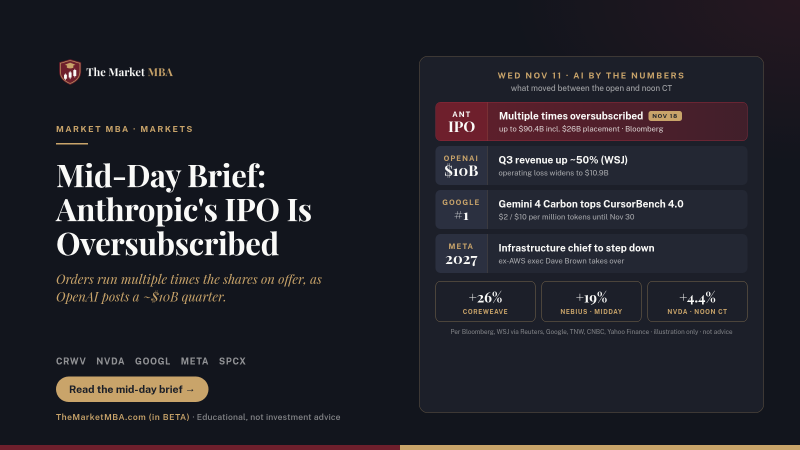
Anthropic launched its roadshow on Nov. 10 for 825 million shares at an expected $70 to $78 each (Anthropic), with pricing planned for Nov. 18 (CNBC). By Wednesday, Bloomberg reported the order book was multiple times oversubscribed (Bloomberg Law). Anthropic is still private and its registration is not yet effective. We explained how bankers turn orders into a price and, on Friday, how the new 3x Anthropic ETP really works.
The concept: every price is future cash divided by the cost of waiting
Here is the idea that connects all of it. A stock is worth the cash a business is expected to produce in the future, translated into today’s dollars. The rate used for that translation is the discount rate. Its starting point is the 10-year Treasury yield, the return you can get with almost no risk. Investors then add a premium for the risk of owning a stock.
Think of it as a fraction. The top is expected future cash. The bottom is the discount rate. Earnings news moves the top. Inflation and yields move the bottom.
Now see how much the bottom moved. Using the 10-year’s start and end for the week (our math, illustration only), $100 due in 3 years was worth about $86.70 at the start and about $86.00 at the end, a drop of under 1%. $100 due in 10 years fell from about $62.20 to $60.50, nearly 3%. $100 due in 20 years fell from about $38.70 to $36.60, more than 5%. The further away the cash, the harder a higher rate hits it. Investors call that duration.
That is why the week looked contradictory. The top of the fraction improved: CoreWeave raised its outlook, Cisco and Applied posted records, and Cerebras raised guidance. Stocks rose. Meanwhile the bottom rose too, as hot inflation pushed yields up, and the pain landed where cash flows are furthest out or most borrowed:
- Borrowers feel the rate directly. CoreWeave’s interest bill is the discount rate showing up on an income statement.
- Far-future stories are most rate-sensitive. Cerebras is targeting a tripling of revenue in 2027 (Cerebras), and an IPO at Anthropic’s size is a bet on profits years out. Higher yields raise the bar for both.
- Cash today holds up better. Energy and industrials led the week, and mature, profitable companies are less exposed to rate math.
Friday was the fraction in action. With PPI keeping a December hike priced and the 10-year at its highest since mid-October, the AI-heavy Nasdaq fell more than twice as much as the S&P while the Dow edged up (AP; Morningstar).
What to watch next week
- Tue., Nov. 17: Nvidia earnings, plus any word on the CEO search.
- Wed., Nov. 18: planned Anthropic pricing. A price above or below the $70 to $78 range is a direct read on demand.
- Thu., Nov. 19: Anthropic’s expected Nasdaq debut under ANT.
- The 10-year yield: whether it holds above 5% into the Fed’s Dec. 8–9 meeting.
The bottom line
When stocks and yields rise together, ask which side of the fraction is moving. This week, better earnings lifted the top while hotter inflation lifted the bottom. The companies whose cash is furthest away, or most borrowed, felt the bottom most. That simple fraction will matter again on Tuesday, when Nvidia reports, and Wednesday, when Anthropic prices.
Sources
- AP: Stocks fall but Wall Street notches a winning week (Nov. 13)
- AP: How major US stock indexes fared Friday 11/13/2026
- Dow Jones via Morningstar: S&P 500 rises 2.51% this week
- Morningstar: Market wrap, week ended Nov. 13
- Dow Jones via Morningstar: 10-year Treasury yield rises to 5.152% this week
- CNBC: 10-year yield moves to 5.17% (Nov. 13)
- BLS: Consumer Price Index, October 2026
- BLS: Producer Price Indexes, October 2026
- CNBC: Wholesale prices rose 0.3% in October
- Nvidia: CEO transition announcement
- Investing.com: Arm shares slide as Nvidia succession search puts Haas in spotlight
- CoreWeave: Q3 2026 results
- CNBC: Nebius Q3 2026 earnings
- Cisco: Q1 fiscal 2027 results
- Applied Materials: Q4 fiscal 2026 results
- Cerebras: Q3 2026 results
- CNBC: Cerebras Q3 2026 earnings
- Anthropic: Roadshow launch
- CNBC: Anthropic sets IPO price range
- Bloomberg Law: Anthropic IPO said to be multiple times oversubscribed
Not financial advice. This article is for educational purposes only. Nothing here is a recommendation to buy or sell any security.
For education and entertainment only. Not financial advice.