 The Market
By Chief Editor Clark for The Market MBA
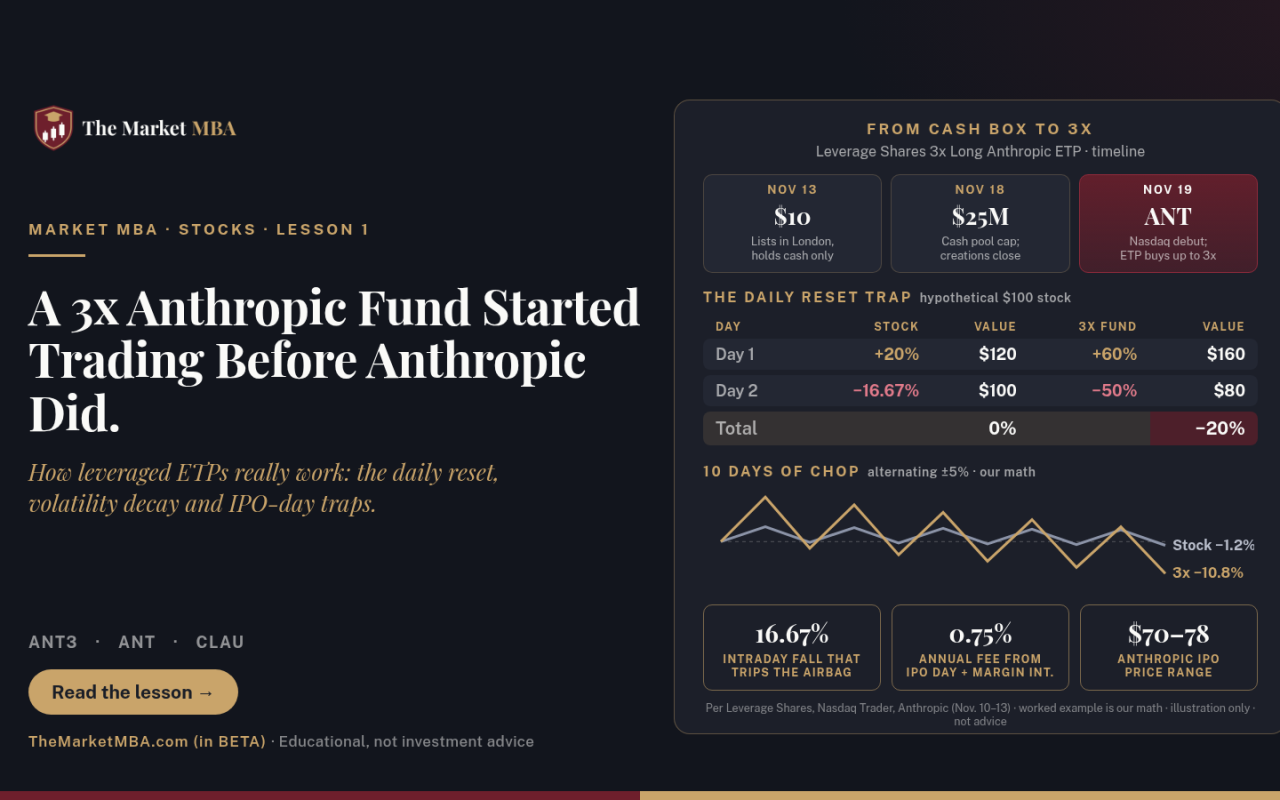
Anthropic does not trade on Nasdaq until Thursday, Nov. 19. But on Friday, Nov. 13, a fund built to deliver three times Anthropic’s daily move started trading in London. It owns no Anthropic shares yet, only cash. That odd setup makes it a perfect classroom for the first lesson in our new series on leveraged ETFs and ETPs: what they are, how the daily reset works, and why a 3x fund can lose money even when the stock goes nowhere.
The news: a 3x Anthropic product, live before the IPO
The Leverage Shares 3x Long Anthropic ETP (ISIN XS3556798455) was admitted to trading on the London Stock Exchange on Nov. 13 at a $10 issue price, with 12,500 units admitted at launch (RNS via TradingView; Leverage Shares). It trades under ANT3 in US dollars, 3ANT in pounds and ANTE in euros (Leverage Shares).
Until the IPO, it is a cash box. The issuer’s Nov. 12 notice says the portfolio will be “comprised only of cash until further notice” and gives “no exposure of any kind” to Anthropic during this phase (Leverage Shares notice). The cash earns the Fed Funds rate minus 1%, and no management fee is charged until IPO day (Leverage Shares).
The switch is set for Anthropic’s first trading day. Nasdaq says Anthropic’s Class A shares will begin trading on the Nasdaq Global Select Market under the ticker ANT on Thursday, Nov. 19 (Nasdaq Trader). Shortly after Anthropic’s opening auction, the ETP plans to buy shares worth up to three times its cash, using margin borrowing. It owns the shares directly and does not use swaps or other derivatives (Leverage Shares).
For context, Anthropic is offering 825 million shares at an expected $70 to $78 each (Anthropic), with pricing planned for Nov. 18 and a large retail allocation of about 20%, per people familiar with the deal (CNBC). We covered how that order book turns into a price in our book-building lesson.
What a leveraged ETP is, in one paragraph
A leveraged exchange-traded product tries to return a multiple, here 3x, of an asset’s daily move. If Anthropic rises 2% on a given day, the goal is about +6% for that day, before fees. To do it, the product borrows. For every $10 of investor money, it holds about $30 of stock, so roughly $20 is borrowed. ETFs and ETPs look the same on a brokerage screen, but this one is an ETP: legally a debt security issued by Leverage Shares plc, outside Europe’s UCITS fund rules (Leverage Shares FAQ). That means you also rely on the issuer’s structure, not just the stock.
Lesson 1: The reset is daily, so the math compounds
Every day at the US close, the fund rebalances back to 3x (Leverage Shares). After a gain it borrows more to get back to 3x; after a loss it sells shares to get back to 3x. That keeps the daily target honest, but it means the fund’s return over a week or a month is not 3x the stock’s return over that period. Here is a simple example with a hypothetical $100 stock and a $100 position in a 3x fund (our math, before fees and borrowing costs):
| Day | Stock move | Stock value | 3x fund move | 3x fund value |
|---|---|---|---|---|
| Start | $100.00 | $100.00 | ||
| Day 1 | +10% | $110.00 | +30% | $130.00 |
| Day 2 | −10% | $99.00 | −30% | $91.00 |
| Total | −1% | −9% |
The stock lost 1%. Three times that would be −3%. The fund lost 9%. That gap is called volatility decay (or “beta slippage”): when prices swing back and forth, a leveraged fund keeps buying high and selling low as it resets, and the losses compound.
Lesson 2: A 3x fund can lose money when the stock ends flat
Now take a stock that rises 20% and then falls back to exactly where it started. Going from $120 back to $100 is a 16.67% drop (our math):
| Day | Stock move | Stock value | 3x fund move | 3x fund value |
|---|---|---|---|---|
| Start | $100.00 | $100.00 | ||
| Day 1 | +20% | $120.00 | +60% | $160.00 |
| Day 2 | −16.67% | $100.00 | −50% | $80.00 |
| Total | 0% | −20% |
The stock is flat. The 3x holder is down 20%. Chop does the same thing slowly: if a stock alternates +5% and −5% for 10 trading days, it ends about 1.2% lower, but a 3x fund ends about 10.8% lower (our math: 1.05 × 0.95 repeated five times, versus 1.15 × 0.85 repeated five times).
Compounding is not always the enemy. In a steady trend, it helps. If a stock rises 5% three days in a row, it gains about 15.8%, and the 3x fund gains about 52.1%, more than three times as much (our math). The rule of thumb: trends help leveraged funds, chop hurts them. A freshly listed stock with no trading history, like Anthropic next week, could deliver plenty of both.
Lesson 3: IPO day has its own traps
Leverage Shares spells out several risks specific to IPO day (Leverage Shares):
- You don’t get the IPO price. The ETP does not take part in the IPO allocation or the opening auction. It buys on the exchange after the first price is known, so any jump from the offer price to the opening price is not captured.
- The entry price can move. The ETP’s Execution Price, the price it actually pays, may differ widely from the opening trade in a fast new market. IPO-day performance is measured from that Execution Price.
- London may be closed. Large Nasdaq IPOs usually open after the London Stock Exchange closes at 17:30 CET (10:30 a.m. CT). If so, holders carry 3x exposure through the US session and may not be able to trade until London reopens the next morning.
- The IPO could slip. If it is delayed, the ETP stays in cash, and the issuer may redeem it early if the delay drags on.
Here is a hypothetical to make the first two points concrete (our math, not a forecast). Say the stock prices at the offer, opens 30% higher, and the ETP buys near that open. If the stock then slides 10% by the close, an investor who got IPO shares at the offer price is up about 17% on the day. The 3x ETP is down about 30%. Same stock, same day, opposite results, because the ETP’s clock starts at the open, not at the offer.
Lesson 4: How the “airbag” and margin work
With 3x leverage, a 33.3% one-day fall in the stock would wipe out a fund’s entire value (3 × 33.3% = 100%). To stop that, this ETP has an intraday rebalance it calls an “airbag,” which triggers if the stock falls 16.67% during the day, the point where the fund is down about 50% (Leverage Shares). The airbag rebalances mid-session so that a further fall hits a smaller position, instead of waiting for the close.
Two takeaways. First, the airbag is designed to cushion, not to protect your money: by the time it fires, you have already lost about half. Second, the issuer says you can lose all you invest, but not more (Leverage Shares). That is a key difference from buying stock on margin in your own account, where a fast drop can leave you owing your broker money. The fund does the borrowing; your loss is capped at what you put in.
Lesson 5: Watch the price versus the cash (premium to NAV)
Normally, market makers keep a fund’s price close to its net asset value (NAV), the value of what it actually holds, by creating new units when demand is high. This product caps its pre-IPO cash pool at $25 million. New units stop being created when that cap is hit or at the end of Wednesday, Nov. 18, whichever comes first, so the first purchase stays small enough to complete quickly after Anthropic opens. Creations reopen on IPO day (Leverage Shares).
While creations are paused, buyers can still trade existing units, but the issuer warns the price can rise above the cash the ETP holds, and that premium can disappear when creations reopen (Leverage Shares). A simple example (our math): pay $12 for a unit backed by $10 of cash, and you are already down about 17% if the price snaps back to NAV, before Anthropic moves at all. The issuer’s live capacity figure is the place to check how full the pool is; its page has shown conflicting readings, so we are not quoting a number.
Lesson 6: The costs are bigger than the fee
During the cash phase there is no management fee. From IPO day, the ETP charges a 0.75% annual management fee plus margin interest on the borrowed amount (Leverage Shares FAQ). Because about $20 is borrowed for every $10 invested, interest is charged on roughly twice your stake. Add trading spreads, which can be wide on a brand-new product, and holding for weeks gets expensive even before volatility decay.
Not the only Anthropic wrapper: 3x physical versus 1x synthetic
A different product has traded since October. The 21shares Anthropic Synthetic ETP (CLAU) listed on the Vienna MTF and gives unleveraged exposure to Anthropic’s market-implied value through notes issued by FalconX that are backed by perpetual futures. It does not own Anthropic shares and does not convert into them at the IPO (21shares factsheet). It charges a 1% annual fee (21shares) and a 2% redemption fee on settlement (21shares final terms). Lesson: two products can have Anthropic in the name and work in completely different ways. Read what each one actually holds.
Who these products are for, and who they aren’t
- Built for: active traders who watch positions daily and want a short-term, magnified view, without opening a margin account. The issuer calls them complex products for “sophisticated investors and active traders” and says they are designed for short-term trading (Leverage Shares).
- Not built for: long-term, buy-and-hold investors. Over more than a day, returns can drift far from 3x because of the daily reset.
- Not a way to get the IPO price: if you want Anthropic at the offer, that comes through an IPO allocation from a broker, not a leveraged product.
- Access varies: ANT3 is listed in London. Whether you can buy it depends on your broker and where you live.
Key dates
- Fri., Nov. 13: ANT3 lists in London at $10, holding cash (Leverage Shares).
- Wed., Nov. 18: planned Anthropic pricing (CNBC); ETP creations close by the end of the day if the $25 million cap isn’t hit first (Leverage Shares).
- Thu., Nov. 19: Anthropic opens on Nasdaq as ANT (Nasdaq Trader). The ETP buys after the opening auction, publishes its Execution Price, and resets to 3x at the US close (Leverage Shares).
- Fri., Nov. 20: expected first London session with 3x exposure, if Anthropic opens after London closes (Leverage Shares).
The bottom line
A leveraged ETP is a one-day tool. It multiplies each day’s move, then starts over. Over time, that reset rewards trends and punishes chop, which is why a 3x fund can lose money while the stock ends flat. On Anthropic’s first day, add the gap from offer to open that the fund cannot capture, a possible premium over cash and a 16.67% airbag trigger, and the case for treating ANT3 as a short-term trading instrument, not an investment, is clear.
Next lesson
Lesson 2 will cover the other side: inverse and short ETFs, and how to read a leveraged fund’s holdings and its first published Execution Price after Anthropic’s IPO day.
Sources
- Leverage Shares: 3x Long Anthropic ETP product page and FAQ (accessed Nov. 13)
- Leverage Shares: Market Notification No. 1, cash portfolio (Nov. 12)
- Leverage Shares RNS via TradingView: Notification of New Series, 3x Anthropic (Nov. 13)
- Nasdaq Trader: Data Technical News #2026-28, Anthropic IPO on Nasdaq (updated Nov. 11)
- Anthropic: roadshow launch for proposed IPO (Nov. 10)
- CNBC: Anthropic sets IPO price range of $70 to $78 (Nov. 10)
- StockAnalysis: Anthropic IPO said to be multiple times oversubscribed (Nov. 11)
- 21shares: Anthropic Synthetic ETP (CLAU) product page
- 21shares: CLAU factsheet
- 21shares: CLAU final terms
- The Market MBA: How bankers turn Anthropic’s IPO orders into a price (Nov. 11)
Not financial advice. This article is for educational purposes only. Nothing here is a recommendation to buy or sell any security. Leveraged and inverse products are complex and can lose value quickly. The worked examples are hypothetical and ignore fees, borrowing costs and spreads.
For education and entertainment only. Not financial advice.