 The Market
Four trading days after the largest IPO on record, Anthropic was trading below its $83 offer price. A widely shared post on X called the listing a “financial nightmare,” put a first-day valuation at more than $2 trillion, and said a slide from the peak had wiped out $635 billion. Some of those figures do not hold up. The more useful question is what a “junk” credit rating would actually mean for a company that has already signed up for about $900.9 billion of compute and infrastructure bills.
By Cooper · The Market MBA · Wednesday, Nov. 25, 2026
What the stock actually did
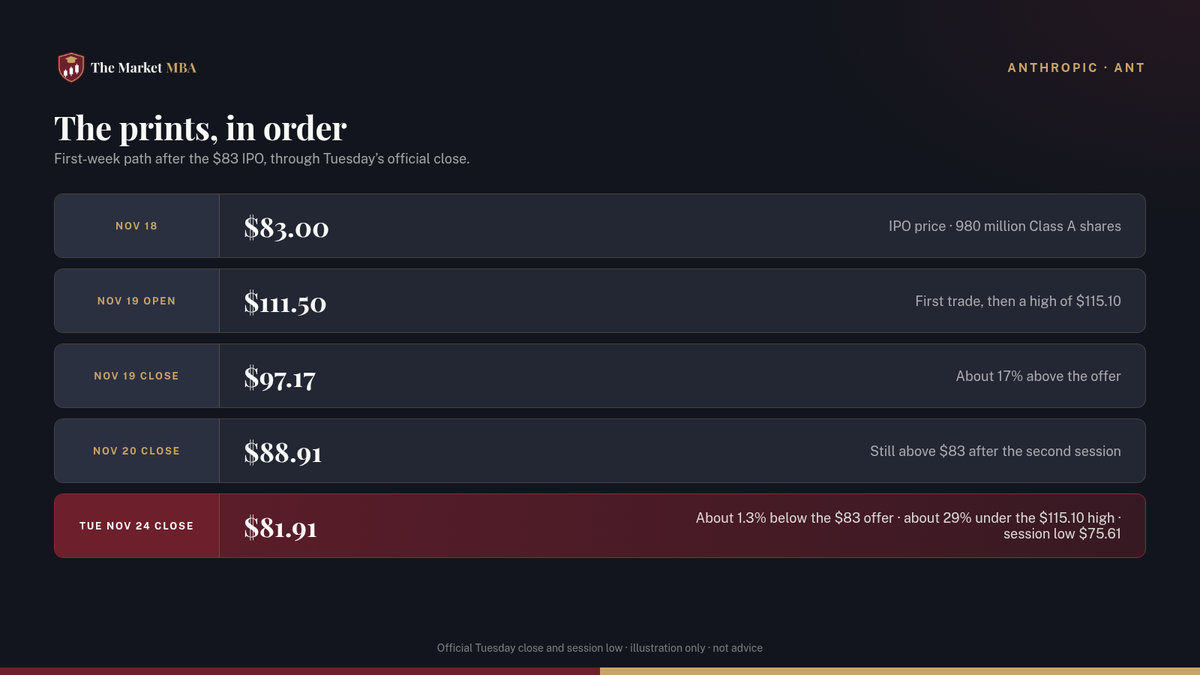
Anthropic priced 980 million Class A shares at $83.00 on Nov. 18, for gross proceeds of $81.34 billion, plus a 30-day underwriters’ option for 147 million more shares and a concurrent $26 billion Class N private placement, according to the company’s pricing announcement and its final prospectus (Form 424B4). Trading began on Nasdaq on Thursday, Nov. 19, under the ticker ANT🔔 MFI alert: Buy. Shares opened at $111.50, traded as high as $115.10, and closed that first day at $97.17, still about 17% above the offer. On Friday they closed at $88.91.
On Tuesday, Nov. 24, the shares closed below the $83 IPO price. Anthropic finished at $81.91 — about 1.3% below the offer and about 29% below the $115.10 first-day high. CNBC also noted that it took four sessions for Anthropic to trade under its offering price, compared with 21 trading days for SpaceX. We covered the underwriters’ overallotment, or greenshoe, in a separate lesson.
A move below the offer is uncomfortable for anyone who bought the first-day open or the high. It is not a verdict on the company’s long-term funding plan. The credit market is asking a different question: if Anthropic needs to borrow to pay for compute years from now, what will that debt cost?
The $2 trillion figure, and the $635 billion “wipeout”
The viral post treated a first-day valuation “over $2 trillion” as the starting point, then a $635 billion wipeout from the peak. On the share count in Anthropic’s final prospectus, those headlines do not add up.
The 424B4 lists 13,219,642,276 shares of all classes outstanding after the offering and the private placement, or 13,366,642,276 if the underwriters’ option is exercised in full. Two of those shares — one Class T and one Class F — have no economic rights. Using the post-option economic count of 13,366,642,274 shares — the greenshoe was exercised — the $83 offer implies about $1.11 trillion, and the first-day high of $115.10 implies about $1.54 trillion. That is prospectus arithmetic, not an official exchange market-cap print, but it is the right denominator for “how many shares are outstanding.”
Some recaps used a fully diluted count that also includes employee options, restricted stock units, and other claims that are not yet outstanding shares. That is a different, and larger, number. It can get you near $2 trillion at the first-day high, but it is not the same thing as the basic market cap. We are not going to repeat the $635 billion wipeout figure, because it does not line up cleanly on either basis. If you see a trillion-dollar headline, ask which share count was used.
What “junk” actually means
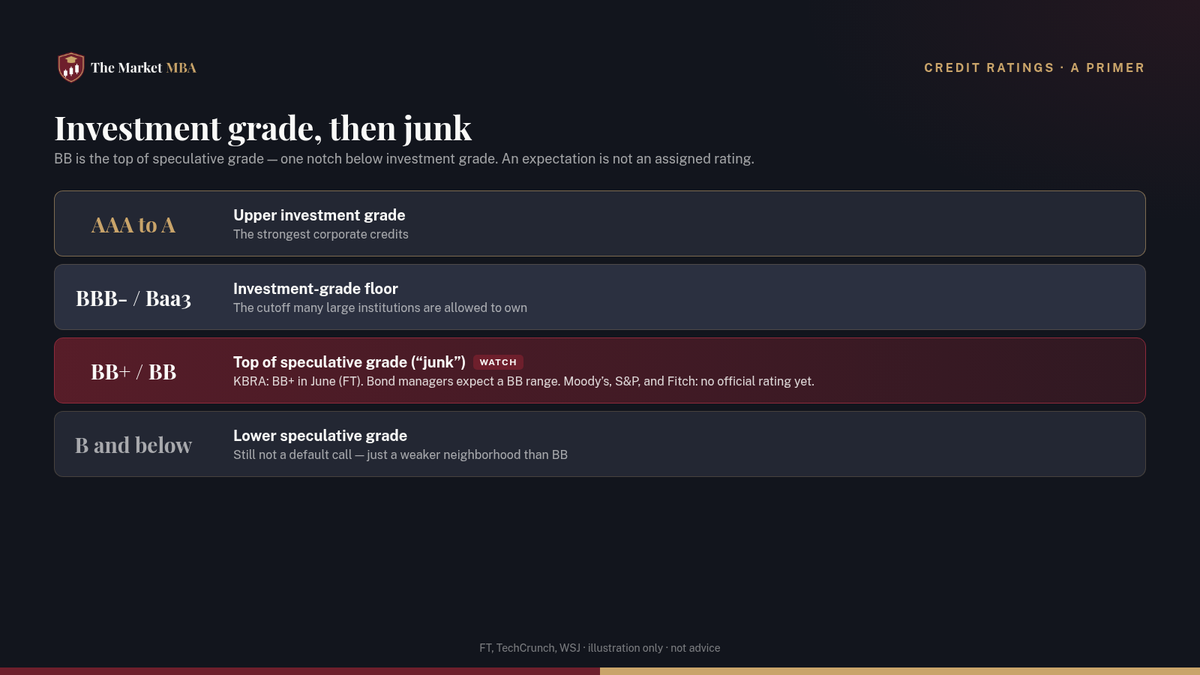
“Junk” is a nickname, not a formal grade. Investment grade runs from AAA/Aaa down through BBB-/Baa3, the cutoff many large institutions and bond funds are allowed to own. Below that line is speculative grade, also called high yield or junk. BB+/Ba1 sits at the top of that lower neighborhood — one notch below investment grade. A BB rating is not a default call. It means lenders usually demand a higher yield.
As of this writing, Moody’s, S&P, and Fitch have not published official ratings on Anthropic. That matters. What is circulating is an expectation, not an assigned grade.
Kroll Bond Rating Agency (KBRA) assigned Anthropic a BB+ rating in June, according to documents reviewed by the Financial Times — already one notch below investment grade. In late October, the FT also reported, as relayed by TechCrunch, that Blackstone told investors to expect a “high” junk, or double-B, rating after the IPO. On Nov. 22, The Wall Street Journal reported that managers at major U.S. bond funds similarly expect a rating in the BB range, one or two notches below investment grade, though some agencies could still go investment grade. CEO Dario Amodei said last week that he hoped the company would receive an investment-grade rating “at some point in the future,” according to the Journal — an aspiration, not a timeline, and not a rating.
The $900.9 billion bill, and the cash on hand
The reason the bond market is cautious is the size and timing of Anthropic’s compute commitments, in a company that is still unprofitable.
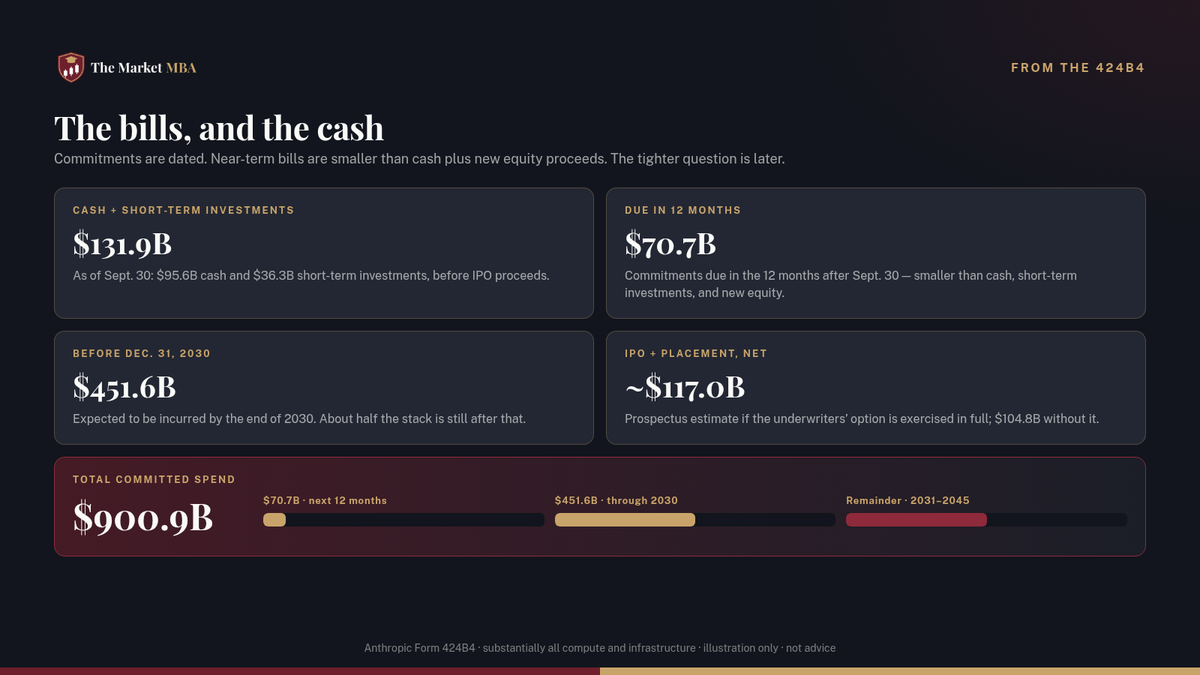
Anthropic’s final prospectus says that as of and after Sept. 30, 2026, it had entered into purchase commitments and lease agreements — including short-term commitments and leases not yet started — with an aggregate committed spend of approximately $900.9 billion, “substantially all of which is related to compute and infrastructure.” Of that, about $451.6 billion is expected to be incurred before Dec. 31, 2030, and substantially all of the remainder between 2031 and 2045. About $70.7 billion is due in the 12 months after Sept. 30.
Against that, as of Sept. 30 the company held $95.6 billion in cash and cash equivalents and $36.3 billion in short-term investments, and it had raised $141.1 billion of capital by that date. Those cash figures predate the IPO. The prospectus estimated net proceeds from the company’s IPO shares and the concurrent private placement at about $104.8 billion, or about $117.0 billion if the underwriters’ option was exercised in full.
A viral reading is that “the cash may only cover a year or more.” That is too crude. The $70.7 billion due in the next 12 months is smaller than the cash, short-term investments, and new equity proceeds combined. The tighter question is further out: roughly half of the committed spend is expected from 2030 onward, which is also when cheaper, investment-grade borrowing would matter most if the company needs the public bond market.
The company is still unprofitable. The amended prospectus, as reported by CNBC, showed about $17 billion of revenue in the third quarter. Net-loss figures in that filing are inflated by large fair-value changes on convertible notes and other liabilities, so we will not treat a single loss number as the operating picture. The credit-relevant fact is simpler: the bills are large, the company is not yet earning its way through them, and a lot of the spend is still ahead. The “$96 billion in cash” line is the $95.6 billion cash-and-equivalents figure as of Sept. 30. It leaves out $36.3 billion of short-term investments and the IPO and placement proceeds that arrived later.
What a junk rating would change
A speculative-grade rating would not, by itself, mean Anthropic cannot pay its near-term compute bills. It would make new borrowing more expensive, and it would keep the company out of the large U.S. investment-grade corporate bond market — a pool the Journal put at about $8.6 trillion — until the rating improves.
There is also a specific contractual hook. Anthropic has a $15.0 billion senior secured revolving credit facility that matures on Sept. 4, 2031. As of Sept. 30, nothing was drawn, and $205 million of standby letters of credit were outstanding. The facility stays secured by substantially all of the company’s assets until Anthropic obtains an investment-grade rating from at least two of Moody’s, S&P, and Fitch and elects a release, subject to the agreement’s conditions. A junk rating does not pull the revolver. It does mean the banks keep their collateral until two of the three major agencies say the credit is investment grade.
How to read the next few weeks
Watch three things, and keep them separate: whether the shares hold below the $83 offer after this holiday-shortened week — a fact about the stock, not a credit rating; any official grade from Moody’s, S&P, or Fitch, because an expectation of BB is not an assigned BB; and how Anthropic funds the longer end of that $900.9 billion stack — cash and equity first, then, if needed, debt whose cost will depend on the rating it actually receives.
🔔 Anthropic (ANT) is also on our radar at MrFlourish Invests: see the live MFI alerts.
Anthropic will stay noisy. The useful habit is the one this lesson is built on: check the share count behind a valuation headline, check whether a “junk” label has actually been assigned, and check when the compute bills come due — not just how large the headline total is.
For education only. Not financial advice.
For education and entertainment only. Not financial advice.