 The Market
On Friday, one day after Anthropic’s record debut, the company’s underwriters exercised a 147 million-share option that added about $12.2 billion to the IPO. Here is what that “greenshoe” actually does, who it helped, and what “lost buying support” does and does not mean.
By Cooper · The Market MBA · Sunday, Nov. 22, 2026
What just happened
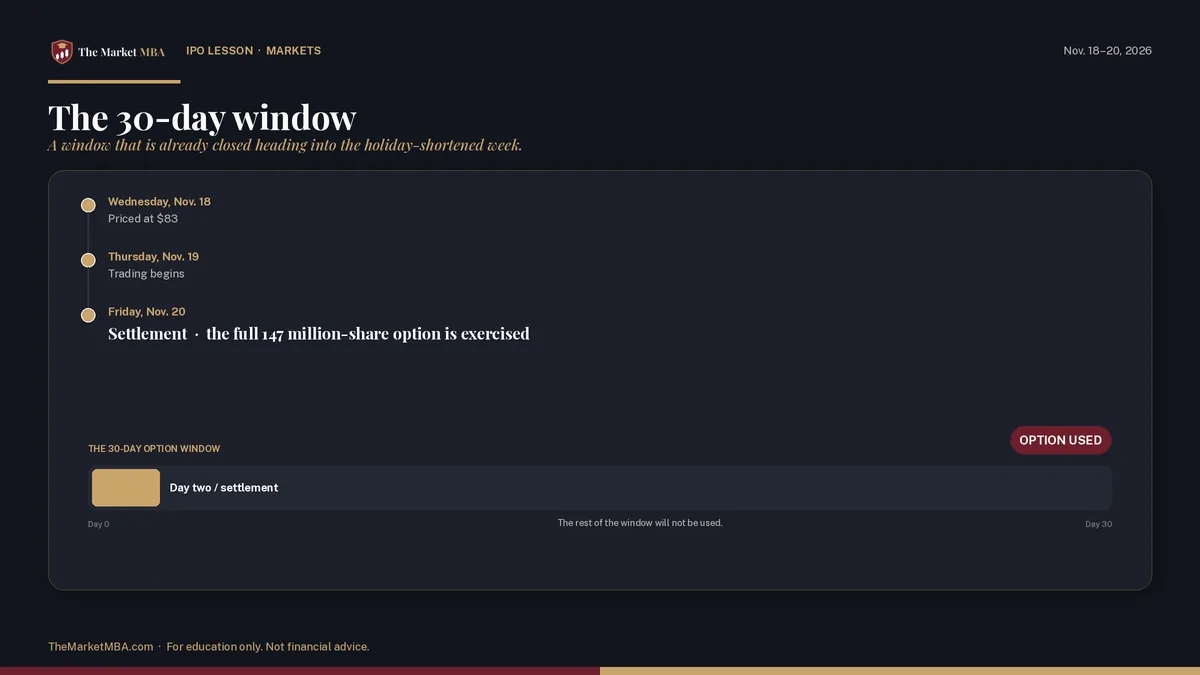
Anthropic closed its initial public offering on Friday, November 20, and the closing announcement included a detail that is easy to skim past. The underwriters had exercised, in full, their option to buy an additional 147 million shares from the company at the $83 offer price. That option — the greenshoe, or overallotment — took the public IPO from a base deal of about $81.3 billion to about $93.5 billion in gross proceeds (Anthropic; CNBC).
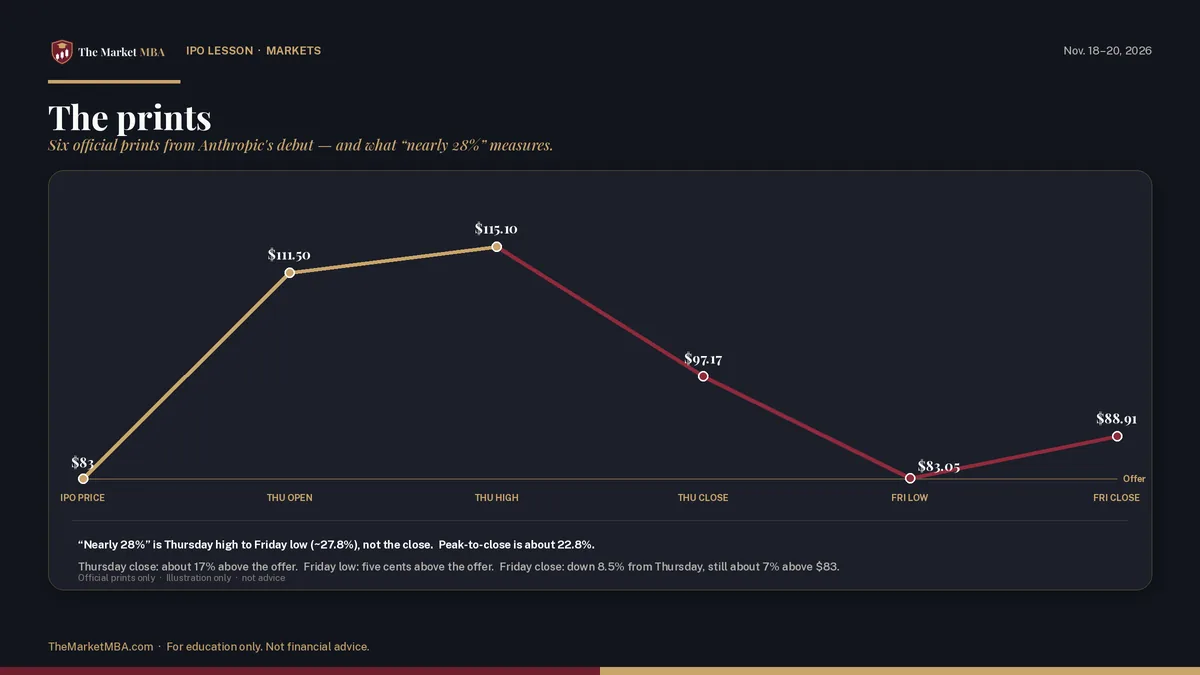
Friday was also the first full session after Thursday’s debut, and the scheduled settlement date. The stock had opened Thursday at $111.50, traded as high as $115.10, and closed that first day at $97.17, still about 17% above the offer. On Friday it fell as low as $83.05 — five cents above the IPO price — and closed at $88.91, down 8.5% from Thursday and still about 7% above $83.
From Thursday’s high to Friday’s low, that is a drop of nearly 28%. From the high to Friday’s close, it is about 22.8%. The $12.2 billion question is why the banks used a 30-day option on day two, and what that choice does to the stock from here.
What a greenshoe actually is
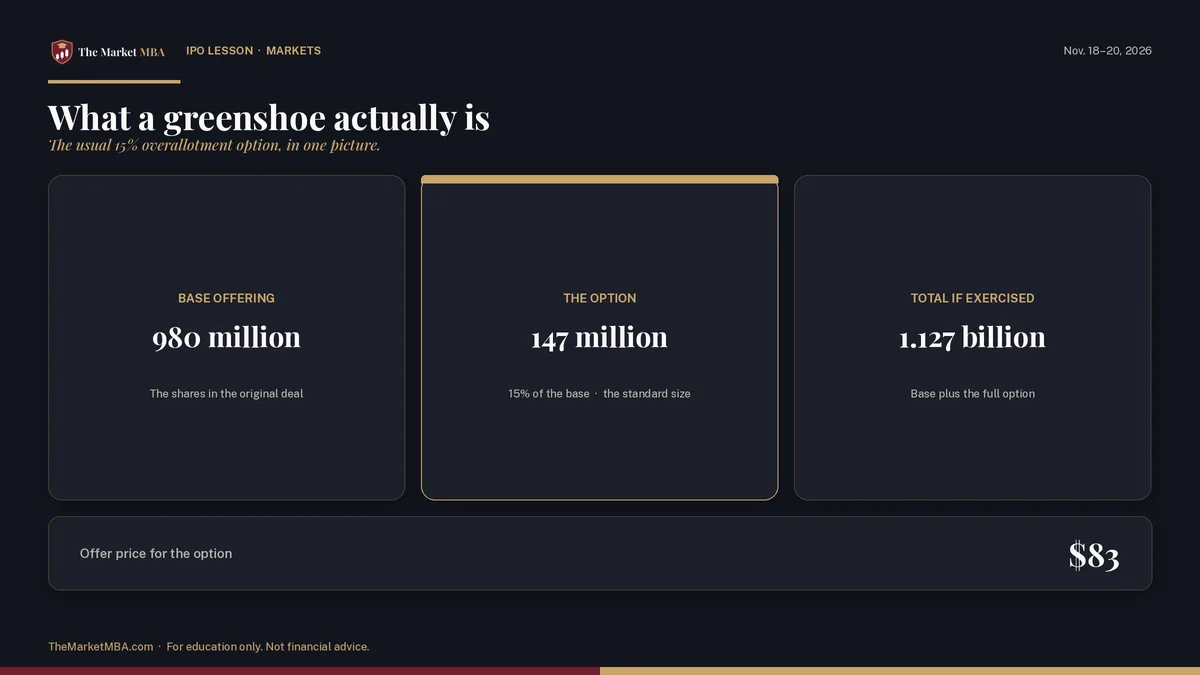
A greenshoe is a standard clause in almost every large IPO. The nickname comes from Green Shoe Manufacturing, which first used the clause in 1960. In practice it is an overallotment option, usually sized at 15% of the base deal.
Anthropic’s base offering was 980 million shares. Fifteen percent of that is 147 million shares, exactly the option the banks just used. When the deal was allocated, the underwriters could sell more shares than the base offering — leaving themselves short those extra 147 million shares — and then had up to 30 days to cover that short (SEC pricing document).
They can cover it in one of two ways: by exercising the option and buying the shares from the company at the $83 offer price, or by buying the shares in the open market. Goldman Sachs and Morgan Stanley were the lead bookrunners; the prospectus names Morgan Stanley as the stabilization agent, and says the banks would weigh the market price against the $83 option price when deciding how to cover (Anthropic).
The option is a way to manage the first days of trading. It is not a promise to hold the stock up, and it is not a floor at the IPO price.
The two paths, in plain English
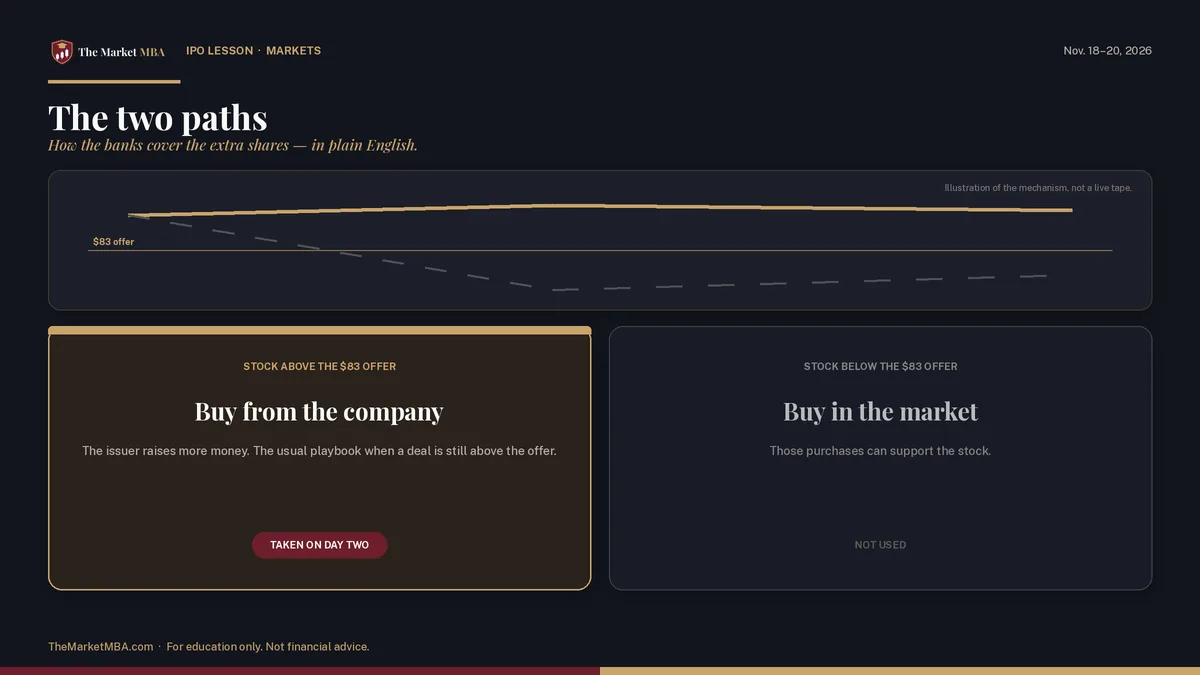
If the new stock stays above the offer, the cheap way to cover the short is to buy from the company at $83. The banks close their position at a price they already know. The company sells more shares and raises more money. Reuters notes that this is the common playbook when a deal is trading above the offer on the first day (Reuters).
If the stock falls below the offer, the cheap way to cover is to buy in the open market, where the shares cost less than $83. Those purchases can support the price, or at least slow a decline. In that case the company may not get the extra proceeds, because the banks are covering with stock they bought from other investors, not from the issuer.
That is the fork. Path one favors the company’s fundraising. Path two can favor holders who are watching the stock fall, because it adds a real bid in the market. The banks have up to 30 days to choose, and can use a partial exercise if the stock chops around the offer.
What the banks did, and why some people objected
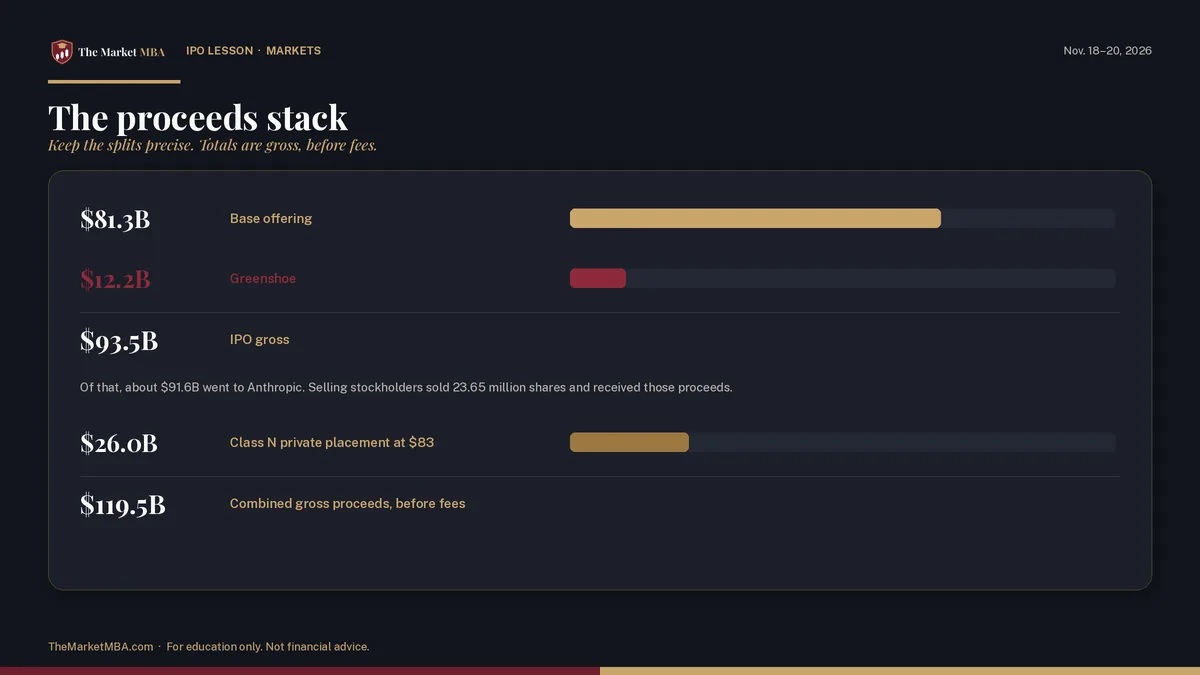
They took path one. Anthropic announced the full exercise on Friday, after a first close that was still about 17% above $83. The extra 147 million shares added about $12.2 billion of gross proceeds. About $91.6 billion of the $93.5 billion IPO went to Anthropic; selling stockholders sold 23.65 million shares and received those proceeds. A separate $26 billion private placement, sold at $83 to a group of large technology companies, brought combined gross proceeds to about $119.5 billion, before fees (Anthropic).
According to IFR, the banks also received no underwriting fee on the greenshoe shares (IFR).
Carsten Hesse, Berenberg’s London-based head of index events, told clients the move was positive for Anthropic because it increased the proceeds, but “less positive for investors, who are losing an important potential source of buying support.” In his words, “the bookrunners have given up their remaining stabilisation option already after 1 day just as the share price is getting closer to the IPO price.” Reuters, in the same story, also said some market participants had questioned the timing given Thursday’s volatility, citing one person familiar with the matter. Morgan Stanley declined to comment (Reuters).
Exercising a greenshoe when the stock is still above the offer is the usual path, not an exotic one. Using the entire 30-day window on settlement day, while the stock was sliding back toward $83, is the part that drew the critique. The announcement went out Friday morning, after Thursday’s close and into a session that would tag $83.05.
Who was helped, and who wasn’t
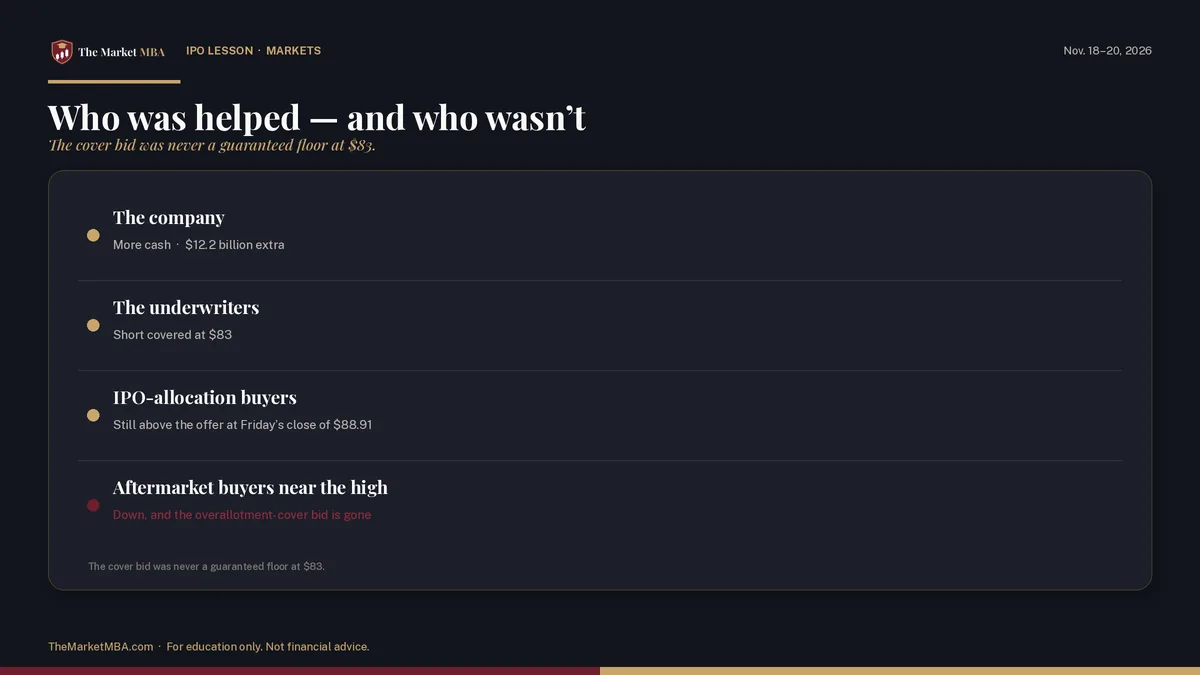
Start with the company. The greenshoe added a clean $12.2 billion of record proceeds: more cash for the issuer, and no remaining overallotment short for the banks to cover in the market.
IPO-allocation buyers — the investors who received shares at $83 — were still ahead at Friday’s close of $88.91. Their experience is not the same as that of someone who bought the opening print at $111.50, or the high at $115.10.
What holders no longer have is the built-in bid that comes from covering the overallotment in the open market. That bid was never a guaranteed floor at $83, and full exercise does not bar the banks from buying shares later for other reasons. It does mean they can no longer use open-market purchases to close out that 147 million-share short, because the short has already been closed with stock from the company.
So “lost buying support” is real, and it is narrower than it sounds. The safety net, such as it was, was a side effect of how the banks cover a short — not a pledge to defend the IPO price.
What to watch from here
The number to keep in view is still $83. Friday’s low came within five cents of it. The stock does not have to treat the offer price as a floor, and it does not have a leftover overallotment-cover bid sitting underneath it if trading gets heavy again.
This coming week is also a short one around Thanksgiving, and it is Anthropic’s first stretch of sessions as a public company with the greenshoe already used. That is a mechanics point, not a forecast. A used greenshoe does not tell you where the stock goes next. It tells you how the first days of the IPO were managed, who received the extra proceeds, and which form of support is no longer on the table.
Sources
- Anthropic: IPO close, including full greenshoe and the $26 billion private placement
- Anthropic: IPO pricing release
- CNBC: underwriters exercise the greenshoe, $93.5 billion
- Reuters / Echo Wang: stabilization position closed
- Reuters: $1.5 trillion fully diluted valuation at pricing
- SEC free-writing prospectus: 980 million base shares, 147 million option, settlement Nov. 20
- IFR: greenshoe proceeds and underwriting fees
- CNBC: Saturday wrap with Friday’s close
- Axios: Thursday high and Friday slide
For education only. Not financial advice.
For education and entertainment only. Not financial advice.