 The Market
Anthropic just completed the largest IPO on record. By Friday, the Nasdaq had booked its worst week since the early days of the pandemic, the S&P 500 was in a correction, and Nvidia had its worst week since 2008. Here is the week in plain English.
By Cooper · The Market MBA · Saturday, Nov. 21, 2026
The week in one picture
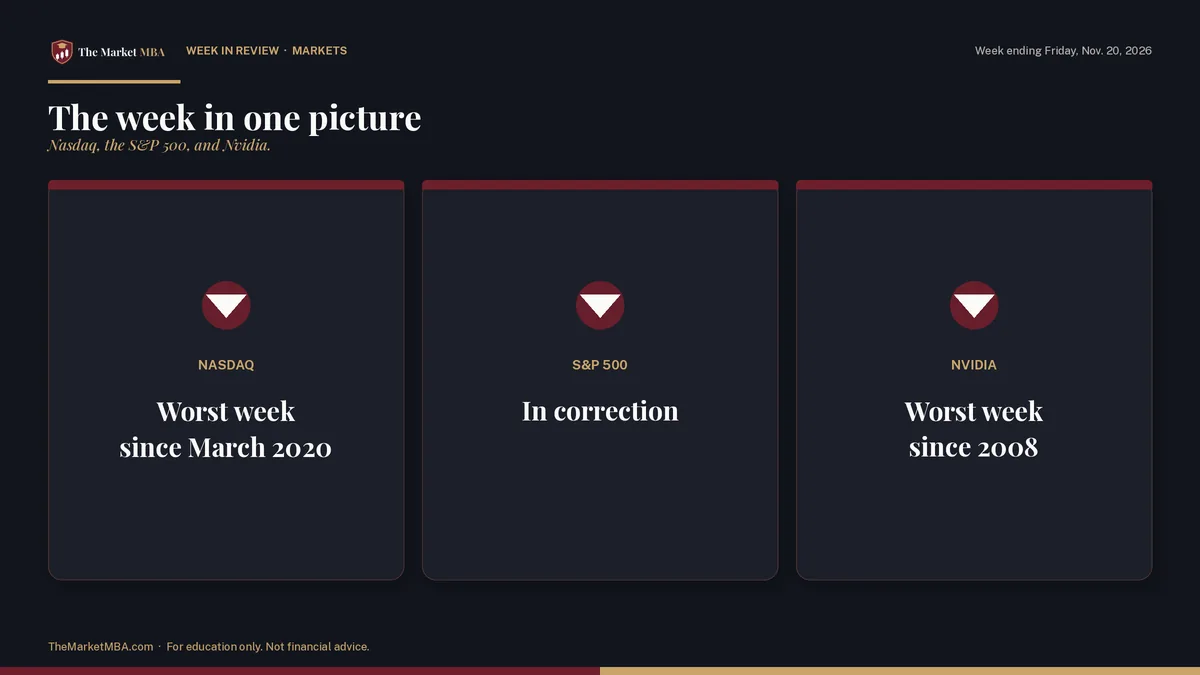
By Friday’s close, the S&P 500 had fallen 3.7% on the day, to 6,910.39. It lost about 8.6% for the week and closed about 11.6% below its Oct. 6 all-time high, a correction (AP; ETF.com). The Nasdaq Composite dropped about 5.3% on Friday and about 10% for the week, to 22,617.73 — its worst week since March 2020 — and was nearly 20% off its high (AP; CNBC; ETF.com). Nvidia finished at $125.53, down about 14% on Friday and about 23% for the week, its sharpest weekly drop in 18 years. From its early-October peak, the stock has lost nearly half its value and more than $2 trillion of market value; AMD also fell more than 13% on Friday (Axios; CNBC; ETF.com).
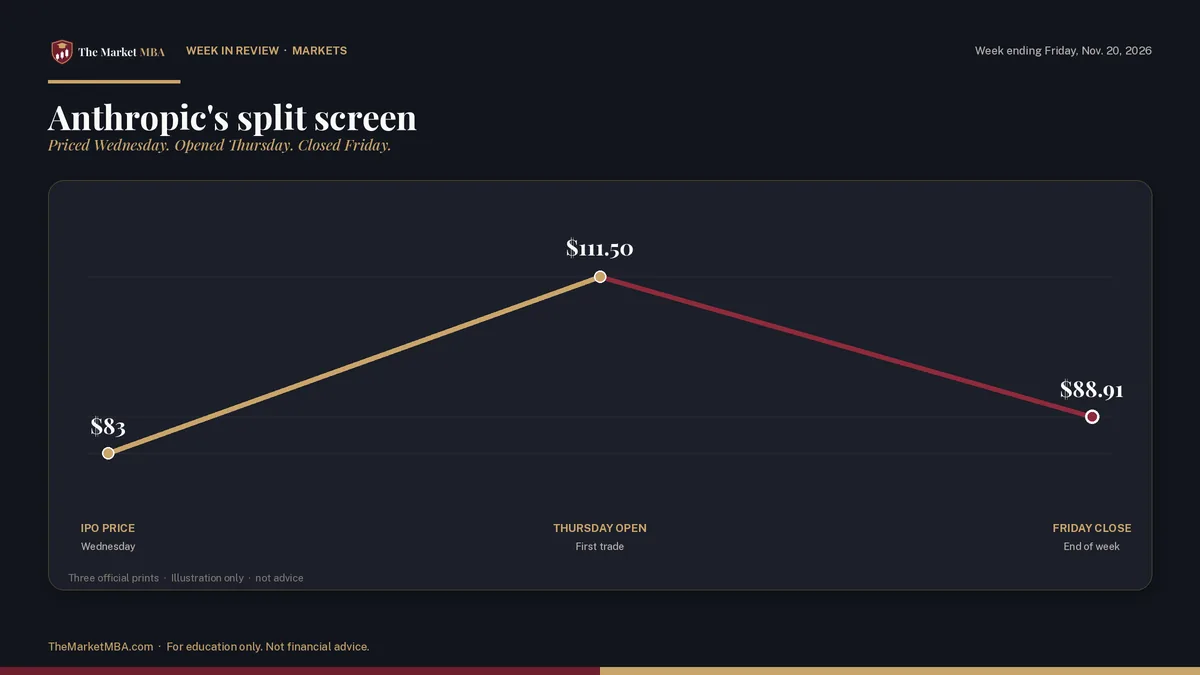
In the middle of that tape, Anthropic made its public debut. The company priced at $83 a share on Wednesday and began trading Thursday. Shares opened at $111.50, gained about 17% on day one, then closed Friday at $88.91 — down 8.5% from Thursday’s close, and only a little above the offer (Anthropic; CNBC; Axios). The IPO was supposed to relight the AI trade. It didn’t.
Anthropic’s split screen
The deal itself was a record. Anthropic sold 980 million shares at $83, a base offering of about $81.3 billion. A 30-day overallotment option would take the deal to about $93.5 billion if fully exercised, and CNBC reported about $26 billion more in purchases by tech giants at the offer price (Anthropic; CNBC). A successful IPO for the company is not the same thing as a green light for every AI stock. Friday’s fade put a brighter light on the math: whether too many firms are building a similar product, and whether the numbers add up.
The prospectus already shows the tension. Anthropic reported $33.24 billion of revenue for the first nine months of 2026, including about $17 billion in the third quarter. Year-over-year growth is still very fast, but it slowed to about 47% quarter to quarter after 144% in the second quarter. The nine-month net loss was $104 billion, most of it from the change in fair value of convertible notes and derivative liabilities, not from cash operating losses of that size (CNBC, citing the S-1). Against that, it had signed purchase commitments and leases of roughly $900 billion, “substantially all” for compute and infrastructure, with about $70.7 billion due in the next 12 months (CNBC; Data Center Dynamics). Those obligations run years into the future. They are not a bill due next week, or proof the company cannot pay, but they still have to be earned, refinanced, or renegotiated. We walked through the debut on Thursday and the pricing the day before.
Why the selling piled up
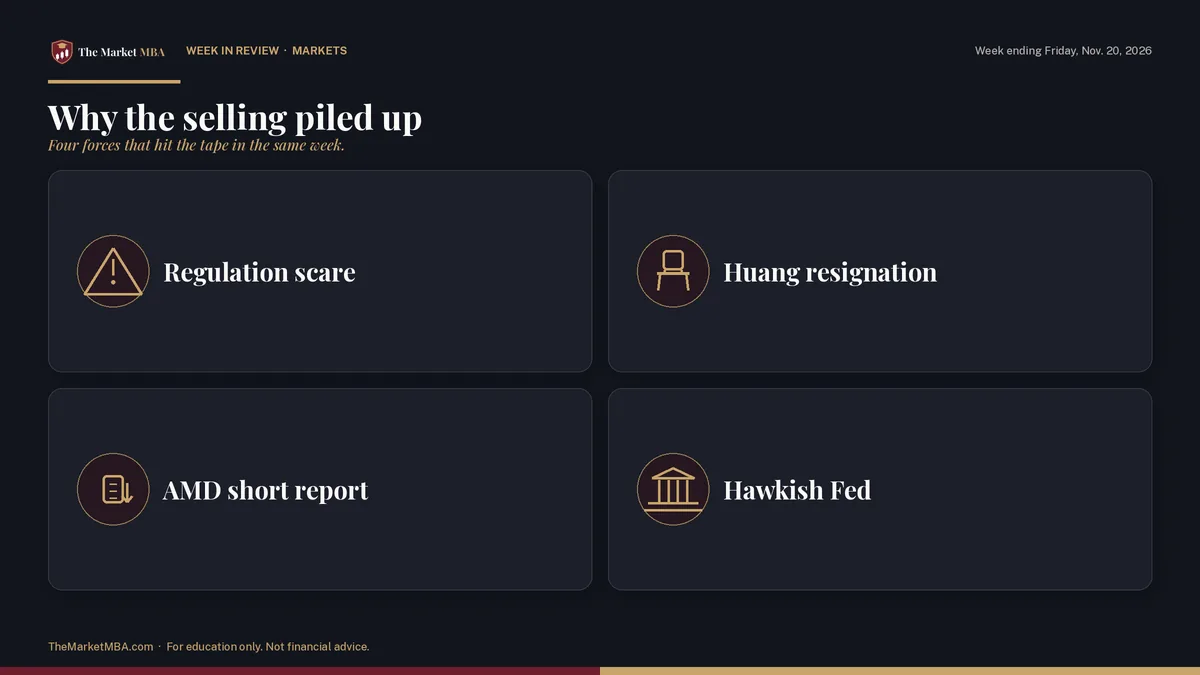
Selloffs rarely have one cause. Analyst Dan Ives called this week a “perfect storm,” and most of the pieces showed up in the news. Democrats won both chambers in this month’s midterms and will take control in January, and investors have been pricing a tougher stance on AI and data-center buildouts (NPR; CNBC). Nvidia founder Jensen Huang resigned as president, CEO, and a director on Nov. 11, with chief financial officer Colette Kress serving as interim CEO, after published reports of personal misconduct, including alleged counterintelligence concerns (Nvidia; Politico; NPR). On Thursday, short seller Hunterbrook published a report on AMD’s China-linked exposure. Those are allegations, not findings, but AMD shares fell in a market already worried about tighter rules (CNBC).
The rest is opinion or market color: selling can beget selling, funds often reduce risk into year-end, and a record IPO can act as a valuation mirror rather than a relief valve. Overlay the Fed: after a September rate hike, the first in more than three years, Governor Christopher Waller said a December increase is likely and that a half-point move should be on the table if inflation stays sticky (Federal Reserve; CNBC). The next meeting is Dec. 8–9. Ives still argues that a multi-trillion-dollar AI buildout is underway into 2027. The long-term spending may be real, and this week’s price action can still be brutal.
Nvidia: a beat that didn’t help
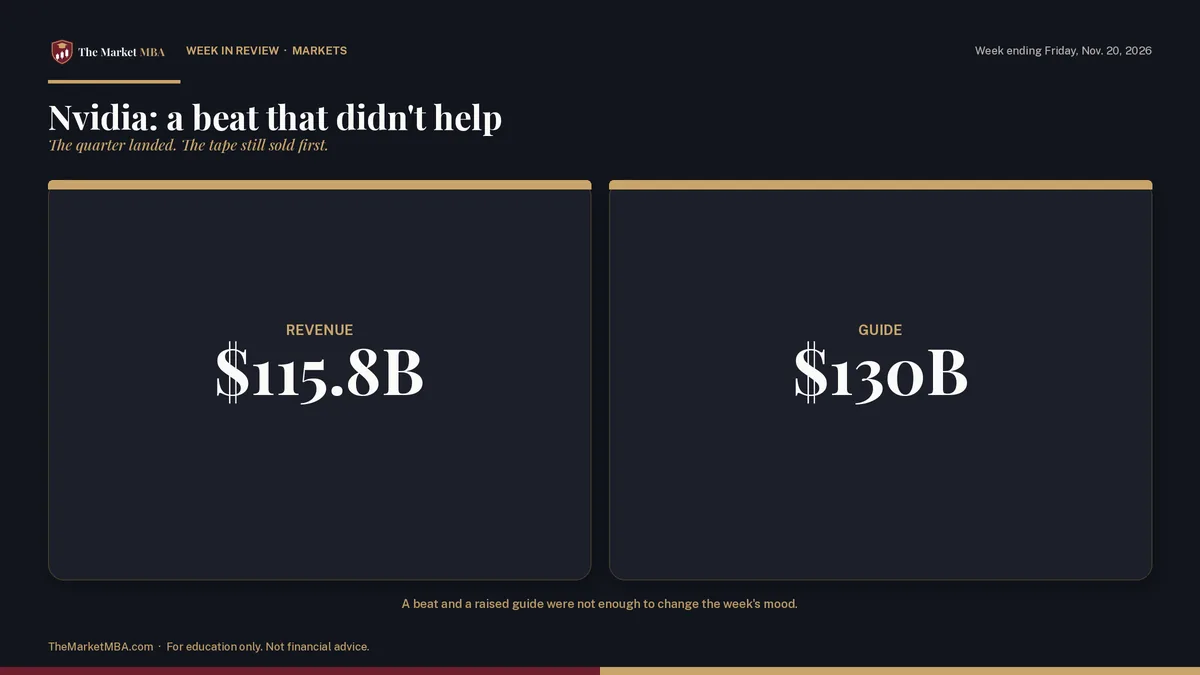
On Tuesday, Nvidia reported results that, in a calmer week, might have been a relief. Revenue for the third quarter of fiscal 2027 was $115.8 billion, up 103% from a year earlier, including $107.6 billion from the data center. The company guided the fourth quarter to $130 billion and said it was not assuming any data-center compute revenue from China. Revenue beat Wall Street’s estimate by about $6 billion to $7 billion (Nvidia).
Goldman Sachs, in a note after the call, said management raised its calendar-2027 revenue growth forecast to 75% from 70%, and that the board does not intend to reinstate Huang or expedite the CEO search. Goldman also wrote that Nvidia intends to execute its remaining $227 billion buyback authorization by the end of calendar 2027. The official release is more careful: the board added $150 billion to the authorization in September, and $227.3 billion remained at quarter-end (Nvidia; Goldman Sachs note, Nov. 17).
The market was not arguing about whether Nvidia beat. It was arguing about who is financing the buyers. UBS kept a Buy rating but cut its price target to $220 from $240, and said there is “a very real risk” that Nvidia “becomes beholden to these purchase commitments and has to keep throwing money at its customers to drive revenue.” It put supply and capacity commitments at about $430 billion, up from $311 billion (UBS note; Proactive Investors). Kress also told analysts the company would be more “disciplined and selective” about supporting neocloud customers, and that some loan guarantees start only after those customers have their own financing (CNBC; TechCrunch). The lesson: when the supplier is also helping to finance the customer, reported growth can look stronger than end-demand. We broke down the quarter, and the margin catch, on Tuesday.
What the index hid, and what "cheap" really means
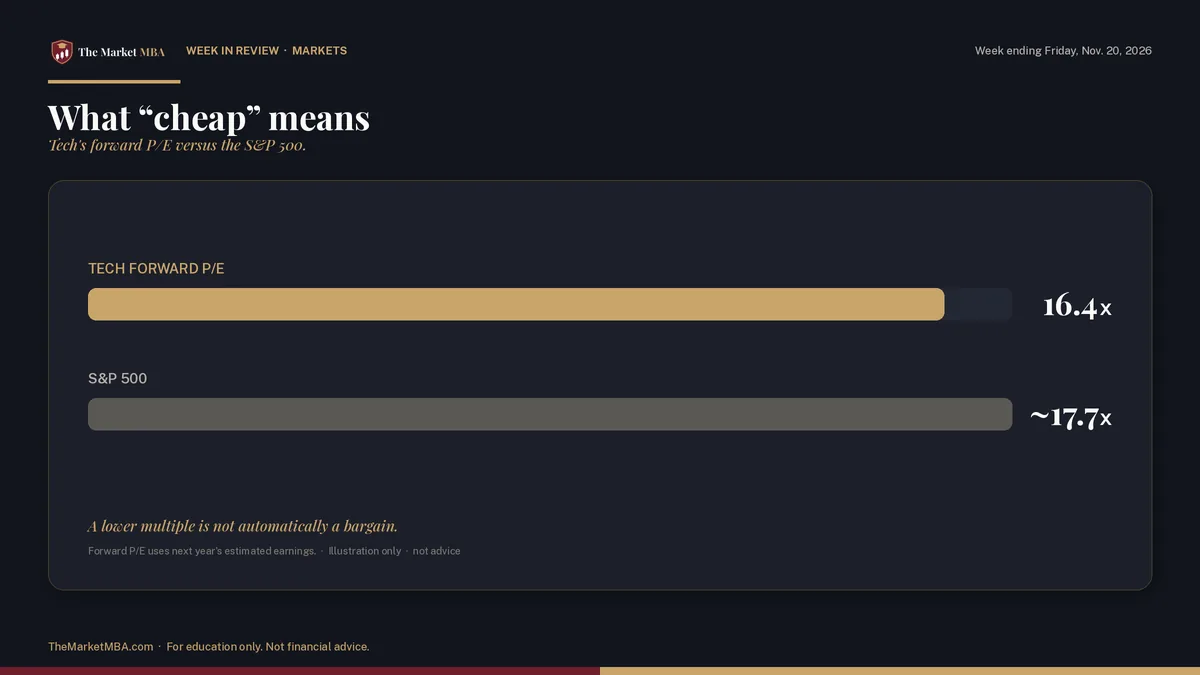
Two lessons sit underneath the scoreboard. The first is about what an index hides. The S&P 500 is down about 11.6% from its high — a correction, not a crash. Underneath it, the damage in chips and AI infrastructure has been much deeper. A widely followed semiconductor ETF was about 43% off its midyear high by Friday, and Nvidia has been cut nearly in half from October (ETF.com). Mega-cap software names held up better than the chip cohort for most of the slide, which is why the S&P’s drawdown looked shallower than the damage in the AI trade — though those names closed lower on Friday, too. Today’s mega-caps are highly profitable in a way many dot-com leaders were not, but that should not be read as proof the buildout is being paid for entirely with cash.
The second lesson is about the word “cheap.” On Thursday, the S&P 500 Information Technology index was trading at 16.4 times forward earnings, its lowest valuation since March 2020, and below the broader S&P 500’s forward multiple of about 17.7 times for the first time since 2017 (Bloomberg chart via The Kobeissi Letter; FactSet). A forward price-to-earnings ratio is the price you pay for each dollar of profit analysts expect over the next 12 months. That multiple can fall because prices drop, or because earnings estimates rise. In this case, both happened: tech has been sold, and sector earnings estimates have risen about 17% in recent months. If those estimates hold, the multiple really is lower than it has been in years. If AI earnings get cut, “cheap” can disappear without prices bouncing an inch.
What to watch next week

Next week is Thanksgiving week. The market is closed Thursday, Nov. 26, and sessions around the holiday are typically shorter, so liquidity will be thin. Watch the December Fed debate (the meeting is Dec. 8–9), any further signal from Nvidia’s board or interim CEO, Anthropic’s first full week as a public company, early talk from the incoming Congress on AI and data-center rules, and whether the AMD/China story has a second leg.
The week asked a simple question: can a record IPO, a beat-and-raise, and a cheaper-looking multiple all be true, and the market still sell first? This week, the answer was yes. The homework is to keep asking whether the earnings estimates underneath those multiples are real.
Sources
- AP: S&P 500 sinks 3.7%; Nasdaq goes negative for the year (Nov. 20)
- AP: How major U.S. stock indexes fared Friday, Nov. 20, 2026
- ETF.com: Stocks erase 2026 gains as AI selloff deepens
- CNBC: Anthropic's record IPO collides with tech's worst week since 2020
- CNBC: Anthropic stock falls; Nvidia and AMD also sink
- Axios: Nvidia plunges as Anthropic can't stop the AI selloff
- NPR: The AI boom had a bad week
- Anthropic: IPO pricing release
- CNBC: Anthropic amended S-1 financials
- Data Center Dynamics: Anthropic compute commitments
- Nvidia: Q3 fiscal 2027 results
- Nvidia: CEO transition announcement
- Proactive Investors: UBS cuts Nvidia target, keeps Buy
- CNBC: Nvidia neocloud financing
- TechCrunch: Nvidia clarifies neocloud guarantees
- CNBC: AMD falls on Hunterbrook short report
- Federal Reserve: Waller speech
- CNBC: Waller on a possible half-point hike
- FactSet: S&P 500 and IT sector forward P/E
For education only. Not financial advice.
For education and entertainment only. Not financial advice.