 The Market
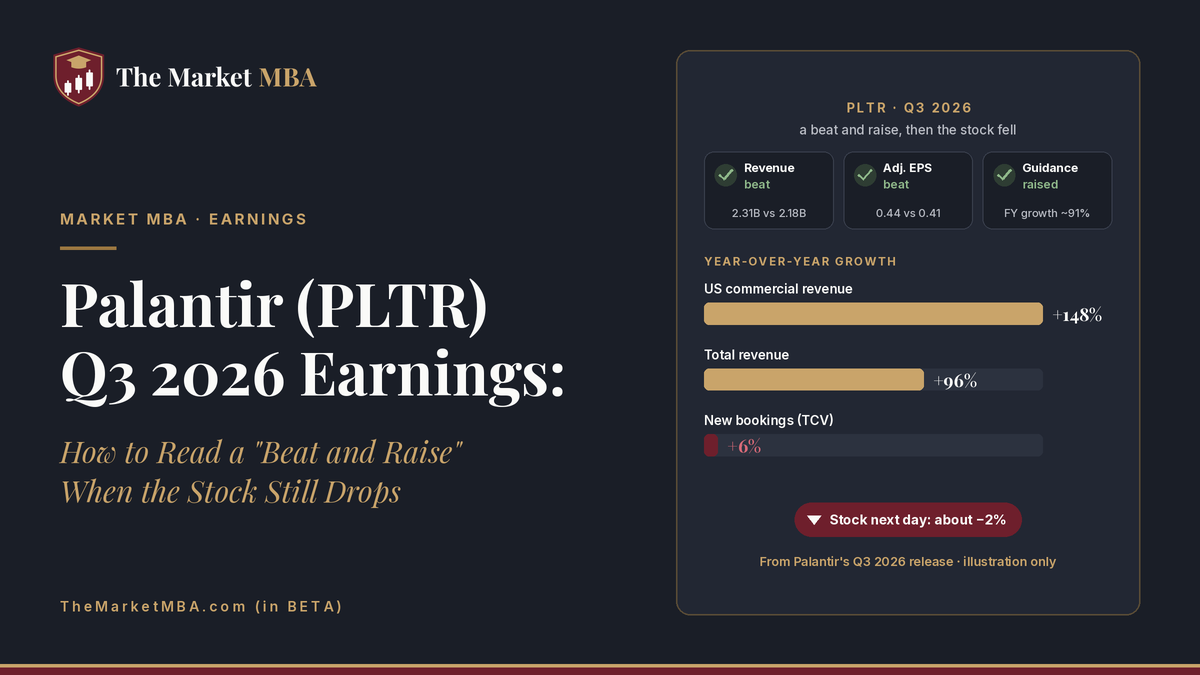
Palantir’s Q3 2026 revenue nearly doubled to $2.31 billion. It beat estimates on revenue and EPS and raised its full-year forecast. The stock fell anyway, because investors focused on a forward-looking number: new contract bookings grew only 6%. This report teaches four skills: reading growth rates, comparing GAAP and adjusted profit, spotting stock-based pay, and treating bookings as a preview of future revenue.
Palantir reported third-quarter results after the close on November 2, 2026 (Palantir investor relations; Form 10-Q). The company sells data and AI software to governments and businesses. New to financial statements? Start with how to read financial statements.
Step 1: Headline vs. expectations
| Metric | Q3 2026 actual | Analyst estimate (LSEG) | Result |
|---|---|---|---|
| Revenue | $2.31B | $2.18B | Beat |
| Adjusted EPS | $0.44 | $0.41 | Beat |
Source: CNBC.
That’s a clean beat. Revenue rose 96% from a year earlier and 20% from the prior quarter (Palantir). Hold that thought, because the stock’s reaction is the lesson.
Step 2: Find where the growth is coming from
Palantir breaks revenue down by customer type and geography (Palantir):
| Revenue line | Q3 2026 | Year-over-year growth |
|---|---|---|
| Total revenue | $2.313B | +96% |
| US revenue | $1.937B | +119% |
| US commercial | $984M | +148% |
| US government | $953M | +96% |
For the first time, US commercial revenue (businesses) was bigger than US government revenue. This is why segment data matters. A company known as a government contractor now gets its fastest growth from corporate customers.
Two quick ratios to know:
- Year-over-year (y/y) compares a quarter with the same quarter last year. It removes seasonal effects.
- Quarter-over-quarter (q/q) compares it with the previous quarter. It shows recent momentum. US commercial grew 29% q/q.
Step 3: GAAP vs. adjusted profit, and the cost of stock pay
Palantir reports both GAAP and adjusted (“non-GAAP”) numbers (Palantir):
| Measure | Q3 2026 | Margin |
|---|---|---|
| GAAP operating income | $1.085B | 47% |
| Adjusted operating income | $1.427B | 62% |
| GAAP net income | $1.128B | 49% |
| GAAP diluted EPS | $0.44 | |
| Adjusted EPS | $0.44 |
The biggest difference between GAAP and adjusted operating income is stock-based compensation, which was about $319 million this quarter (Palantir). That’s roughly 14% of revenue (our calculation). Companies add it back because no cash leaves the business. But it’s a real cost to shareholders, because paying people in stock creates new shares.
You can see that in the share count. Palantir’s diluted share count, about 2.57 billion, was roughly 7% higher than its basic share count of about 2.41 billion (our calculation from the Palantir release). When you value a stock, use diluted shares. Our guide to calculating intrinsic value explains why.
Cash backs up the profit: cash from operations was $1.205 billion, and adjusted free cash flow was $1.216 billion, a 53% margin. The company ended the quarter with $10.4 billion in cash and short-term US Treasuries.
Step 4: Bookings are tomorrow’s revenue
Revenue tells you what a company earned this quarter. Bookings tell you how much new business it signed, which turns into revenue later. Palantir reports this as total contract value (TCV):
- Total TCV: $2.918 billion, up 6% year over year.
- US commercial TCV: $1.463 billion, up 11% (Palantir).
Compare that with the prior quarter. In Q2, US commercial TCV was a record of about $2.1 billion, up 153%. Analysts zeroed in on the slowdown. Goldman Sachs pointed to shorter contract durations. Piper Sandler said investors want evidence that the slowdown is “a fluke of duration and not something structural” (CNBC).
The lesson: when revenue is growing 96% but bookings grow 6%, investors ask whether today’s growth can last. Other forward-looking signals were stronger. US commercial remaining deal value reached $6.517 billion, up 79%. Net dollar retention was 165%, which means customers from a year ago spent about 65% more over the last twelve months than in the twelve months before (Q3 2026 business update).
Step 5: Guidance and the “Rule of 40”
Palantir raised its forecasts (Palantir):
- Q4 2026 revenue: $2.649 billion to $2.653 billion
- Full-year 2026 revenue: $8.530 billion to $8.534 billion, about 91% growth
- Full-year US commercial revenue: above $3.559 billion, at least 143% growth
- Full-year adjusted free cash flow: $4.8 billion to $5.0 billion
Software investors also use the Rule of 40: revenue growth plus profit margin should be at least 40%. Palantir’s version, 96% growth plus a 62% adjusted operating margin, comes to 158%. That’s far above the benchmark.
Step 6: Why the stock fell anyway
PLTR closed at $178.34 on November 2, before the report (Yahoo Finance price history). On November 3 it fell about 2% (CNBC), trading near $175 as of midday November 3, 2026.
How can a beat and raise lead to a drop?
- The price already assumed a beat. When a stock is valued for near-perfect growth, a beat is the minimum. That’s a key reason the hottest stocks fall the hardest.
- Forward indicators matter more than past results. A 6% bookings increase raised questions about future growth, even as current revenue soared.
- Options set expectations. Before a report, options prices imply how big a move traders are braced for. If the actual move is smaller than that, even bad news can be less of a shock than feared.
Your earnings-report checklist
- Compare revenue and EPS to estimates.
- Find the fastest-growing segment and check y/y and q/q growth.
- Compare GAAP and adjusted profit, and note stock-based compensation.
- Use diluted shares when you value the company.
- Check bookings (TCV, remaining deal value, retention) as a preview of future revenue.
- Read the guidance, and ask what the stock price already assumed.
What we said on X
- Before the report, we looked at what options traders were pricing in: a ~12% expected move in PLTR.
- After the release, we scored that call: Keeping score.
- That night, we broke down why the stock fell after a beat and raise: beat and raised, but bookings grew just 6%.
Sources
- Palantir, Q3 2026 results release (Nov. 2, 2026): https://investors.palantir.com/news-details/2026/Palantir-Reports-Q3-2026-U-S–Comm-Revenue-Growth-of-148-YY-and-Revenue-Growth-of-96-YY-Raises-FY-2026-Revenue-Guidance-to-91-YY-Growth-and-U-S–Comm-Revenue-Guidance-to-143-YY-Crushing-Consensus-Expectations
- Palantir, Form 10-Q for the quarter ended Sept. 30, 2026 (SEC): https://www.sec.gov/Archives/edgar/data/1321655/000132165526000048/pltr-20260930.htm
- Palantir, Q3 2026 business update: https://investors.palantir.com/files/Palantir%20-%20Q3%202026%20Business%20Update.pdf
- CNBC, Palantir Q3 2026 earnings (Nov. 2, 2026): https://www.cnbc.com/2026/11/02/palantir-pltr-earnings-q3-2026.html
- CNBC, Palantir shares after earnings (Nov. 3, 2026): https://www.cnbc.com/2026/11/03/apple-palantir-stock-earnings.html
- Yahoo Finance, PLTR price history: https://finance.yahoo.com/quote/PLTR/history/
- Percentages marked as our calculation: The Market MBA, from the figures above
🌐 MrFlourishinvests.com (in BETA) – Daily market moves, stock ideas, and money flow from MrFlourish and Team.
🌐 TheMarketMBA.com (in BETA) – Plain-English lessons on how markets, investing, and money really work crafted by MrFlourish and Team.
NFA
For education only. Not financial, investment, legal or tax advice.
For education and entertainment only. Not financial advice.