 The Market
By Cooper for The Market MBA
Key takeaways
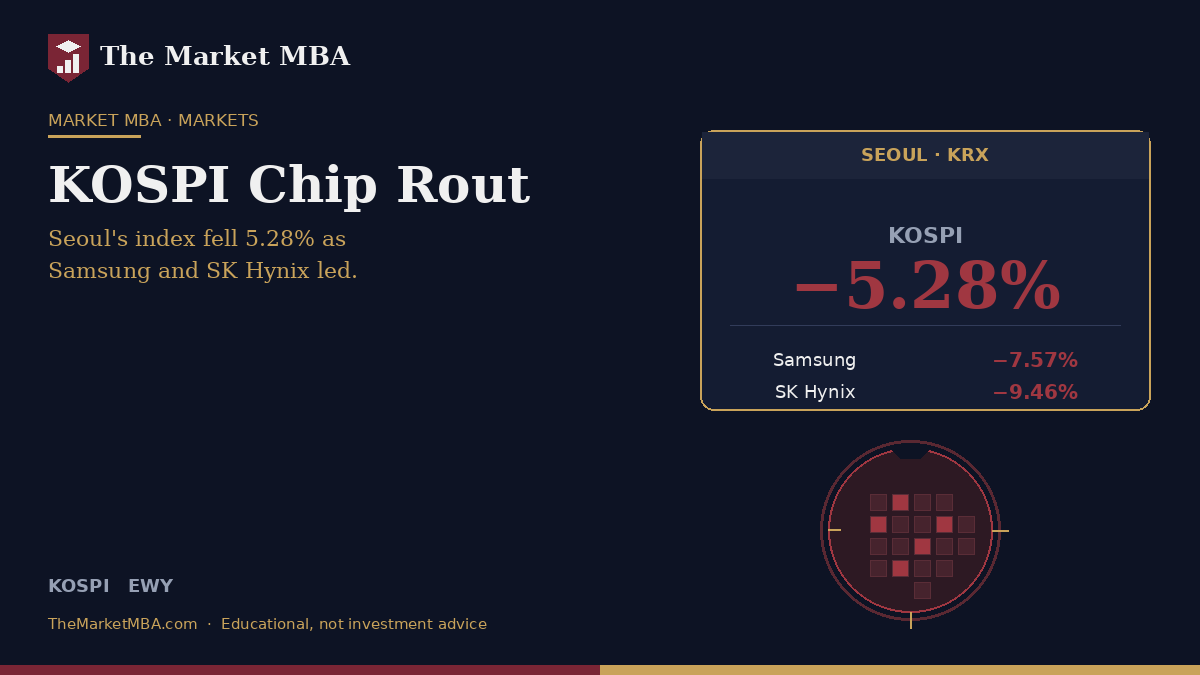
- South Korea’s benchmark KOSPI index fell 5.28% (300 points) to 5,383.80 on Thursday, Nov. 5, Yonhap reported.
- Chip giants Samsung Electronics (-7.57%) and SK Hynix (-9.46%) led the drop. Analysts tied it to fears that the new Democratic U.S. Congress could tighten rules on AI data centers.
- Foreign investors sold a net 3.39 trillion won of Korean shares, and the exchange triggered a “sidecar” that briefly paused computer-driven trading.
- The lesson: when two companies make up roughly half an index, that index is effectively a single bet on one industry.
The setup: what the KOSPI is and why it’s so “chippy”
The KOSPI (Korea Composite Stock Price Index) is South Korea’s main stock index, much like the S&P 500 is for the U.S. It tracks the large companies listed on the Korea Exchange.
The KOSPI is unusually concentrated. Samsung Electronics and SK Hynix, the country’s two semiconductor heavyweights, together account for roughly half of the index’s market capitalization (the total value of all its shares), according to The Korea Times. Both companies make memory chips, including the high-performance memory used in AI servers. So the KOSPI is heavily tied to one question: how much will the world spend building AI data centers?
U.S. investors usually get exposure to Korea through the iShares MSCI South Korea ETF ($EWY). An ETF (exchange-traded fund) is a basket of stocks that trades like a single share. Because it follows a similar group of big Korean companies, $EWY tends to move with the same chip stocks.
What happened on Thursday
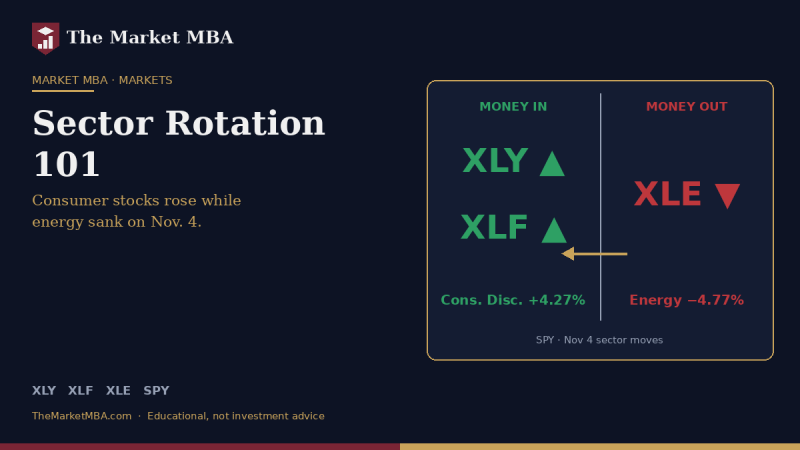
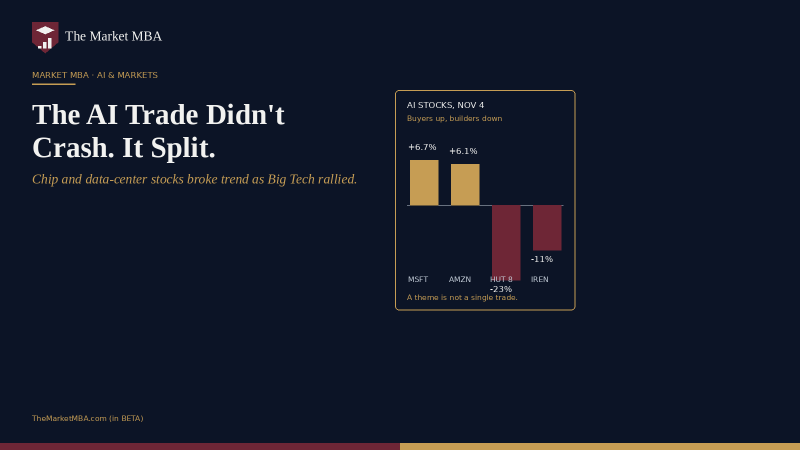
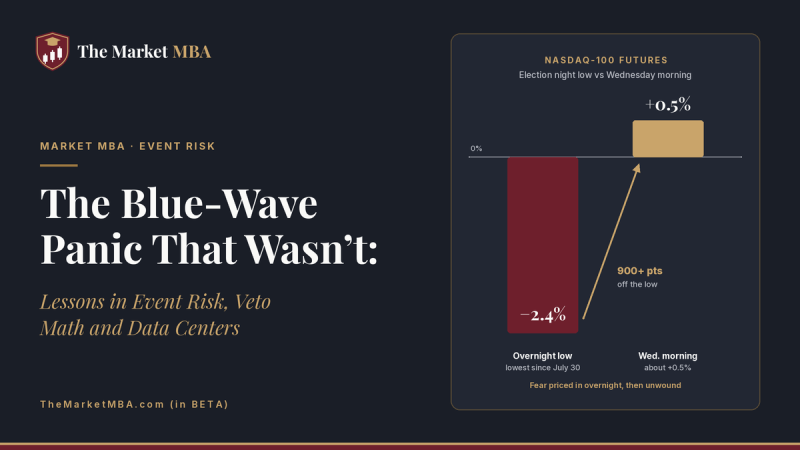
Democrats won control of both chambers of the U.S. Congress in the Nov. 3 midterm elections. In the U.S., the reaction was a broad rally. On Nov. 4 the S&P 500 rose 1.58%, the Nasdaq Composite 1.44% and the Dow 3.03% (+1,569 points), per the Associated Press. Under the surface, though, AI-infrastructure stocks were hit. The Korea Times reported that Nvidia fell 3.17%, while memory makers Micron and SanDisk lost about 7% and 7.91% in the U.S. session.
Seoul picked up that baton when its market opened Thursday. According to Yonhap:
- The KOSPI opened 1.82% lower and kept sliding, closing down 300 points, or 5.28%, at 5,383.80.
- Samsung Electronics fell 7.57% to 201,500 won, and SK Hynix fell 9.46% to about 1.26 million won.
- Samsung Electro-Mechanics dropped 15.34% and chip-equipment maker Hanmi Semiconductor fell 9.13%.
- Refiners and defense stocks also fell, as hopes rose for diplomatic progress on the wars in the Middle East and Eastern Europe. SK Innovation fell 7.68% and Hanwha Aerospace 7.48%.
- Foreign investors sold a net 3.39 trillion won of shares, while individual and institutional investors were net buyers.
According to MoneyToday, the index touched an intraday low of 5,336.88 (down 6.10%). The Kosdaq, Korea’s smaller-company index, also fell more than 5%.
Not everything fell. Drugmakers and biotech names rose on expectations of U.S. policies favoring lower-cost medicines, The Korea Times reported. Celltrion gained 7.5% and Hanmi Pharmaceutical rose 9.8%.
The “why”: a data-center worry with Texas roots
The link from a U.S. election to Korean chip stocks runs through AI data centers, the giant warehouses of servers that train and run AI models. Those servers need huge amounts of memory, which is exactly what Samsung and SK Hynix sell.
“The ‘blue wave’ hit the KOSPI, dragging down shares within the semiconductor value chains and stoking a foreign sell-off,” Mirae Asset Securities analyst Kim Seok-hwan told Yonhap. “Democrats gained control of both chambers of Congress, raising concerns over tighter regulations on AI data centers and slower AI investments.”
Samsung Securities researcher Lee Jong-wook offered a more specific explanation in MoneyToday. He said investors appeared to be selling emerging-market chip suppliers and moving into U.S. AI stocks seen as safer. His reasoning: if new data-center construction slows, suppliers could be at greater risk than cloud giants that already own their data centers. (An emerging market is a country whose economy and financial markets are still developing; index providers have long classified South Korea this way.)
What’s a “sidecar”?
At 10:16 a.m. Seoul time, the Korea Exchange activated a sell-side sidecar. This is a circuit breaker that pauses program trading (computer-driven orders, often tied to futures contracts) for five minutes when markets move sharply, Yonhap reported. Think of it as a speed bump, not a full trading halt. MoneyToday said it was the KOSPI’s 56th sidecar of the year, and a sidecar was also triggered on the Kosdaq that afternoon. Some posts on X described chip stocks as “halted.” The reputable reports we reviewed describe a program-trading pause, not a halt in individual stocks.
Why it matters for investors
1. Concentration cuts both ways. An index dominated by one industry soars when that industry is in favor and sinks fast when it isn’t. Before buying a country fund like $EWY, check its top holdings. You may be buying a chip bet rather than “Korea.”
2. Global markets are linked. A U.S. policy shift moved Seoul more than it moved New York. AI spending decisions made in America ripple through suppliers in Korea, Taiwan and Japan.
3. Pros disagree on whether the selling went too far. “It is unlikely that data center regulations will lead to a structural shrinkage of the AI investment cycle,” Kiwoom Securities researcher Han Ji-young told MoneyToday. The Korea Times also noted Han’s view that projects already underway were unlikely to face major delays. Remember: no new law has passed. The new Congress isn’t seated until January, and any rules would take time.
4. Big moves hide context. MoneyToday reported that Thursday’s close leaves the KOSPI more than 40% below a record high of 9,385.59 set June 19, which is deep in bear market territory (a decline of 20% or more from a peak). We could not independently confirm that peak, so treat it as one outlet’s figure.
What to watch next
- U.S. chip stocks overnight: MoneyToday said Friday’s Korean session depends on how U.S. semiconductor shares trade and whether foreign selling eases. Watch Nvidia, Micron, $SMH and $QQQ.
- Foreign flows: whether overseas investors keep selling Korean shares. That’s reported daily by the Korea Exchange.
- Data-center policy: statements from incoming committee chairs in January, and state-level actions on new data centers.
- The won: the Korean currency weakened to about 1,342 per dollar, per The Korea Times. A weaker won lowers returns for U.S. investors in $EWY.
- Fri, Nov. 6 U.S. jobs report: it could move global rates and risk appetite.
Sources
- Yonhap News Agency, “(LEAD) Seoul shares plunge over 5 pct on AI regulation concerns after U.S. midterms” (Nov. 5, 2026): https://en.yna.co.kr/view/AEN20261105007251320
- The Korea Times, “KOSPI tumbles as Democrat sweep fuels AI infrastructure concerns”: https://www.koreatimes.co.kr/economy/20261105/kospi-tumbles-as-democrat-sweep-fuels-ai-infrastructure-concerns
- MoneyToday, “KOSPI falls to 5,300 level…”: https://www.mt.co.kr/en/stock/2026/11/05/2026110515534966157
- MoneyToday, “‘Blue wave’ rattles Samsung and SK hynix shares, but experts say ‘don’t sell yet'”: https://www.mt.co.kr/index.php/en/stock/2026/11/05/2026110516030863340
- Seoul Economic Daily, “KOSPI Plunges 5.28% to Close at 5,383.80”: https://en.sedaily.com/finance/2026/11/05/kospi-plunges-528-percent-to-close-at-538380
- Associated Press, “Stocks surge, and the Dow soars 1,500 points as oil prices tumble following the US midterm elections” (Nov. 4, 2026): https://apnews.com/article/stock-markets-ai-earnings-oil-4d12764c0b3ce38ffde3077712811182
https://MrFlourishinvests.com (in BETA)
https://TheMarketMBA.com (in BETA)
This article is for educational purposes only and is not financial advice. Do your own research or consult a licensed professional before investing.
For education and entertainment only. Not financial advice.