 The Market
Key takeaways
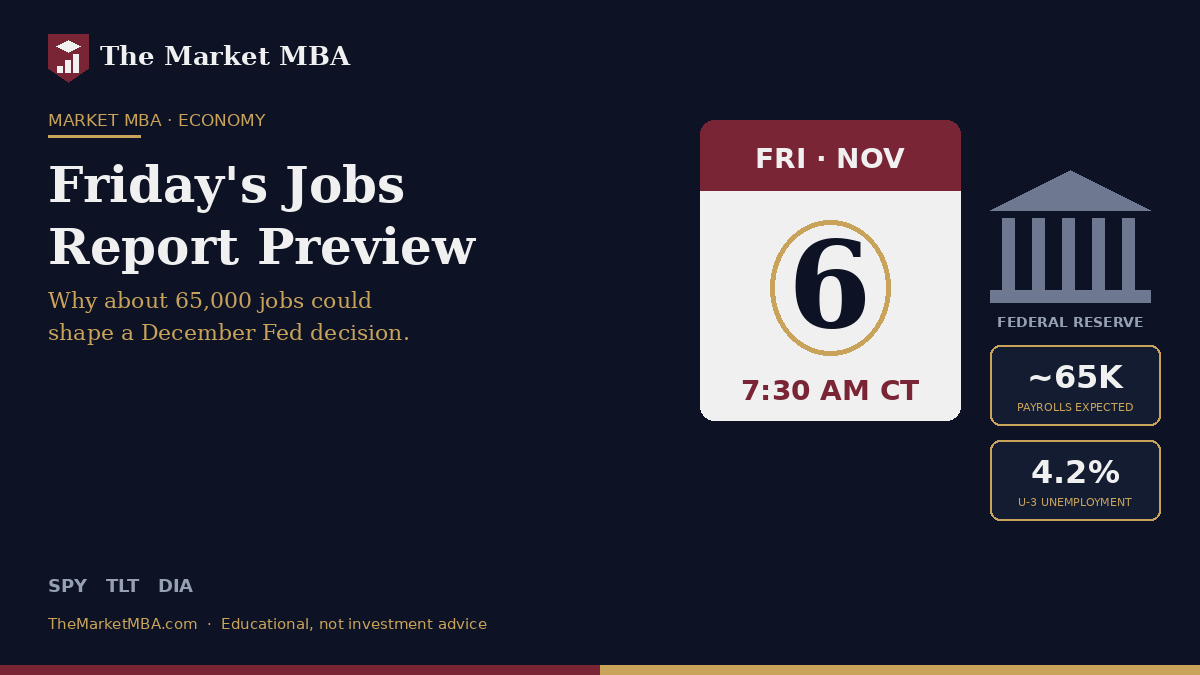
- The government’s October jobs report comes out Friday, Nov. 6, at 7:30 a.m. Central (8:30 a.m. Eastern).
- Economists expect roughly 59,000 to 65,000 new jobs and an unemployment rate that holds at 4.2%.
- The Federal Reserve held rates at 3.75%–4.00% on Oct. 28, but traders were pricing a strong chance of a rate increase in December.
- A hot report could make a hike more likely. A weak one could make it less likely. Both outcomes move stocks and bonds.
The setup: why one Friday morning matters so much
On the first Friday of most months, the U.S. Bureau of Labor Statistics (BLS) publishes the Employment Situation report, better known as the jobs report. It’s one of the most closely watched economic releases there is. It tells us how many people employers hired, how many people are looking for work, and how fast paychecks are growing.
Investors care because the Federal Reserve (the Fed, America’s central bank) watches the same numbers. The Fed has two jobs set by Congress: keep employment high and keep inflation low and steady (its target is 2%). When it raises its benchmark interest rate, borrowing gets more expensive across the economy, which tends to cool spending and inflation. When it cuts, borrowing gets cheaper.
This month the stakes are unusual. Most investors in recent years have been asking when the Fed will cut. Right now the live question is whether the Fed will raise rates again.
What happened at the Fed’s last meeting
On Oct. 28 the Fed held its benchmark rate in a range of 3.75% to 4%, by a 10–2 vote, according to an ETF.net Research summary. The two dissenters, Governor Lisa Cook and Cleveland Fed President Beth Hammack, wanted a quarter-point increase. The committee’s statement said the economy is expanding at a strong pace and called inflation “elevated.”
As of Nov. 4, investors were pricing roughly an 80% chance of a quarter-point hike at the Dec. 8–9 meeting — Morningstar put the figure at about 79% that Wednesday, up from about 70% at the end of the prior week. Those numbers are secondary reports of market-implied odds from tools such as CME FedWatch, not a direct live verification from CME. (FedWatch converts prices of interest-rate futures, contracts that let traders bet on where rates will be, into implied odds.) St. Louis Fed President Alberto Musalem said on Oct. 30: “I judge that additional firming of monetary policy will be necessary, and soon.” In Fed language, “firming” means raising rates.
Inflation is the reason a hike is on the table at all. Prices rose 3.7% in the 12 months through September, AOL/Investopedia’s preview notes. That’s well above the Fed’s 2% goal.
The three numbers to know, explained
1. Nonfarm payrolls (the headline number). This is the net number of jobs U.S. employers added during the month, excluding farm workers, private household workers and a few other groups. It comes from a survey of businesses. In September employers added just 29,000 jobs, about a third of what economists had predicted, according to Morningstar. BLS also revised July and August down by a combined 60,000.
For October, forecasters expect a rebound to about 65,000 (FactSet, per Morningstar; Reuters’ survey per RiskStock). The Dow Jones survey is a bit lower, at about 59,000. Individual forecasts range widely, from about 45,000 (KPMG) to 100,000 (Pantheon Macroeconomics), RiskStock reports.
2. The unemployment rate. This is the share of people in the labor force (working or actively looking) who don’t have a job. It comes from a separate survey of households. It ticked up to 4.2% in September and is expected to stay there.
Here’s an important lesson. A “low” jobs number doesn’t automatically mean a weak economy. KPMG chief economist Diane Swonk has argued that with retirements and lower immigration shrinking the pool of workers, employers may not need to add many jobs to keep unemployment from rising, according to the AOL/Investopedia preview. “The labor market is shrinking,” she wrote.
3. Average hourly earnings (wage growth). This shows how fast pay is rising. Economists expect a 0.3% monthly gain after 0.1% in September, Morningstar reports, or about 2.9% over the past year. Faster wage growth can feed inflation, which matters to a Fed that’s thinking about a hike. On the other hand, 2.9% wage growth against 3.7% inflation means many paychecks are losing ground to prices.
A word on Wednesday’s ADP number
On Nov. 4 the payroll firm ADP reported that private employers added 86,000 jobs in October, more than the roughly 67,000 to 69,000 expected, according to RiskStock. ADP’s estimate is built from its own clients’ payroll data. It has often diverged from the official count, so treat it as a hint, not a preview.
Why it matters for your portfolio
Think of the jobs report as a fork in the road:
- Stronger than expected (say, well above 65,000 with faster wage growth). This reinforces the case for a December hike. Bond yields (the interest rate a bond pays, which moves opposite to its price) could rise, which often pressures richly valued growth stocks. For the math, see our explainer Why Bond Prices Fall When Interest Rates Rise.
- Roughly in line. Per ETF.net’s summary of Bloomberg reporting, a 65,000 gain with steady unemployment would leave the Fed on track for more increases. Markets may treat that as already “priced in,” meaning it’s already reflected in prices.
- Much weaker than expected (or a jump in unemployment). Odds of a hike could fall, but worries about growth could rise. That’s good for bonds and mixed for stocks.
Not everyone thinks Friday will be decisive. “The bar for this report to really move the needle is a bit higher than what we’ve seen in the last couple of reports,” Vanguard senior economist Adam Schickling told Morningstar.
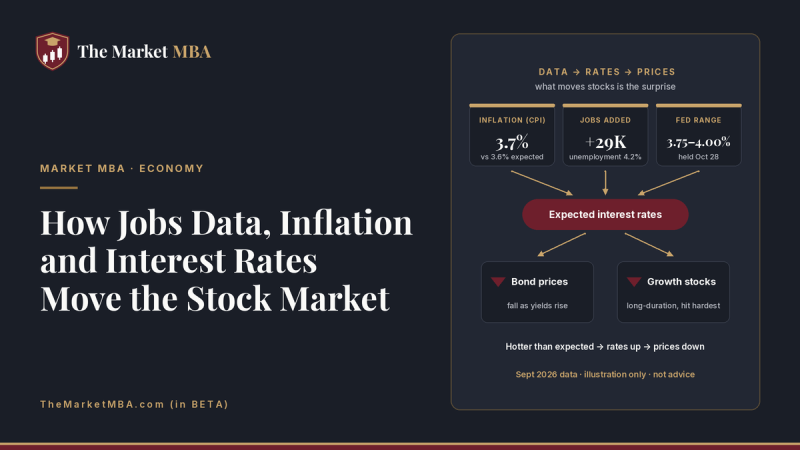
The bigger lesson: markets react to surprises versus expectations, not to the raw number. A “bad” number that’s better than feared can lift stocks. For more on how this chain works, read our primer How Jobs Data, Inflation and Interest Rates Move the Stock Market.
What to watch next
- Fri, Nov. 6, 7:30 a.m. CT: October jobs report. Check the headline payrolls number, the unemployment rate, wage growth, and the revisions to prior months, which can matter as much as the headline.
- Tue, Nov. 10, 7:30 a.m. CT: October consumer price index (CPI), the government’s main inflation gauge (per ETF.net).
- Fri, Dec. 4: November jobs report, the last one before the Fed meets (per ETF.net).
- Dec. 8–9: Fed meeting, with new economic projections.
- Market reaction: watch the 10-year Treasury yield and rate-sensitive funds like TLT alongside broad index funds like SPY.
We’ll publish a follow-up after the numbers hit.
Sources
- ETF.net Research, “Friday’s jobs report is the test of a December rate increase” (Nov. 1, 2026): https://etf.net/news/jobs-report-tests-december-rate-hike-2026-11-01
- Morningstar, “October Jobs Report Seen Showing Resilient Labor Market” (Nov. 4, 2026): https://www.morningstar.com/economy/october-jobs-report-seen-showing-resilient-labor-market
- AOL/Investopedia, “What To Expect From Friday’s Jobs Report”: https://www.aol.com/articles/expect-friday-jobs-report-205422000.html
- RiskStock, “October Jobs Report Preview: ADP Beats With 86,000”: https://riskstock.com/news-us-october-jobs-report-preview-adp-86000.html
https://MrFlourishinvests.com (in BETA)
https://TheMarketMBA.com (in BETA)
This article is for educational purposes only and is not financial advice. Do your own research or consult a licensed professional before making investment decisions. Not financial, investment, legal, or tax advice.
For education and entertainment only. Not financial advice.