 The Market
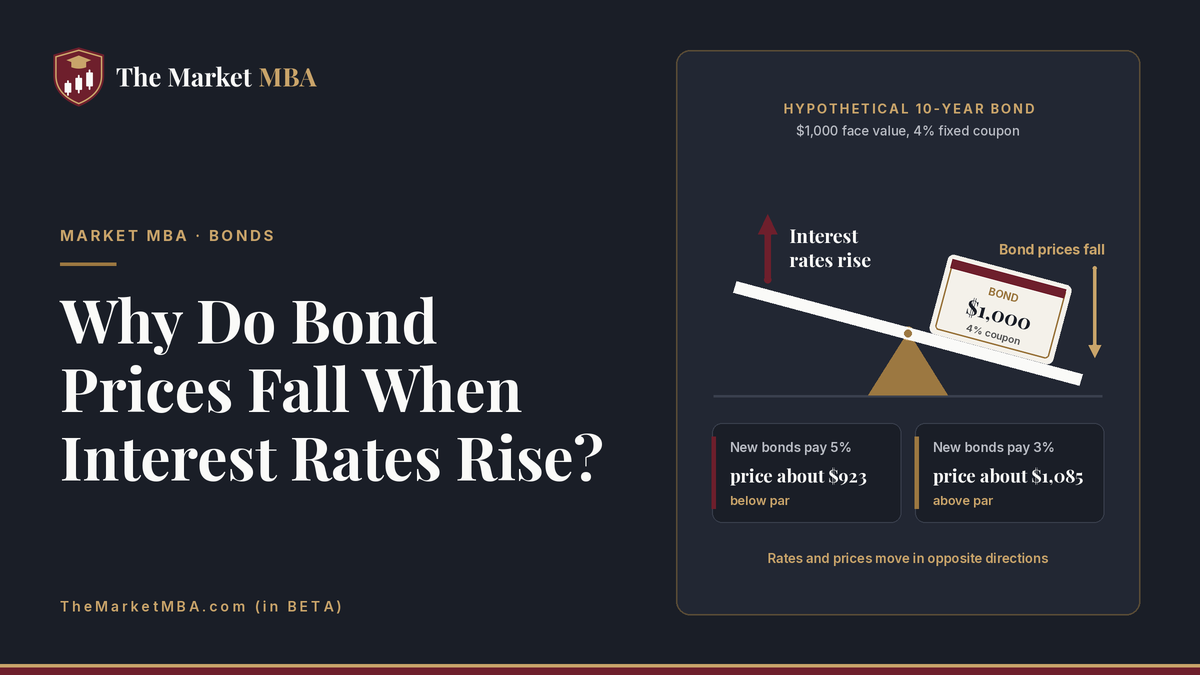
A bond pays a fixed coupon. When market rates rise, new bonds pay more, so an existing lower-coupon bond is worth less to a buyer. Its price drops until its yield matches what new bonds offer. The longer the bond’s duration, the bigger the price drop for each 1-point rise in rates.
This is one of the most important relationships in investing, and one of the most confusing the first time you see it. A bond fund can lose value even though nothing went wrong with any of the borrowers. Let’s make it concrete with real arithmetic.
The short answer: fixed coupon, moving market
A typical bond is a loan with fixed terms. You lend $1,000 (the face value); the borrower pays you a set amount of interest each year (the coupon) and returns the $1,000 at maturity.
The coupon doesn’t change. Market interest rates do. So when rates move, the only thing that can adjust to keep an old bond competitive with new ones is its price.
A worked example: a $1,000 bond paying 4% when new bonds pay 5%
You buy a newly issued 10-year bond with a $1,000 face value and a 4% coupon: $40 a year, plus $1,000 back at the end. (We’ll use one annual payment to keep the math clean.)
Shortly after, market rates rise and comparable new 10-year bonds pay 5%, or $50 a year.
Why the price has to fall
Put yourself in a buyer’s shoes. Why would anyone pay $1,000 for your bond’s $40 a year when $1,000 buys a new bond paying $50? They wouldn’t. They’ll buy yours only at a price low enough that your $40 coupons plus the $1,000 at maturity earn them the same 5% the new bond does.
That price works out to about $922.78, a drop of about 7.7%. At that price, the buyer gets $40 a year plus a $77.22 gain at maturity, which together add up to a 5% yield.
Nothing about the issuer changed. The bond just became less attractive relative to the new ones.
The same example in reverse (rates fall → price rises)
Now suppose rates fall instead and new 10-year bonds pay 3%, or $30 a year. Your $40 coupon looks great, and buyers will pay up for it. The price rises to about $1,085.30, roughly 8.5% above face value, so that its yield matches 3%.
Same mechanism, opposite direction. Bond prices and interest rates move in opposite directions.
Price, coupon and yield: three numbers, one relationship
- Coupon rate: the fixed interest the bond pays, as a percentage of face value. Set at issuance.
- Price: what the bond trades for today. It moves.
- Yield (to maturity): the total annual return you’d earn if you bought at today’s price and held to maturity, counting coupons and any gain or loss back to face value.
The rule: when price falls, yield rises, and when price rises, yield falls. Market rates set the yield buyers demand; price is the lever that delivers it.
| Market rate for new 10-year bonds | Price of our 4% bond | vs face value |
|---|---|---|
| 3% | about $1,085 | premium |
| 4% | $1,000 | at par |
| 5% | about $923 | discount |
Duration: how much a bond’s price moves
Not every bond moves the same amount. Duration measures how sensitive a bond’s price is to changes in interest rates. It’s expressed in years, but think of it as a sensitivity number.
The rule of thumb: duration × rate change ≈ % price change
For each 1 percentage point change in rates, a bond’s price moves roughly its duration in percent, in the opposite direction. A bond with a duration of 6 would fall about 6% if rates rose 1 point and rise about 6% if they fell 1 point.
This is an approximation. It works best for small rate moves. For larger moves the actual change differs, and for a rate rise the actual drop tends to be a bit smaller than the estimate.
Here’s how it plays out for hypothetical 4% coupon bonds, priced at $1,000, when rates rise 1 point (4% to 5%):
| Bond (4% coupon) | Approx. duration | Rule of thumb | Actual price change |
|---|---|---|---|
| 2-year | about 1.9 | about −1.9% | about −1.9% |
| 7-year | about 6.0 | about −6.0% | about −5.8% |
| 12-year | about 9.4 | about −9.4% | about −8.9% |
Calculated by The Market MBA with annual coupons. Illustrative only.
Why long-term and low-coupon bonds move more
- Longer maturity: more of your money comes back far in the future, and distant cash is more sensitive to the rate you discount it at. Longer maturity generally means higher duration.
- Lower coupon: less of your money arrives early as coupons, so more of the value rides on the far-off principal. A higher coupon generally means lower duration.
Duration isn’t maturity. A 10-year bond with a 4% coupon has a duration of about 8, not 10, because the coupons return part of your money along the way.
Individual bonds held to maturity vs bond funds
If you hold an individual bond to maturity and the issuer doesn’t default, rate changes don’t change what you get: the coupons you signed up for and your $1,000 back. The price drop in between is real if you sell, but it disappears as the bond nears maturity and its price heads back to face value.
A bond fund works differently. It holds many bonds and usually keeps buying and selling to maintain a target maturity or duration, so the fund as a whole never “matures.” Its share value (or NAV) reflects current market prices every day, so rising rates show up as a loss right away. The upside is that as its bonds mature or are replaced, the fund can reinvest at the new, higher rates. A fund’s fact sheet usually lists its duration, which gives you a rough guide to how much it may move for each 1-point rate change.
What it means for a long-term portfolio
Rising rates hurt bond prices in the short run, but they also raise the income bonds pay going forward. Coupons and maturing bonds get reinvested at higher yields.
That creates a real trade-off between price risk and reinvestment risk. CFA Institute’s curriculum puts it this way: the longer your investment horizon, the more reinvestment matters relative to the price drop, and when your horizon equals a bond’s Macaulay duration (the duration measure expressed in years), the two effects roughly offset. If you’ll need the money sooner, the price drop matters more. This is one reason some investors try to match bond duration to when they’ll actually need the money, a topic we cover in our guide to asset allocation by age.
The takeaway isn’t to predict rates. It’s to know how much rate risk you own.
Other bond risks that aren’t about rates
- Credit (default) risk: the borrower might pay late or not at all. Lower-rated bonds generally pay higher interest to compensate.
- Inflation risk: fixed coupons buy less when prices rise.
- Call risk: some issuers can repay early, often when rates have fallen, leaving you to reinvest at lower rates.
A low duration doesn’t make a bond low-risk. Read a bond’s offering documents or a fund’s prospectus for the full picture.
FAQ
Do bond prices always go down when interest rates go up?
For fixed-rate bonds, prices generally move opposite to rates, holding other things equal. Other forces, such as a borrower’s improving credit, can offset that in a given period. Floating-rate bonds work differently: their coupons move with a benchmark rate, so check the offering documents for how and when they reset.
If I hold a bond to maturity, do rising rates matter?
If the issuer doesn’t default, you’ll still receive every coupon and the full face value at maturity. Rising rates matter mainly if you sell early, and as an opportunity cost, since new bonds pay more than yours.
What is bond duration?
A measure of how sensitive a bond’s price is to interest rate changes. As a rule of thumb, a bond’s price moves about its duration in percent for each 1-point change in rates, in the opposite direction.
Why do bond funds lose money when rates rise?
A fund’s value reflects the current market prices of its bonds, and those prices fall when rates rise. Because most funds don’t hold everything to maturity, the loss shows up in the share value right away. Over time, the fund can reinvest at higher yields.
Do bond prices go up when interest rates go down?
Yes. Existing bonds with higher coupons become more valuable, so their prices rise. In our example, a 4% bond rises to about $1,085 when new bonds pay 3%.
Sources
- Investor.gov (SEC), Investor Bulletin: Fixed Income Investments – When Interest Rates Go Up, Prices of Fixed-Rate Bonds Fall: https://www.investor.gov/introduction-investing/general-resources/news-alerts/alerts-bulletins/investor-bulletins-86
- FINRA, Brush Up on Bonds: Interest Rate Changes and Duration (Sept 19, 2024): https://www.finra.org/investors/insights/bonds-interest-rate-changes-duration
- Federal Reserve Bank of St. Louis, Why Do Bond Prices and Interest Rates Move in Opposite Directions? (Nov 3, 2023): https://www.stlouisfed.org/publications/page-one-economics/2023/11/03/why-do-bond-prices-and-interest-rates-move-in-opposite-directions
- CFA Institute, Interest Rate Risk and Return (2026 refresher reading): https://www.cfainstitute.org/insights/professional-learning/refresher-readings/2026/interest-rate-risk-and-return
- Investor.gov (SEC), Bond Funds and Income Funds: https://www.investor.gov/introduction-investing/investing-basics/glossary/bond-funds-and-income-funds
- Investor.gov (SEC), Bonds – FAQs: https://www.investor.gov/introduction-investing/investing-basics/investment-products/bonds-or-fixed-income-products/bonds
- FINRA, Bonds (fixed-rate and floating-rate definitions, call and credit risk): https://www.finra.org/investors/investing/investment-products/bonds
- Prices and durations in the tables: calculated by The Market MBA (annual coupons, illustrative)
Keep going. This article is part of 210 Bonds and credit in Level 200 Securities of The Market MBA, a 4-level, 12-course program that ends with you writing your own investment policy statement.
For education only. Not financial, investment, legal or tax advice.
For education and entertainment only. Not financial advice.