 The Market
By Chief Editor Clark for The Market MBA
October’s consumer price index beat forecasts by a tenth of a point on Tuesday. That sounds tiny, but within hours the futures market went from leaving room for a pause in December to pricing a Fed rate hike as a near-certainty. Here is the math that turns a 0.3% monthly reading into a policy decision, and how to read the market’s odds yourself.
The setup
The Bureau of Labor Statistics said the consumer price index (CPI) rose 0.4% in October after 0.6% in September, and core CPI, which leaves out food and energy, rose 0.3% (BLS). Economists had expected 0.3% and 0.2% (CNBC). Because October 2025 prices were never collected during last year’s government shutdown, there is no official year-over-year number this month, so the monthly figures are the whole story.
We already covered why oil’s recent slide is not in this report yet, and how seasonal adjustment turned a 0.7% drop in pump prices into a 1.0% rise in the gasoline index, in Oil Fell 17% in 10 Days, but October’s CPI Ran Hot. This lesson picks up where that one ends: what the Federal Reserve does with a number like this.
Lesson 1: Turn a monthly number into an annual pace
The Fed targets 2% inflation a year. CPI is reported month by month. To compare the two, compound the monthly change over 12 months: (1 + monthly change) to the 12th power, minus 1.
- 0.2% a month works out to about 2.4% a year. Moody’s Analytics economist Mark Zandi told CNBC that a steady monthly core reading around 0.2% would be more in line with the Fed’s target (CNBC).
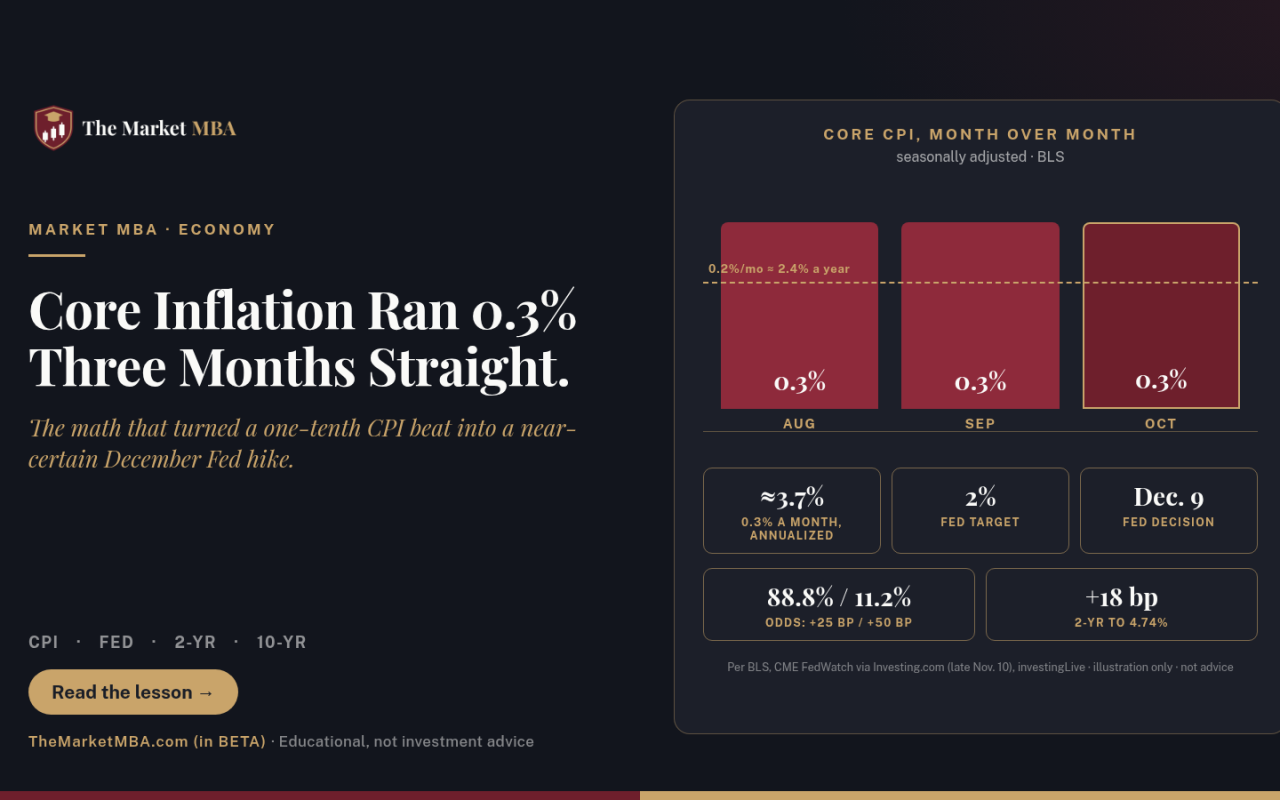
- 0.3% a month works out to about 3.7% a year.
- 0.4% a month works out to about 4.9% a year.
Core CPI rose 0.3% in August, September and October (BLS). Three straight months at that pace is about 3.7% annualized, close to double the Fed’s goal. Headline CPI rose 0.4%, 0.6% and 0.4% over the same months, which annualizes to roughly 5.7%, though energy swings drove much of that.
One caution: the BLS rounds to one decimal place. A reported 0.3% can be anything from 0.25% to just under 0.35%, which annualizes to anywhere from about 3.0% to 4.3%. That is why economists also look at the unrounded index, and why a single month rarely settles a debate. Three months in a row is harder to wave away.
Lesson 2: Why core matters more than headline to the Fed
Food and energy prices jump around with weather, wars and harvests. Core is the Fed’s read on the underlying trend. In October the energy index rose 0.7% after a 5.2% jump in September, so energy added much less than a month earlier, yet core did not slow (BLS). Shelter rose 0.3% and accounted for more than 30% of the overall increase; transportation services jumped 0.8% (BLS; CNBC).
Vanguard senior U.S. economist Josh Hirt told CNBC that core inflation “reflects three outsized shocks: tariffs, energy prices, and AI-related demand” (CNBC). Chicago Fed President Austan Goolsbee said he was concerned about persistently high services inflation and that tariff-driven price pressure had not faded as he had hoped (CNBC).
Lesson 3: When a Fed official sets a bar, the market keeps score
Hours before the release, Fed Governor Christopher Waller said in London that if core CPI came in around 0.3% or higher, a half-point hike “should be considered” in December, adding that “hiking only 25 basis points would put our credibility at risk” (FXStreet). The bar was met.
Other officials followed. Dallas Fed President Lorie Logan said she sees a need for two more quarter-point increases and that “it may be possible to move more rapidly this winter than the FOMC has moved so far this fall.” Goolsbee called the report “another distressing report — borderline disturbing” in a PBS NewsHour interview, but declined to say what the Fed should do in December (CNBC). Waller and Logan vote on rates this year; Goolsbee votes next year (CNBC).
The Fed raised its benchmark rate a quarter point in September, to a range of 3.75% to 4%, then held in October (CNBC). Its next decision is due Dec. 9 (FXStreet).
Lesson 4: How to read ‘the odds’
When you see “a 100% chance of a hike,” that number is not a poll. CME Group’s FedWatch tool backs it out of the prices of 30-day fed funds futures, contracts that pay off based on where the Fed’s rate averages over a month (CME Group). If those prices imply a higher average rate after the meeting, the tool reports a higher probability of a hike.
- Late Tuesday: FedWatch showed an 88.8% chance of a quarter-point hike in December and an 11.2% chance of a half point, with no chance left of holding. A week earlier the quarter-point odds were about 72% (Investing.com).
- Wednesday morning: CNBC put the half-point odds at 15% and the chance of rates reaching 4.25% to 4.5% by the January meeting at 60% (CNBC).
- Wall Street forecasts: Deutsche Bank now expects quarter-point hikes in December, January and March, taking the range to 4.50% to 4.75%. It does not expect a half point in December, citing officials who favor a gradual pace, easing oil prices and steady market inflation expectations (FXStreet).
The odds move every day, so treat them as the market’s current bet, not a forecast you can bank on.
Lesson 5: Why the 2-year moved more than the 10-year
On Tuesday the 2-year Treasury yield jumped about 18 basis points to 4.74%, while the 10-year rose about 12 basis points to settle at about 5% (investingLive). The 2-year is the bond most tied to what the Fed does over the next couple of years, so it reacts hardest to changes in rate-hike expectations. The 10-year also reflects long-run growth and inflation, which is why it moves less on a single report but matters more for mortgages and for how investors value stocks with profits far in the future.
A Veterans Day quirk: the U.S. bond market is closed today, Nov. 11, on SIFMA’s recommendation, while stocks trade normally (SIFMA). That means no fresh Treasury yields to show whether Tuesday’s move is sticking until trading resumes Thursday, and thinner trading can exaggerate stock moves in the meantime (investingLive).
What to watch
- Friday’s producer price index (PPI). Wholesale prices feed into parts of the Fed’s preferred inflation gauge.
- Thursday’s bond reopen. Whether the 2-year holds near 4.7% tells you if the market is sticking with its hike bet.
- Fed speakers. Any voter who joins Waller in backing a half point would push those odds higher.
- November CPI. One more 0.3% core reading would make it four months in a row.
- Oil and pump prices. Cheaper crude could cool headline inflation in coming reports, but core is what the Fed is watching most closely.
The bottom line
A 0.3% core reading sounds small until you annualize it: about 3.7% a year, three months running, against a 2% target. That is why one tenth of a point above forecast moved the Fed debate from whether to hike in December to how much. For learners, the habit to build is simple: compound the monthly number, check whether the trend is repeating, and read rate odds as prices, not promises.
Sources
- U.S. Bureau of Labor Statistics: Consumer Price Index, October 2026
- CNBC: CPI inflation report, October 2026 (Nov. 10)
- CNBC: Here’s the inflation breakdown for October 2026 (Nov. 10)
- CNBC: Goolsbee calls inflation report ‘borderline disturbing’ (Nov. 11)
- Investing.com: Fed rate hike odds in December at 88% after hot CPI, CME FedWatch
- FXStreet: Deutsche Bank adds January Fed hike after hot CPI (Nov. 11)
- investingLive: US bond market closed for Veterans Day (Nov. 11)
- SIFMA: Veterans Day 2026 fixed income market close
- CME Group: FedWatch tool
- The Market MBA: Oil Fell 17% in 10 Days, but October’s CPI Ran Hot (Nov. 10)
Not financial advice. This article is for educational purposes only. Nothing here is a recommendation to buy or sell any security.
For education and entertainment only. Not financial advice.