 The Market
By Chief Editor Clark for The Market MBA
Nebius (NBIS) reported third-quarter revenue well above Wall Street’s estimate on Thursday, and the stock still fell about 16%. The reason is a lesson every earnings reader should learn: a beat is only as good as what it is made of, and the market prices the next year, not the last quarter.
What Nebius reported
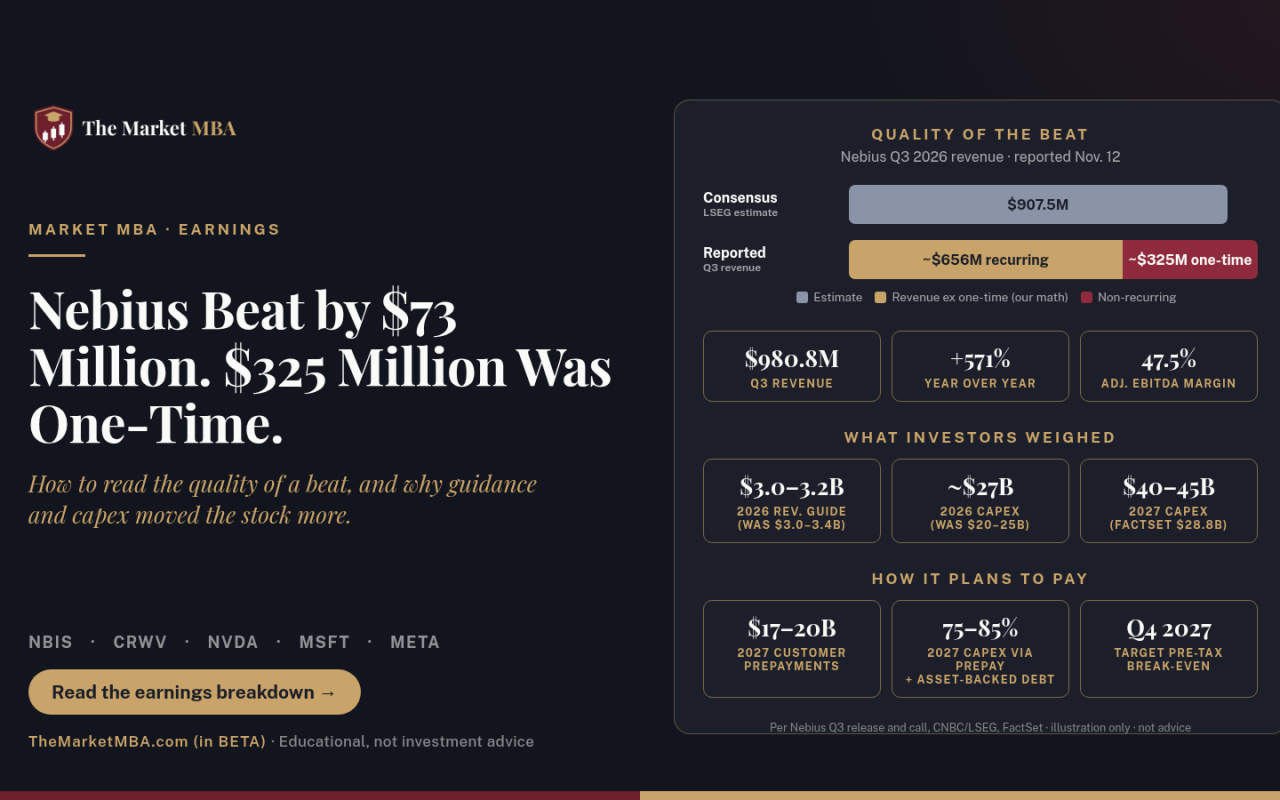
Nebius, an Amsterdam-based “neocloud” that rents out AI computing power, reported Q3 2026 revenue of $980.8 million, up 571% from $146.1 million a year earlier (Nebius Q3 release). Analysts polled by LSEG expected $907.5 million (CNBC). The company posted a net loss from continuing operations of $37.5 million, or 13 cents a share, and adjusted EBITDA of $465.8 million, a 47.5% margin (Nebius; Q3 call).
On the surface, that is a clean beat of about $73 million (our math: $980.8 million minus $907.5 million). Yet shares sank about 16% Thursday (CNBC), giving back Wednesday’s 15% jump that followed CoreWeave’s upbeat outlook (Reuters).
Lesson 1: Check what the beat is made of
On the earnings call, Nebius’s chief financial officer said Nebius recognized “approximately $325 million of non-recurring revenue” in the quarter from its new asset-light model, where partners fund the data center capacity and Nebius earns fees for deploying its architecture and cloud platform on it (Q3 call). He said it was the first such deal and that the company expects this revenue to become “a more regular part of our business” over time.
Here is why that matters. Take the one-time piece out and Q3 revenue would have been about $656 million (our math). That is below the $907.5 million estimate, though we can’t tell from public reports how much of the one-time revenue analysts had modeled, so treat the comparison as a rough guide, not a verdict.
The same item flatters profit margins. The CFO said the third quarter “had revenue recognized at a point in time that does not recur in the same form” and told investors not to read too much into any single quarter, while keeping full-year adjusted EBITDA margin guidance at about 40% (Q3 call). A 47.5% quarter inside a roughly 40% year tells you the rest of the year runs lower.
The takeaway: when a company beats, look for words like “non-recurring,” “one-time” or “point in time” in the release, the shareholder letter and the call. Revenue that won’t repeat is real money, but it should not be multiplied by four in your head.
Lesson 2: Guidance usually matters more than the quarter
Stocks trade on expected future cash flows, so the outlook often moves a stock more than the results. Nebius trimmed its 2026 revenue forecast to $3.0 billion to $3.2 billion from $3.0 billion to $3.4 billion, citing third-party (colocation) capacity, including its New Jersey site, shifting into 2027 (Q3 call). FactSet’s consensus had been $3.35 billion (CNBC). Management said none of the delayed capacity was canceled and called the change “just about timing, not demand” (Q3 call).
A quick check you can do yourself: Nebius has booked $1,962.1 million of revenue in the first nine months (Nebius). Subtract that from the new range and the guide implies roughly $1.04 billion to $1.24 billion in Q4 (our math). Compare that with the roughly $656 million of recurring Q3 revenue and you see how much new capacity has to start billing in the final quarter.
The 2027 outlook was actually upbeat on sales: $12 billion to $13 billion, about four times this year, versus FactSet’s $12.09 billion (CNBC). Nebius also said it expects to break even on a pre-tax basis in the fourth quarter of 2027 (Q3 call).
Lesson 3: Capex is the bill for growth, and the market reads it
The bigger surprise was spending. Nebius raised 2026 capital expenditures to about $27 billion from $20 billion to $25 billion, and guided 2027 capex to $40 billion to $45 billion, far above FactSet’s $28.77 billion (CNBC). In Q3 alone it spent about $7.3 billion on property and equipment, more than seven times the quarter’s revenue (Nebius; our math).
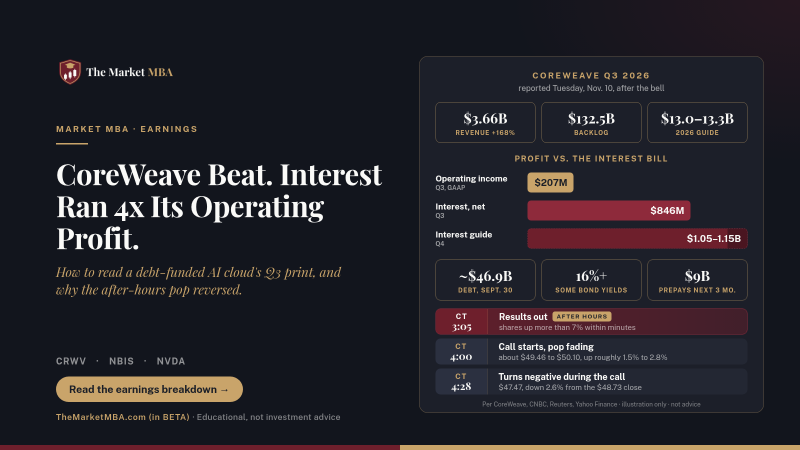
Capex is cash going out today for revenue that arrives later. When the bill grows faster than expected, investors ask who pays it. That is the same question we raised in AI’s Next Test Is the Debt, Not the Models and in our CoreWeave earnings breakdown.
Nebius’s answer is customer money. Management said prepayments on contracts signed in Q3 covered more than 100% of the capex needed to bring that capacity online, up from 50% to 60% a quarter earlier, and that it expects $17 billion to $20 billion of customer prepayments in 2027 (Q3 call). It said 75% to 85% of 2027 capex should be funded by prepayments plus asset-backed financing on existing investment-grade contracts (Reuters; Q3 call). The rest still has to come from somewhere. In Q3 Nebius also sold $5.75 billion of convertible notes and issued 4.6 million new shares through its at-the-market program for about $1.0 billion of net proceeds (Q3 call). Selling new shares dilutes existing holders, so it belongs in the same column as debt when you weigh funding risk.
Lesson 4: Context can swamp a single report
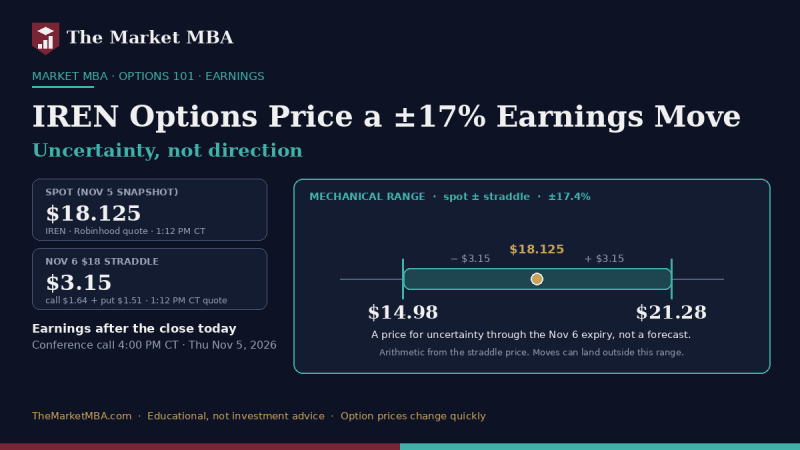
Nebius did not report in a vacuum. On the same morning, Nvidia (NVDA) said CEO Jensen Huang had resigned and named CFO Colette Kress interim CEO (Nvidia). Nvidia has invested across the neocloud space and held about $329 million of Nebius shares at the end of June, according to a filing cited by CNBC (CNBC). By Thursday morning, CoreWeave (CRWV) was down about 9% and IREN 6.6% (TechCrunch). When a whole group falls together, not all of one stock’s drop is about its own numbers. Separating company news from sector news is part of reading any print.
What to watch
- Q4 delivery: whether the delayed colocation capacity, including New Jersey, comes online as described. Management expects annualized run-rate revenue above $7 billion for February, then will stop guiding to that metric (Q3 call).
- Repeat asset-light deals: if more partner deals like Q3’s arrive, the $325 million starts to look less one-off. Nebius said its 2027 guide includes no revenue from such deals (Q3 call).
- Funding mix: how much of the $40 billion to $45 billion 2027 budget ends up coming from prepayments versus new debt or shares.
- Nov. 17: Nvidia’s Q3 fiscal 2027 report, the first under its interim CEO, and a read on demand for the chips neoclouds buy.
The bottom line
Nebius grew revenue more than sixfold and says demand has “never been stronger.” But about a third of the quarter’s revenue was a first-of-its-kind item, the 2026 range came down and the spending plan went sharply up. Read the beat, then read the footnotes, then read the guidance. The stock reaction usually follows the last two.
Sources
- Nebius: Q3 2026 financial results (Nov. 12)
- Nebius Q3 2026 earnings call transcript, via StockAnalysis (Nov. 12)
- CNBC: Nebius falls 16% as company expects increased 2026 capex spend (Nov. 12)
- Reuters via StreetInsider: Nebius pares back 2026 revenue forecast on capacity delays (Nov. 12)
- Investing.com: Nebius shares fall despite beating Q3 estimates (Nov. 12)
- Nvidia: NVIDIA Announces CEO Transition (Nov. 12)
- TechCrunch: Nvidia’s Jensen Huang resigns (Nov. 12)
- The Market MBA: CoreWeave Q3 earnings breakdown (Nov. 10)
- The Market MBA: AI’s Next Test Is the Debt, Not the Models (Nov. 10)
Not financial advice. This article is for educational purposes only. Nothing here is a recommendation to buy or sell any security.
For education and entertainment only. Not financial advice.