 The Market
By Clark Kent for The Market MBA
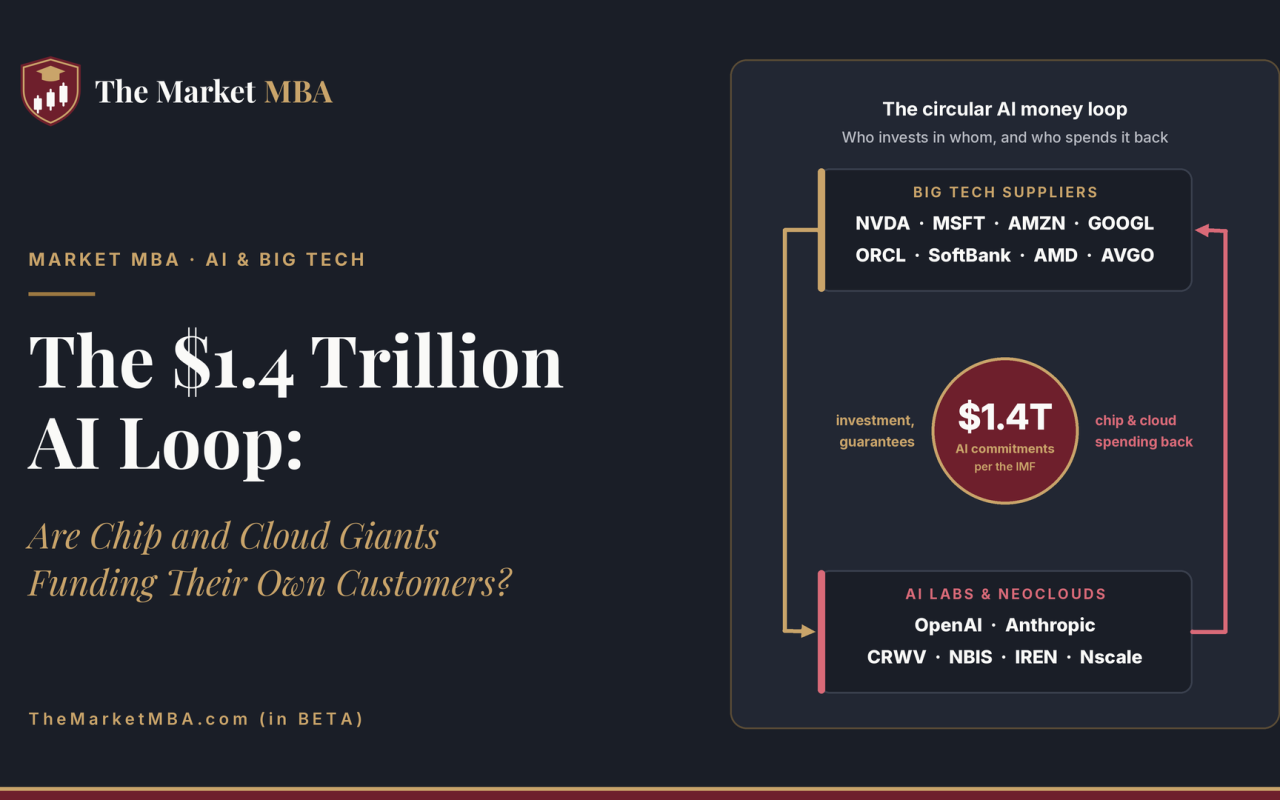
The International Monetary Fund has put a number on one of the market’s biggest worries. In its October 2026 Global Financial Stability Report, the IMF reviewed 14 publicly disclosed AI deals since 2023. They involve about $300 billion of equity and about $650 billion of debt, tied to about $1.4 trillion in future revenue commitments (IMF blog). Those are three separate measures. They should never be added together. Put simply, the companies selling AI chips and cloud capacity are often the same companies funding the buyers.
Bull Theory (@BullTheoryio) mapped 17 of these links in a widely shared post this week. It is Bull Theory’s own list, not the IMF’s, and several of its deals came after the IMF report. Below, we check the key pieces against filings and company releases and lay out what investors should watch.
What a “circular” AI deal is
The loop has three steps. First, an investor puts money into a customer, usually an AI lab or a smaller cloud company. Second, that customer signs a long-term commitment to buy the investor’s chips or cloud capacity. Third, the investor books revenue as the customer spends.
Some of this is ordinary vendor financing. The issue is scale and concentration. The IMF calls it “wrong-way risk”: the stakes and loans lose value at exactly the moment the promised revenue is in doubt (The Next Web). About $320 billion of the debt sits with the firms receiving the money, including debt backed by guarantees and other off-balance-sheet arrangements (Financial Express).
The double counting is part of the story
You cannot add up the 17 deals to get a total. The same dollars show up from several angles. Nvidia’s Ohio guarantee backs the same lease payments OpenAI owes SB Energy. The $63 billion Broadcom financing pays for the same chips Anthropic rents. Google’s $10 billion in the Anthropic IPO placement is partly money it had already committed. That overlap is the point: when one loop is described three ways, revenue across the whole system can look bigger and more independent than it really is.
The biggest loops
Here are the major links we could confirm from filings, company releases or major outlets. Amounts are maximums or multi-year commitments, not cash already paid.
| Backer | Receiver | Money or support in | What flows back |
|---|---|---|---|
| Microsoft (MSFT) | OpenAI | About 24% stake as of Sept. 30, 2026 (Microsoft 10-Q) | Incremental $250B Azure commitment (OpenAI) |
| Amazon (AMZN) | OpenAI | $50B, fully invested by Q3 2026 (Amazon 10-Q) | AWS deal expanded by $100B over 8 years (OpenAI) |
| Nvidia (NVDA) | OpenAI | $30B in the March round; Ohio lease guarantees capped at $105B (10-Q) | Ohio campus to host Nvidia hardware |
| SoftBank | OpenAI | $64.6B cumulative, about 13% (SoftBank) | OpenAI leases the Ohio campus from SB Energy (same leases Nvidia guarantees) |
| Oracle (ORCL) | OpenAI | Heavy borrowing to build data centers (Reuters) | About $300B, five-year cloud contract (reported) |
| AMD (AMD) | OpenAI | Warrant for up to 160M AMD shares at $0.01 (AMD) | Up to 6 gigawatts of AMD GPUs |
| Google (GOOGL) | Anthropic | Up to $40B ($10B upfront) (CNBC) | At least $121.3B Google Cloud commitment (S-1/A) |
| Amazon | Anthropic | Up to $33B ($8B earlier plus up to $25B new) (Anthropic) | At least $110B AWS commitment (S-1/A) |
| Microsoft + Nvidia | Anthropic | Up to $15B combined (Microsoft) | At least $47.2B, up to $49.2B, Azure commitment (S-1/A) |
| Broadcom (AVGO) | Anthropic | $63B committed financing structure; Broadcom gives residual value support (Broadcom) | Vehicle buys Broadcom chips and leases them to Anthropic, deliveries from 2027 |
| SpaceX (SPCX), part-owned by Nvidia | Anthropic | Sells Nvidia-GPU compute through SpaceXAI, and is lining up an approximately $40B Apollo-led GPU finance lease for its own buildout, expected to close by year-end (SpaceX) | Anthropic spend of up to $120.5B with SpaceXAI into 2029 (S-1/A); Nvidia holds about 122.8M SpaceX shares (13F) |
| Nvidia | CoreWeave (CRWV) and other neoclouds | About 11.5% CoreWeave stake (Reuters) | $6.3B CoreWeave capacity order; $36B of AI cloud agreements (10-Q) |
| Microsoft | Nscale, Nebius (NBIS), IREN (IREN) | Contracts worth up to about $70.9B, now under review (AI Weekly) | Neoclouds build capacity for Microsoft |
| TeraWulf (WULF), Cipher | About $1.8B and $1.4B lease backstops for Fluidstack (TeraWulf; Cipher) | Warrants for equity stakes | |
| Meta (META) | Blue Owl (OWL) Hyperion joint venture | JV issued about $27.3B of debt; Meta residual value guarantee starting near $28B (Meta) | Meta leases the campus, off its balance sheet |
| Seven suppliers incl. Nvidia, Google, AMD, Broadcom, Micron (MU), Microsoft, TSMC (TSM) | Anthropic IPO | $26B share purchase, contingent on the IPO closing (S-1/A) | Suppliers become shareholders in a top customer |
Two names show up again and again: OpenAI and Anthropic. Both have promised hundreds of billions of dollars of future spending to companies that own pieces of them.
Nvidia’s balance sheet is the hub
Nvidia (NVDA) sits in the middle of the web. Its latest 10-Q, for the quarter ended July 26, 2026, lists $366 billion of future commitments. Supply and capacity commitments jumped to $279 billion from $119 billion the quarter before (Nvidia 10-Q). Most of that is purchase obligations to memory and manufacturing suppliers, a bet on demand rather than a loan to anyone.
The unusual items are the guarantees, which total $108.5 billion. The big one, signed in August, is capped at $105 billion and covers leases for about 4.25 gigawatts at SB Energy’s Ohio campus on behalf of OpenAI. It phases in over nine data centers starting in fiscal 2029, pays only on certain tenant defaults, and the site will host Nvidia hardware (Nvidia 10-Q). A $250 billion backstop was only ever under discussion. The Wall Street Journal reported on Nov. 13 that CFO Colette Kress reworked the deal, cut Nvidia’s initial commitment to OpenAI in half, and raised questions about how to value the guarantees and calculate the return (The Wall Street Journal, Nov. 13).
The widely quoted $530 billion is not a line in the filing. It is a sum of the 10-Q’s tables: $366 billion of commitments, $56 billion of additional commitments and $108.5 billion of guarantees (Yahoo Finance). Most of it is supplier orders and contingent guarantees, so comparing it with Nvidia’s $91 billion of balance-sheet liabilities overstates the risk.
The timing is what makes this urgent. Nvidia announced on Thursday, Nov. 12, that Jensen Huang had resigned as president, CEO and a board member, effective immediately. The board accepted his resignation on Nov. 11, according to Nvidia’s 8-K filing. CFO Colette Kress is interim CEO and remains CFO, and longtime director Harvey C. Jones is the board’s first chair. Nvidia says it will still report earnings on Tuesday, Nov. 17 (Nvidia; 8-K). The executive who questioned how these deals were valued now decides how many more get written.
The cracks investors can already see
The stress is showing up first at the edges, not at Big Tech:
- Neocloud stocks. On Thursday, Nov. 12, Nebius closed down 16.8% and CoreWeave down 6.9%, after intraday drops of about 23% and 17%. Nebius also cut its 2026 revenue outlook (CNA).
- Neocloud credit. The cost of insuring CoreWeave debt rose 94%, nearly doubling, from Oct. 1 to Nov. 5 before settling, and an IREN convertible bond due 2029 fell 23% from Nov. 3 to Nov. 5, according to LSEG data (via CNBC) (CNBC).
- Junk-rated data center bonds. About $37 billion of the roughly $80 billion of U.S. data center bonds issued this year through mid-October, about 46%, is rated junk, versus $8.6 billion in all of 2025, according to a Forbes analysis of FactSet data (Forbes).
- Tighter terms for AI labs. OpenAI closed about $11 billion at a $1.25 trillion valuation, against an original $30 billion target at $1.4 trillion (Bloomberg; CNBC).
- Nvidia pulling back at the margin. In August, Nvidia paused revenue-sharing credit-support deals with AI cloud companies (Reuters), and Microsoft is now reviewing some neocloud deals.
This week’s moves
| Ticker | Role in the loop | Week to Fri pre-market |
|---|---|---|
| NVDA | Investor, guarantor, chip seller | -9.4% |
| AMD | OpenAI warrant | +27.2% |
| AVGO | Anthropic financing | +21.7% |
| CRWV | Nvidia stake, capacity order | +21.3% |
| NBIS | Microsoft contract | -2.7% |
| IREN | Microsoft contract | -11.0% |
| ORCL | OpenAI cloud contract | +10.8% |
| MSFT | OpenAI stake, Azure | -2.3% |
What to watch
- Guarantees. Nvidia’s guarantees totaled $108.5 billion last quarter. Watch whether that grows in Tuesday’s report, and how Kress talks about new ones.
- Off-balance-sheet commitments. Joint ventures and lease vehicles like Meta’s Hyperion deal and Broadcom’s $63 billion structure keep debt off the sponsor’s books. Read the footnotes for residual value guarantees.
- Junk-rated data center bonds. Wider spreads or pulled deals would be an early warning.
- Neocloud stocks and bonds. CoreWeave, Nebius, IREN and TeraWulf are the weakest links. Watch their shares, convertibles and credit default swaps.
- OpenAI and Anthropic funding terms. Anthropic’s IPO, with a $70 to $80 range and expected next week, will show what public investors will pay, and OpenAI’s next round will show whether its valuation holds.
The bull case
Demand is real. Anthropic’s IPO filing lists minimum compute commitments that are owed regardless of actual usage: at least $121.3 billion with Google Cloud and at least $110 billion with AWS (Anthropic S-1/A). Nobody signs take-or-pay contracts that size for products nobody uses. The backers have some of the strongest balance sheets in the world, Nvidia’s guarantees are capped and phased, and OpenAI’s latest $1.25 trillion valuation is still above March’s $852 billion. If AI revenue keeps growing, these loops look like the way big buildouts have always been financed, from railroads to fiber.
The bear case
The same money gets counted more than once. When a supplier funds a customer that then buys from the supplier, revenue can look stronger than the end demand underneath it. The IMF’s worry is not one bad deal. It is that a few weak links, such as a lab that cannot raise its next round or a neocloud that cannot refinance, could hit equity values, debt values and future revenue all at once.
Frequently asked questions
What are circular AI deals?
They are deals in which a chip or cloud supplier invests in, lends to, or guarantees an AI customer, and that customer then commits to buy the supplier’s chips or cloud capacity. The supplier’s money comes back to it as revenue.
Is $1.4 trillion the total value of circular AI deals?
No. The IMF reviewed 14 disclosed AI deals since 2023 and found about $300 billion of equity, about $650 billion of debt and about $1.4 trillion of future revenue commitments. Those are three separate measures and should not be added together.
Why can’t you add up all 17 deals in Bull Theory’s map?
The same money shows up more than once. Nvidia’s Ohio guarantee backs the same lease payments OpenAI owes SB Energy, and Broadcom’s $63 billion financing pays for the same chips Anthropic leases.
How exposed is Nvidia to circular AI deals?
Nvidia’s 10-Q for the quarter ended July 26, 2026 lists $366 billion of future commitments and $108.5 billion of guarantees, including a guarantee capped at $105 billion for OpenAI’s Ohio leases. The widely quoted $530 billion is a sum of those tables, not a figure Nvidia reports.
Are circular AI deals a sign of an AI bubble?
Not on their own. Anthropic’s filing shows take-or-pay compute commitments of at least $121.3 billion with Google Cloud and $110 billion with AWS, which points to real demand. The risk is that weak links, such as neoclouds that cannot refinance, could hit equity, debt and revenue at the same time.
What should investors watch next?
Watch Nvidia’s earnings on Tuesday, Nov. 17, especially whether its guarantees grow, and Anthropic’s IPO, expected next week. Also watch neocloud stocks and credit (CoreWeave, Nebius, IREN) and junk-rated data center bonds.
Bottom line
The circular deals are real and large, and most of the individual deals in Bull Theory’s map hold up. Some are stale or loosely framed, and adding them up double counts. “Circular” does not automatically mean “fake.” The test is whether end customers keep paying for AI, and whether the weakest borrowers can keep refinancing while that plays out. Watch Nvidia’s earnings and the Anthropic IPO next week. If guarantees keep growing while funding terms keep getting worse, the loop is getting more fragile. If revenue keeps outrunning the commitments, the bulls have the better argument.
For more plain-English market explainers, visit TheMarketMBA.com, and follow MrFlourish’s alerts at MrFlourishinvests.com (in BETA).
Sources
- Video and post: Bull Theory (@BullTheoryio) on X
This article is for education and information only. It is not investment advice. Do your own research and consider talking with a licensed financial professional before making investment decisions.
For education and entertainment only. Not financial advice.