 The Market
Alphabet, Meta, Microsoft, Amazon and Oracle have signed roughly $3.3 trillion of future spending commitments for data centers, chips, energy and leases that don’t yet appear as debt on their balance sheets. That’s on top of record capital spending that has already pushed free cash flow negative at several of them. Here’s what those commitments are, where the numbers come from, and why they matter for investors.
When investors talk about Big Tech’s AI spending, they usually mean capex, short for capital expenditures: money spent on long-lasting physical assets like data centers, chips and servers. Capex shows up in the quarterly cash flow statement, and Wall Street tracks it closely. If the cash flow statement is new to you, start with how to read financial statements.
The hidden second bill: off-balance-sheet commitments
There is a second, larger number that gets less attention: off-balance-sheet commitments. These are signed promises to pay in the future that are not yet recorded as liabilities (debts) on a company’s balance sheet. Think of a data-center lease that has been signed but hasn’t started yet, or a multi-year contract to buy chips, energy or cloud computing capacity. Companies disclose them in the footnotes of their quarterly (10-Q) and annual (10-K) filings.
What happened
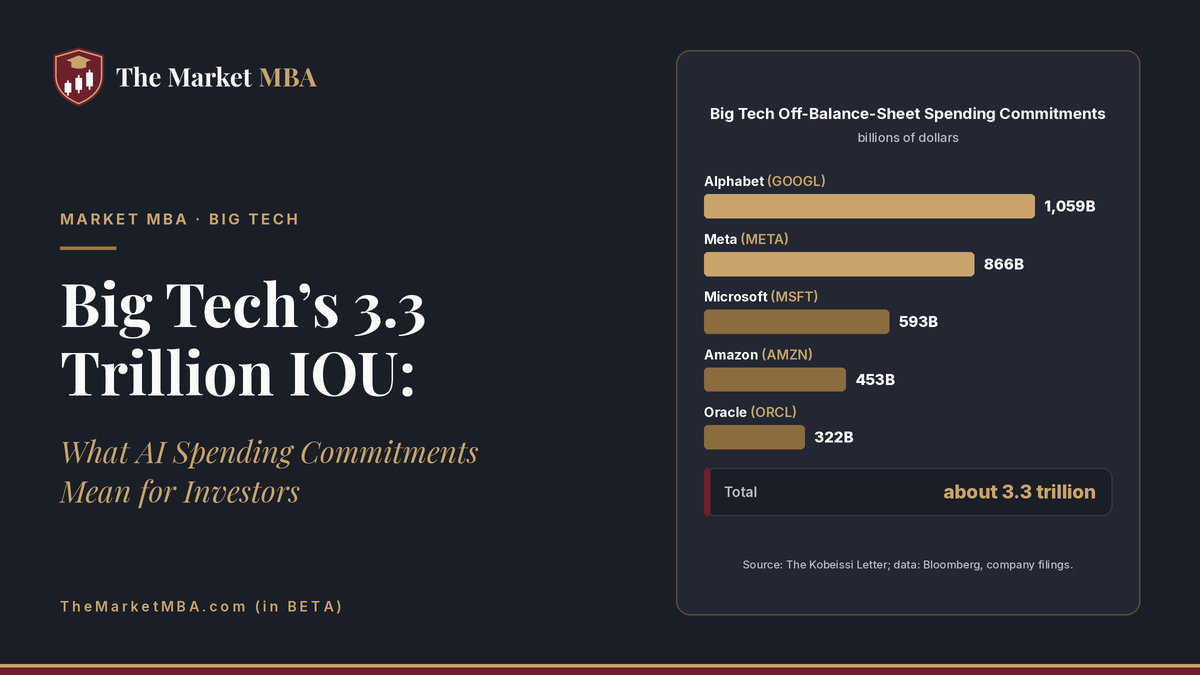
On November 3, The Kobeissi Letter highlighted a record $3.3 trillion in such commitments across Alphabet (GOOGL), Meta (META), Microsoft (MSFT), Amazon (AMZN) and Oracle (ORCL). Its chart, sourced to Bloomberg and company filings, breaks the total down like this:
| Company | Commitments (Kobeissi/Bloomberg chart) |
|---|---|
| Alphabet (GOOGL) | $1,059 billion |
| Meta (META) | $866 billion |
| Microsoft (MSFT) | $593 billion |
| Amazon (AMZN) | $453 billion |
| Oracle (ORCL) | $322 billion |
| Total | about $3.3 trillion |
Source: The Kobeissi Letter on X (chart data: Bloomberg, company filings).
The figure builds on Bloomberg’s October 30 analysis, which found the five companies have committed “more than $3 trillion” across leases, buildings, energy and other equipment, split into about $1.3 trillion of future lease commitments and $1.9 trillion of other purchase commitments.
What the filings show
The company filings back up the big picture:
- Alphabet: Its latest 10-Q lists $924.4 billion of material purchase commitments not reflected on the balance sheet, plus $130.5 billion of future payments for leases that haven’t started yet. That’s about $1.05 trillion combined. Bloomberg says Alphabet’s total is nearly eight times what it was a year earlier. On the earnings call, CFO Anat Ashkenazi said these amounts “reflect the maximum contractual obligations” and that some agreements have “variable pricing and volume flexibility, which could result in lower spend.”
- Meta: Its 10-Q shows about $355.7 billion of leases not yet started (data centers, energy infrastructure, colocations and network infrastructure, with terms of up to 30 years) and $454.5 billion of non-cancelable contractual commitments. The second bucket is mostly third-party cloud capacity, servers and network infrastructure, energy agreements and Reality Labs hardware. Together that’s about $810 billion, before up to $14.7 billion of contingent cloud purchases. In July, Meta’s disclosed obligations were nearly $700 billion, according to Bloomberg.
- Amazon: Its 10-Q lists $164.9 billion of leases not yet started, $159.6 billion of property and equipment commitments and $94.8 billion of other unconditional purchase obligations (energy, digital media content and software).
- Microsoft and Oracle: The $593 billion and $322 billion figures come from the Kobeissi/Bloomberg chart. Bloomberg notes that Microsoft’s number comes from its annual report for the year ended in June, so it’s the oldest figure in the set. Oracle relies heavily on a single customer, OpenAI, whose contracts have added hundreds of billions of dollars to Oracle’s cloud backlog, according to Reuters.
For a sense of the pace: in August, Morgan Stanley put the hyperscalers’ commitments at more than $2.7 trillion, or about three years of their operating cash flow. One caveat: each company discloses these numbers differently, and some totals include content licenses or consumer hardware, which Bloomberg says makes them difficult to compare directly.
Meanwhile, the spending itself keeps rising
Latest-quarter capex and guidance:
| Company | Latest-quarter capex | Outlook |
|---|---|---|
| Alphabet | $51.4 billion | 2026 held at $195–205 billion; expects capex “to increase significantly in 2027” |
| Amazon | $77.3 billion | About $220 billion in 2026; expects to “spend meaningfully more in 2027” |
| Microsoft | $45.2 billion including finance leases | About $170 billion for the calendar year, citing delays at third-party capacity providers |
| Meta | $34.91 billion including finance lease principal | 2026 range narrowed to $135–145 billion |
We walked through Alphabet’s quarter line by line in Alphabet (GOOGL) Q3 2026 earnings.
Why it matters for investors
1. Cash flow is under pressure
Free cash flow (cash from operations minus capex) is what’s left for dividends, buybacks and a safety cushion. It’s now negative at several of these giants:
- Alphabet: −$9.07 billion in Q3. The next day the stock fell about 13%, which CNBC called the steepest drop on record. Yahoo Finance’s daily price history back to the 2004 IPO agrees: the −12.6% close on October 29 is GOOGL’s largest one-day percentage decline (Yahoo Finance; our calculation).
- Meta: −$2.12 billion in Q3.
- Amazon: −$42.4 billion over the trailing 12 months.
- Microsoft is the exception so far, still positive at $18.63 billion for its fiscal first quarter.
2. More borrowing and stock sales are likely
S&P Global revised Meta’s outlook to negative. It forecasts free operating cash flow deficits of $39 billion in 2026 and $71 billion in 2027, and Reuters reports Meta plans to sell $97.5 billion in stock to fund the AI buildout. Prices for Meta’s five-year credit default swaps, a measure of the cost of insuring its debt against default, reached all-time highs. Oracle says it needs up to $20 billion more in funding, split evenly between debt and equity, and expects free cash flow to turn positive in the second half of fiscal 2028.
3. Depreciation is coming
When a company buys a server, it spreads the cost over the server’s useful life as an annual expense called depreciation, and that expense reduces reported profit. Alphabet says about 65% of its Q3 technical infrastructure spending went to servers and networking equipment, which generally have useful lives of six years. Microsoft says about 75% of its capex is now tied to short-lived assets such as CPUs and GPUs. Today’s buildout becomes tomorrow’s expense on the income statement, which is why it matters when you estimate what a stock is worth.
4. The bull case is demand
Microsoft CFO Amy Hood said, “We still have demand that exceeds supply,” and Amazon CEO Andy Jassy said AWS can grow “north of 40%” in each of 2027 and 2028. The question isn’t whether demand exists today. It’s whether AI revenue grows fast enough to cover trillions of dollars in promises that are hard to walk away from. When expectations are this high, disappointments get punished, which is a big part of why the hottest stocks fall the hardest.
What to watch
- 2027 capex guidance on the Q4 calls in late January and early February.
- New bond and stock issuance by Meta, Oracle and Alphabet.
- Whether next quarter’s commitment disclosures keep climbing.
- Whether depreciation starts to squeeze operating margins.
What we said on X
We covered Alphabet’s post-earnings drop live on X: GOOGL got smoked after earnings, down 11%+, and in our October 29 close update.
Sources
- The Kobeissi Letter on X, Big Tech off-balance-sheet commitments chart (Nov. 3, 2026): https://x.com/KobeissiLetter/status/2117424042944721041
- Bloomberg, “Big Tech Holds $3 Trillion in Spending Commitments for AI Boom” (Oct. 30, 2026): https://www.bloomberg.com/news/articles/2026-10-30/big-tech-holds-3-trillion-in-spending-commitments-for-ai-boom (syndicated on Yahoo Finance: https://finance.yahoo.com/technology/ai/articles/big-tech-holds-3-trillion-192531716.html)
- Alphabet Form 10-Q for the quarter ended Sept. 30, 2026: https://www.sec.gov/Archives/edgar/data/1652044/000165204426000084/goog-20260930.htm
- Meta Form 10-Q, commitments and contingencies note: https://www.sec.gov/Archives/edgar/data/1326801/000162828026066773/R18.htm
- Amazon Form 10-Q, commitments and contingencies note: https://www.sec.gov/Archives/edgar/data/1018724/000101872426000040/R11.htm
- Alphabet Q3 2026 earnings call transcript (StockAnalysis): https://stockanalysis.com/stocks/googl/transcripts/712854-q3-2026/
- Amazon Q3 2026 earnings call transcript (StockAnalysis): https://stockanalysis.com/stocks/amzn/transcripts/720308-q3-2026/
- Microsoft fiscal Q1 2027 earnings call transcript (The Motley Fool): https://www.fool.com/earnings/call-transcripts/2026/10/29/microsoft-msft-q1-2027-earnings-call-transcript/
- CNBC on Alphabet (Oct. 28 and Oct. 29), Amazon (Oct. 29), Microsoft (Oct. 28) and Meta (Oct. 22) earnings: https://www.cnbc.com/2026/10/28/alphabet-googl-earnings-q3-2026.html, https://www.cnbc.com/2026/10/29/alphabet-google-search-ai-earnings.html, https://www.cnbc.com/2026/10/29/amazon-amzn-q3-earnings-report-2026.html, https://www.cnbc.com/2026/10/28/microsoft-msft-q1-earnings-report-2027.html, https://www.cnbc.com/2026/10/22/meta-stock-q3-earnings-free-cash-flow.html
- Meta Q3 2026 results: https://investor.atmeta.com/investor-news/press-release-details/2026/Meta-Reports-Third-Quarter-2026-Results/default.aspx
- Quartz on Meta’s commitments: https://qz.com/meta-825-billion-lease-contract-commitments-ai-102226
- Reuters on S&P’s Meta outlook and on Oracle’s financing plan (via Investing.com): https://www.investing.com/news/stock-market-news/sp-global-revises-outlook-on-meta-to-negative-on-cashflow-concerns-4988756, https://www.investing.com/news/stock-market-news/oracle-expects-to-turn-cash-flow-positive-in-second-half-of-fiscal-2028-4980458
- Bloomberg Tax on Morgan Stanley’s commitments estimate (Aug. 25, 2026): https://news.bloombergtax.com/financial-accounting/ai-related-off-balance-sheet-commitments-top-3-trillion-ms
- Yahoo Finance, GOOGL price history: https://finance.yahoo.com/quote/GOOGL/history/
- Sums and percentage changes marked as our calculation: The Market MBA, from the figures above
🌐 MrFlourishinvests.com (in BETA) – Daily market moves, stock ideas, and money flow from MrFlourish and Team.
🌐 TheMarketMBA.com (in BETA) – Plain-English lessons on how markets, investing, and money really work crafted by MrFlourish and Team.
NFA
For education only. Not financial, investment, legal or tax advice.
For education and entertainment only. Not financial advice.