 The Market
By Chief Editor Clark for The Market MBA
CoreWeave beat revenue forecasts and raised its outlook after the bell on Tuesday. The same report showed that its interest bill was about four times its operating profit. Here is how to read an earnings report from a company growing on borrowed money, and why the stock’s after-hours jump turned into a loss during the call.
The setup
CoreWeave (CRWV) rents out Nvidia-powered computing to AI labs and big tech companies. Investors call companies like it “neoclouds”: newer cloud providers built mainly for AI. It buys chips and data center capacity up front, mostly with borrowed money, and gets paid back over multi-year customer contracts.
That model works when money is cheap and demand is strong. It gets tested when borrowing costs rise. Going into the report, CoreWeave stock had lost more than 40% in a month (CNBC), some of its bond yields had topped 16% (CNBC), and its 2032 bonds had traded as low as 74.75 cents on the dollar after last week’s midterms (Investing.com). On Tuesday a hotter-than-expected October CPI pushed the 10-year Treasury yield above 5% during the session before it settled just under, near 4.99% (CNBC).
What CoreWeave reported
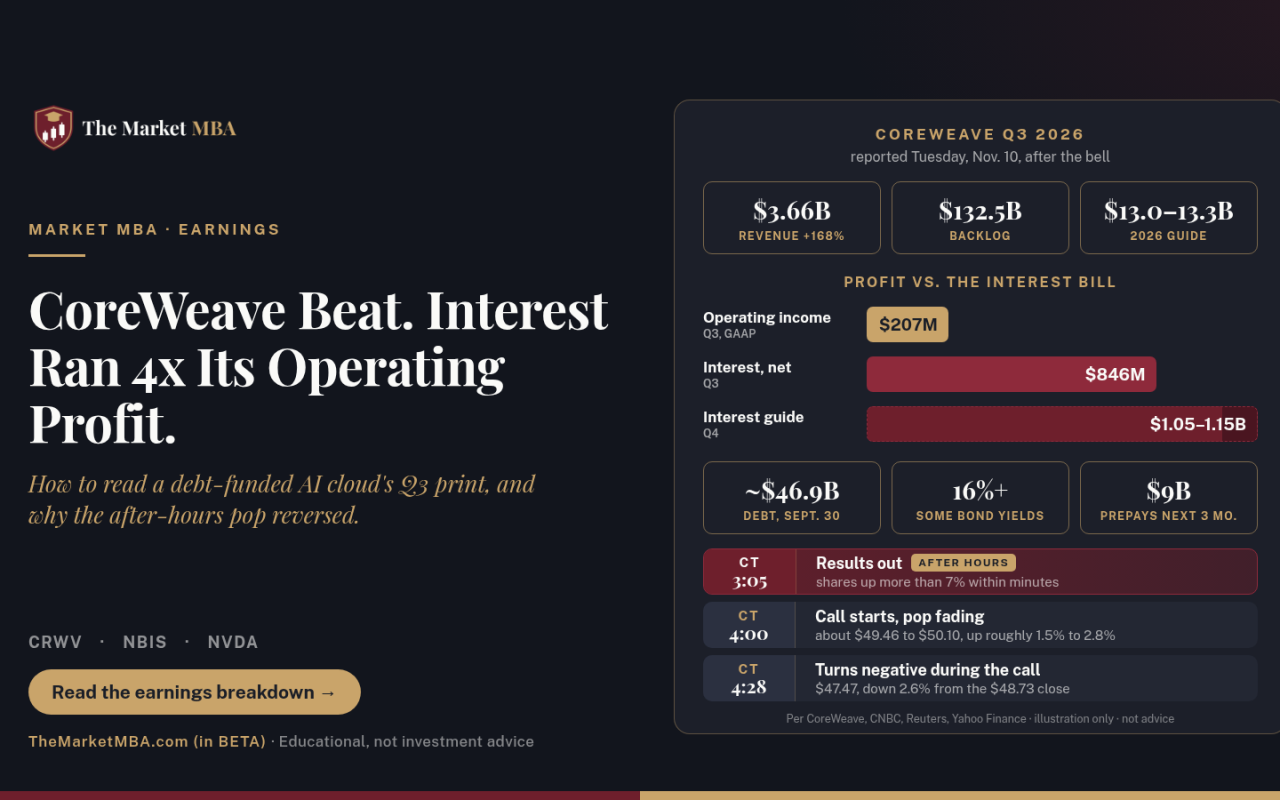
- Revenue: $3.661 billion, up 168% from $1.365 billion a year ago and more than $1 billion higher than the prior quarter. That beat the LSEG consensus of $3.55 billion (CoreWeave; CNBC) and the company’s own forecast of $3.45 billion to $3.60 billion (Stock Titan).
- Loss per share: a GAAP net loss of $709 million, or $1.27 per share, versus $110 million, or $0.22, a year ago. Estimates varied: LSEG had a $1.16 loss (CNBC said it was not clear the numbers were comparable), Bloomberg data had $1.46 (Yahoo Finance), and Zacks had $1.16. On an adjusted basis the loss was $1.00 per share (AP).
- Profit before interest: operating income of $207 million (a 6% margin) and adjusted operating income of $379 million (10%), ahead of the company’s own $200 million to $260 million forecast. Adjusted EBITDA was $2.256 billion, a 62% margin (CoreWeave; Stock Titan).
- Interest expense: $846 million, up from $310 million a year ago and slightly below the company’s $860 million to $940 million forecast (Stock Titan).
- Backlog: about $132.5 billion of contracted future revenue, up from $104 billion at the end of June (CNBC).
- Power: more than 1.7 gigawatts active and over 4.6 gigawatts contracted (CoreWeave).
What CoreWeave expects next
- 2026 revenue: raised to $13.0 billion to $13.3 billion, from $12.4 billion to $13.2 billion in August. LSEG analysts expected $12.86 billion (CNBC).
- 2026 adjusted operating income: raised to $1.275 billion to $1.375 billion, 26% higher at the midpoint, versus the $1.07 billion Visible Alpha analysts expected (CNBC).
- Exit run-rate: $20 billion to $21 billion of annualized revenue by the end of 2026 (CoreWeave).
- Capital spending: $37 billion to $39 billion for 2026, raising the low end of the old $35 billion to $39 billion range because it expects to deliver capacity sooner (CoreWeave).
- Fourth-quarter interest expense: $1.05 billion to $1.15 billion (CoreWeave).
Lesson 1: Read the income statement from the bottom up
For most companies, operating income is the headline profit number. For a company that borrows heavily to build, the line underneath it matters just as much. CoreWeave earned $207 million from operations in the third quarter and paid $846 million in net interest, so interest was about 4.1 times operating income. Add other items and taxes, and that gap is the $709 million net loss.
Adjusted EBITDA of $2.256 billion looks far healthier, because it leaves out depreciation ($1.889 billion in the quarter) and interest. Neither cost is optional for CoreWeave: the chips wear out and the loans have to be paid. EBITDA tells you whether the customers are profitable to serve. It does not tell you whether the company makes money after paying for the equipment and the debt.
Lesson 2: Size the debt and its price
CoreWeave’s debt was about $46.9 billion on Sept. 30, up from $35.1 billion at the end of June, and $10.6 billion of it is due within a year (Stock Titan; CoreWeave balance sheet). In the quarter, operations brought in about $1.98 billion of cash, while purchases of property and equipment were $9.44 billion. The gap was covered mostly by new borrowing: $10.3 billion raised and $2.3 billion repaid (CoreWeave cash flow statement).
Here is a rough way to think about the cost. Third-quarter net interest of $846 million, multiplied by four, is about $3.4 billion a year. Spread over about $47 billion of debt, that is roughly 7% on average. The newest money is far more expensive at the margin: some bond yields recently topped 16% in the market. That yield is not what CoreWeave pays on existing bonds, but it is a signal of what lenders would demand for new unsecured debt. CoreWeave sold unsecured notes with a 9.75% coupon in April and a 9.625% coupon in June; by Nov. 6 those 2032 notes yielded more than 16%, according to TIKR. Secured money is much cheaper: in March it closed an $8.5 billion investment-grade loan backed by GPUs and a customer contract, with its fixed tranche at about 5.9%. As of June, unsecured notes and convertibles were $16.6 billion of $35.6 billion in borrowings (TIKR). On report day, Reuters put the yield on CoreWeave’s 2030 bonds at about 15.2% and its five-year credit-default swaps, a price for insuring against default, at 1,135 basis points (Reuters via U.S. News). When the 10-year Treasury, the base rate for nearly all lending, is near 5%, a 16% yield means investors want roughly 11 percentage points of extra pay for the risk.
CoreWeave is leaning on cheaper channels. In the quarter it sold about $4.2 billion of convertible bonds paying 2.875% (bonds that can later turn into shares), set up a program to sell up to 35 million new shares over time, and closed a $2.6 billion loan facility for shorter customer contracts (CoreWeave; Stock Titan). Convertibles carry a low coupon because buyers get a share of the upside, which means possible dilution for today’s shareholders. Stock Titan reports the company said the share program supports its goal of moving its credit rating toward investment grade.
Lesson 3: Customer cash is a funding source too
CEO Michael Intrator pointed to a third source: “approximately $9 billion in customer prepayments and deposits expected in the next three months alone” (CoreWeave). Prepayments show up on the balance sheet as deferred revenue, which rose by $2.1 billion in the quarter. That money is not debt and carries no interest, but it is an obligation to deliver capacity. If customers pay up front, the company needs to borrow less to build for them.
Intrator made the same case in a statement quoted by Reuters: “Customer contracts come first, and investment follows. Because CoreWeave’s investments are tied to committed demand, lenders have something concrete to lend against and customers typically help fund the buildout through prepayments” (Reuters via U.S. News). That is the key argument for a lender: debt backed by a signed contract with a large customer is safer, and cheaper, than debt backed only by CoreWeave’s promise to pay.
That is why the guidance on interest matters. Fourth-quarter interest of $1.05 billion to $1.15 billion is about 24% to 36% above the third quarter’s $846 million. The bet is that revenue and operating profit grow faster than the interest bill as new capacity comes online. The raised operating income guidance says management thinks it will. The fourth-quarter interest guide says the bill keeps climbing in the meantime.
What management said on the call
The call began at 4 p.m. CT, and the funding question came up right away. Here is what CNBC reported from it (CNBC):
- How 2027 gets paid for. Intrator told analysts that CoreWeave will get most of the capital it needs for 2027 from customer prepayments and from financing provided by hardware partners, and that the company will raise “a limited amount” itself. For a company whose unsecured bonds yield around 15% to 16%, that answer matters: the less it has to borrow in the open market, the less those yields set its cost of growth.
- A construction slowdown as an upside case. Asked about pushback on data center building after last week’s elections, Intrator said: “If data center construction across the sector were to slow, installed compute becomes scarcer, and the knock-on effect is that GPU pricing may stay higher for longer.” He said the company does not expect risks to its 2027 deliveries, based on construction at locations that are already permitted.
- The outside view. “The business can execute well and still face a tougher financing environment,” Joe Tigay, portfolio manager at Equity Armor Investments, told CNBC. “Strong demand is encouraging; the cost and availability of capital remain critical.”
The lesson: “Most of our funding comes from customers and partners” is a claim you can check. Watch deferred revenue on the balance sheet and the financing section of the cash flow statement next quarter. If prepayments rise and new borrowing slows, the plan is working. A full call transcript will be posted on CoreWeave’s investor relations site.
How the stock reacted after the bell
CoreWeave stock closed the regular session at $48.73, down 0.5% on the day, after trading between $47.06 and $51.02 on volume of about 75 million shares, almost twice its average (Yahoo Finance). The results came out at about 3:05 p.m. CT.
- The first reaction: within minutes, Reuters reported the shares up more than 7% in extended trading (story time-stamped 3:09 p.m. CT), and TradingKey said they rose more than 8% at one point (Reuters via U.S. News; TradingKey).
- The fade: the gain then narrowed. TradingKey later had the stock up about 1.8% at $49.60, and Investing.com described trading as choppy, last up about 2% (Investing.com).
- About an hour in: as the 4 p.m. CT call began, Yahoo Finance quotes showed the stock around $49.46 to $50.10, up roughly 1.5% to 2.8% from the close (Yahoo Finance). Nebius, which reports Thursday, rose about 2% in sympathy (Investing.com).
- During the call: the gain disappeared. By 4:28 p.m. CT, Yahoo Finance showed the stock at $47.47, down 2.6% from the regular close, and CNBC updated its story to say the shares slipped in extended trading (Yahoo Finance quote; CNBC).
How to read that: a fast spike followed by a reversal usually means the headline numbers were better than feared, but the details gave buyers pause. Here, the beat and raise were clear. The debt load, the rising interest guide and the cash still flowing out to build were enough for sellers to take back the whole pop once the call was underway. After-hours trading is also thin, so early moves can be exaggerated in both directions.
What to watch
- Bond prices, not just the stock. If CoreWeave’s bond yields fall from the 15% to 16% area, lenders are gaining confidence. That would lower its future borrowing cost more than any single quarter’s revenue beat.
- Interest versus operating income. The gap closing quarter by quarter is the clearest sign the model is working.
- Prepayments arriving. Whether the roughly $9 billion of expected customer prepayments and deposits shows up in the next three months.
- Treasury yields. A 10-year back above 5% raises the base cost of every loan in the AI buildout.
- Nebius on Thursday. Its results will show whether this was a CoreWeave story or a neocloud story.
The bottom line
CoreWeave’s demand story got stronger on Tuesday: revenue up 168%, a $132.5 billion backlog and higher guidance. Its financing story is still the main debate. Interest ran at about four times operating income, debt rose to about $47 billion, and the interest bill is guided higher again next quarter. For learners, the lesson is to read a debt-funded growth company from the bottom of the income statement up and to watch its bonds as closely as its stock. The after-hours round trip, from up more than 7% to down about 2.6% in under 90 minutes, suggests investors are doing exactly that.
Sources
- CoreWeave: Third Quarter 2026 results (Business Wire, Nov. 10, 2026)
- CNBC: CoreWeave beats on revenue and lifts guidance (Nov. 10)
- Yahoo Finance: CoreWeave stock pops as Q3 revenue beats estimates (Nov. 10)
- Yahoo Finance: CRWV quote, Nov. 10 close and after-hours
- TradingKey: CoreWeave Q3 after-hours reaction (Nov. 10)
- Investing.com: After-hours movers, CRWV and NBIS
- Stock Titan: CoreWeave Q3 2026 earnings versus its own forecast
- Investing.com: Can AI revenue growth justify CoreWeave’s debt? (preview)
- AP: CoreWeave Q3 earnings snapshot
- Reuters via U.S. News: CoreWeave beats quarterly revenue estimates (Nov. 10)
- TIKR: CoreWeave borrowed at 9%; its debt now yields 15% (Nov. 9)
- CNBC: Treasury yields after October CPI (Nov. 10)
Not financial advice. This article is for educational purposes only. Nothing here is a recommendation to buy or sell any security.
For education and entertainment only. Not financial advice.