 The Market
Eleven days after Jensen Huang resigned, Nvidia’s board brought him back, and the market answered with one of its biggest days in years. Here is what the reversal teaches about key-person risk, why one company can move an entire index, and why a relief rally does not close the open questions.
By Cooper · The Market MBA · Monday, Nov. 23, 2026
What happened
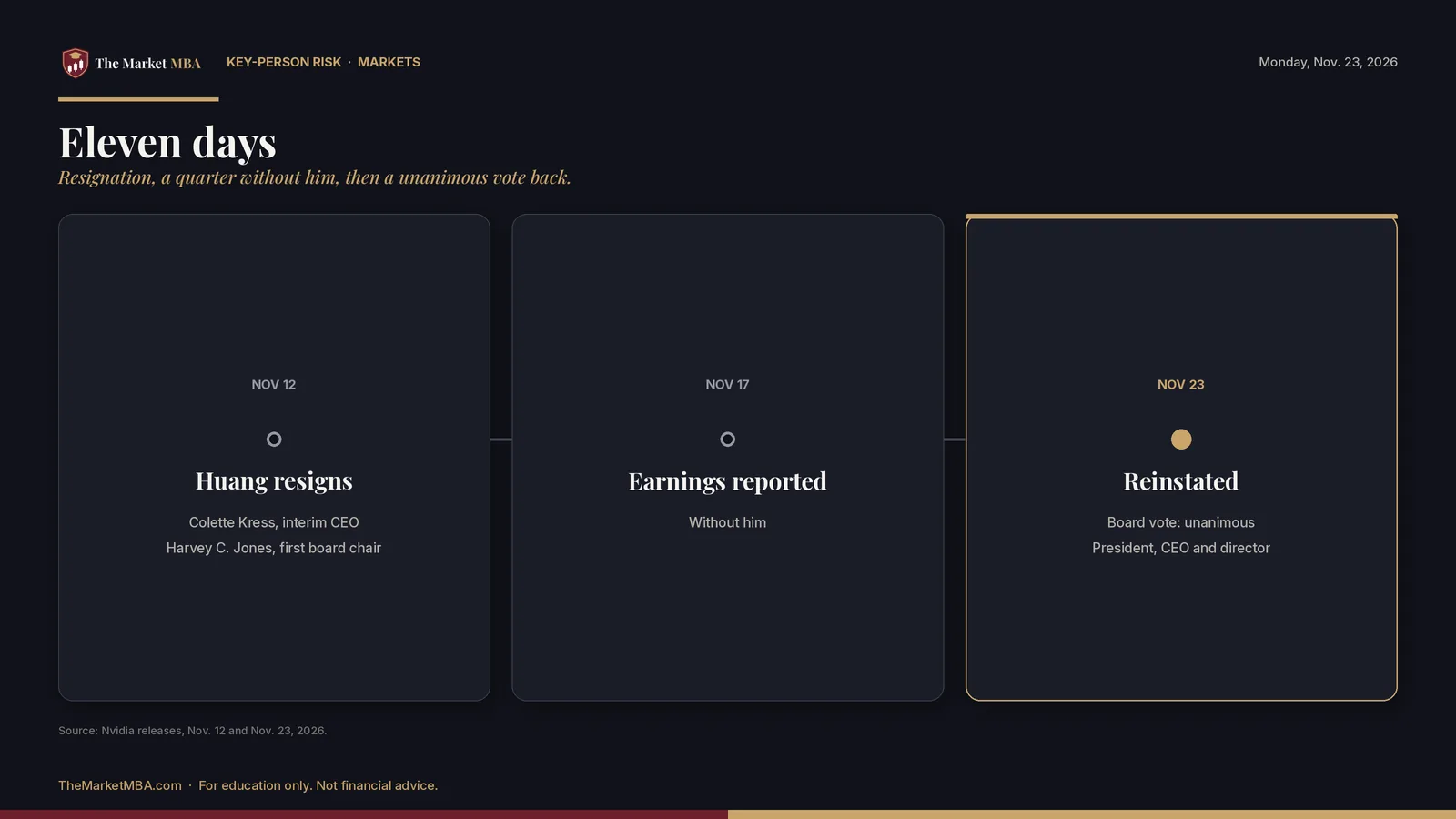
On Nov. 12, Nvidia announced that Jensen Huang had resigned as president, CEO and a board member, effective immediately. CFO Colette Kress became interim CEO, and Harvey C. Jones was named the company’s first-ever board chair (Nvidia).
This morning the same board voted unanimously to reinstate Huang to all three roles, effective immediately. In its release, the board said it was “satisfied with respect to Mr. Huang’s candor and ability to lead NVIDIA.” It also said it “received input from senior levels of the United States government” and, based on that input, “is confident that Mr. Huang’s reinstatement poses no national security risk.” Kress stays on as CFO and Jones stays on as chair (Nvidia).
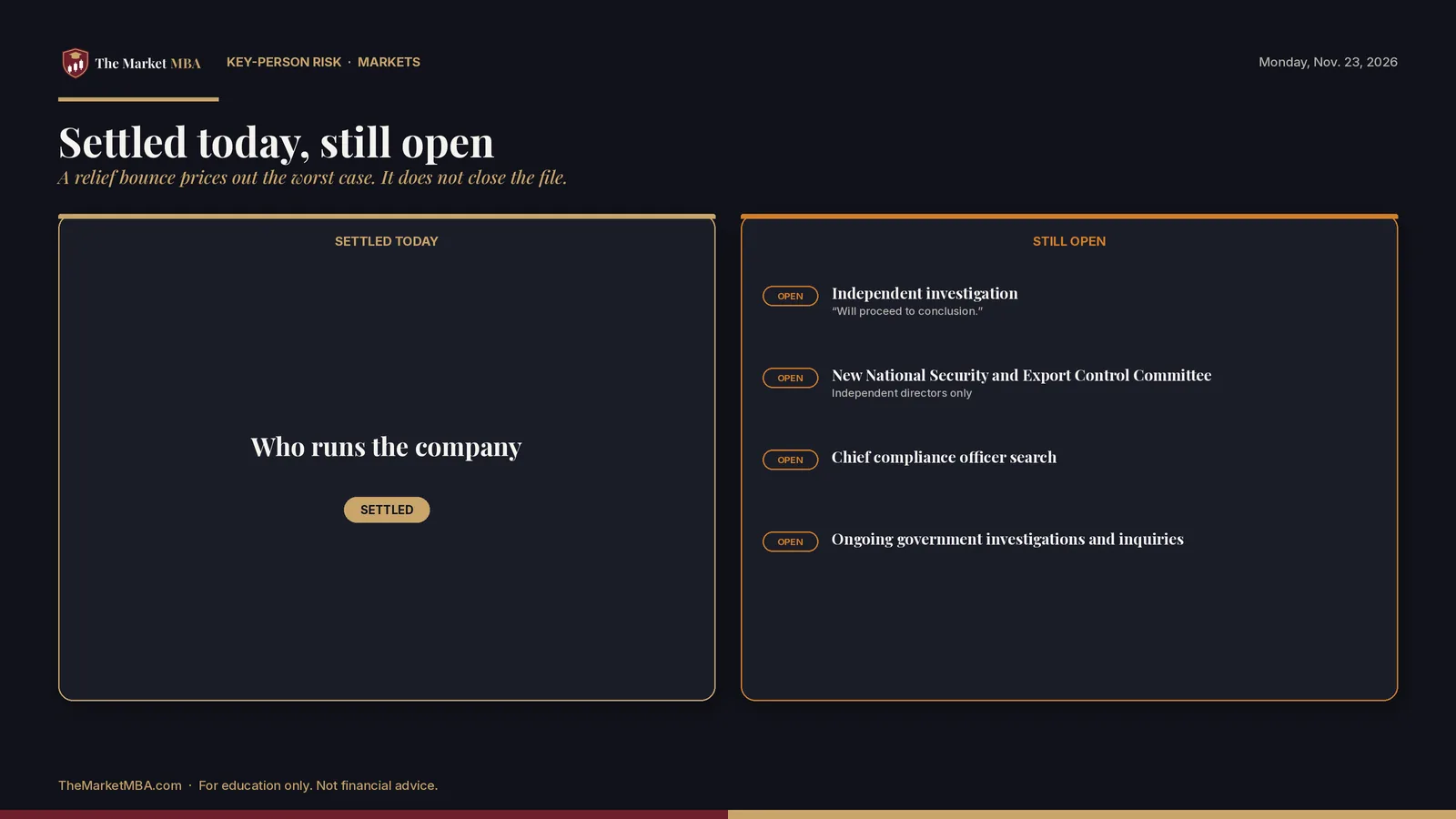
Three other lines in that release matter just as much. The independent directors’ investigation, opened after reporting that Huang had been “the target of a foreign intelligence effort,” will “proceed to conclusion.” The board has formed a new National Security and Export Control Committee made up only of independent directors. And Nvidia is searching for its first chief compliance officer. President Trump told CNBC he spoke with the board and “convinced” it to bring Huang back, and that Huang “did nothing wrong.” That is the president’s account. Nvidia’s release does not say it (CNBC).
The market’s answer, at the close
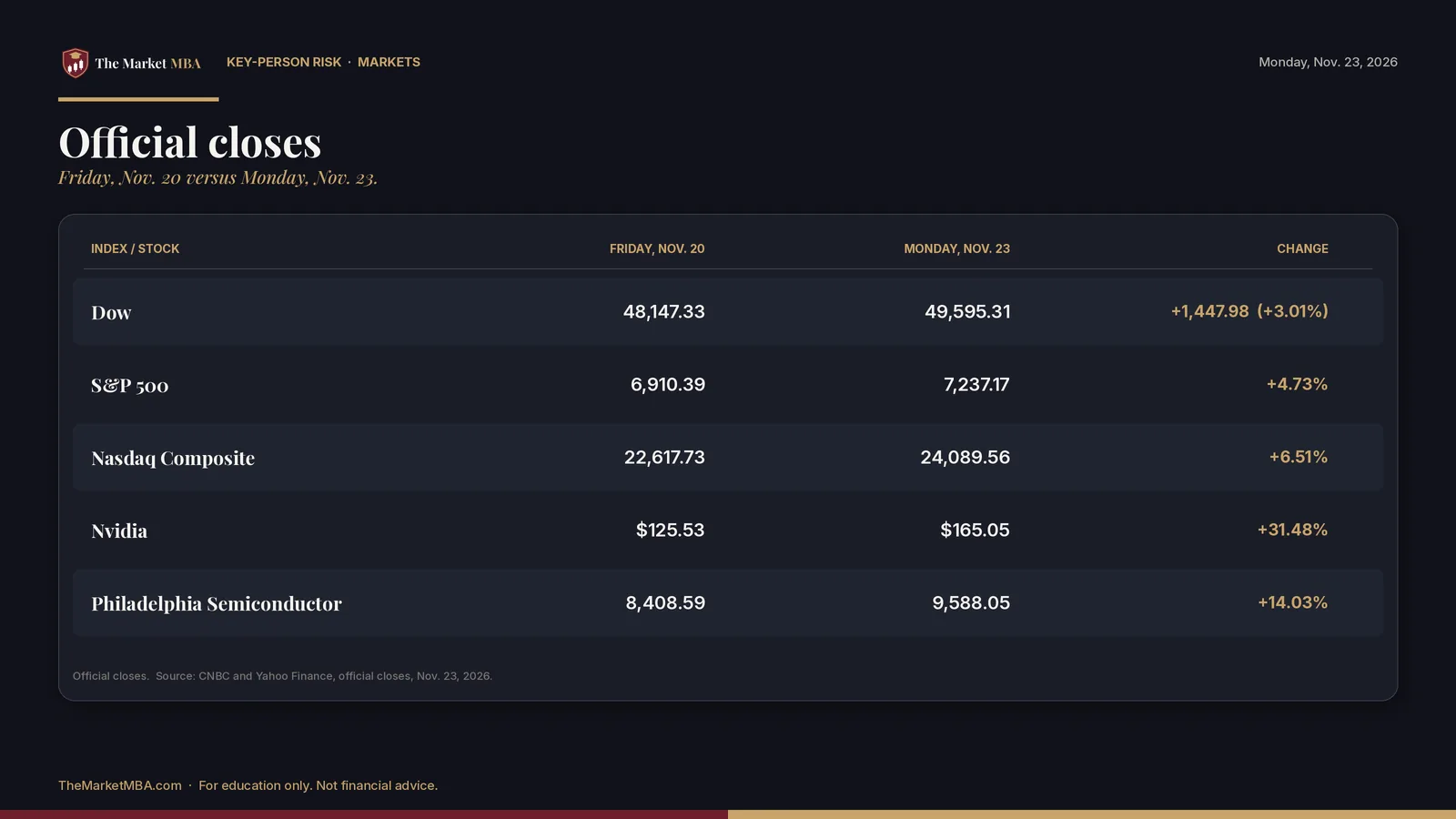
The reaction was immediate. By mid-morning, Reuters had the S&P 500 and the Nasdaq on track for their biggest one-day gains since the April 2025 tariff-pause rally (Reuters via Investing.com). By the close, Nvidia had finished up 31.48% at $165.05, and the Philadelphia Semiconductor Index had closed up 14.03% at 9,588.05.
The broad indexes followed. The S&P 500 closed up 4.73% at 7,237.17, the Nasdaq Composite closed up 6.51% at 24,089.56, and the Dow closed up 1,447.98 points, or 3.01%, at 49,595.31. That comes one trading day after the worst week for the Dow since March 2020.
What key-person risk actually means
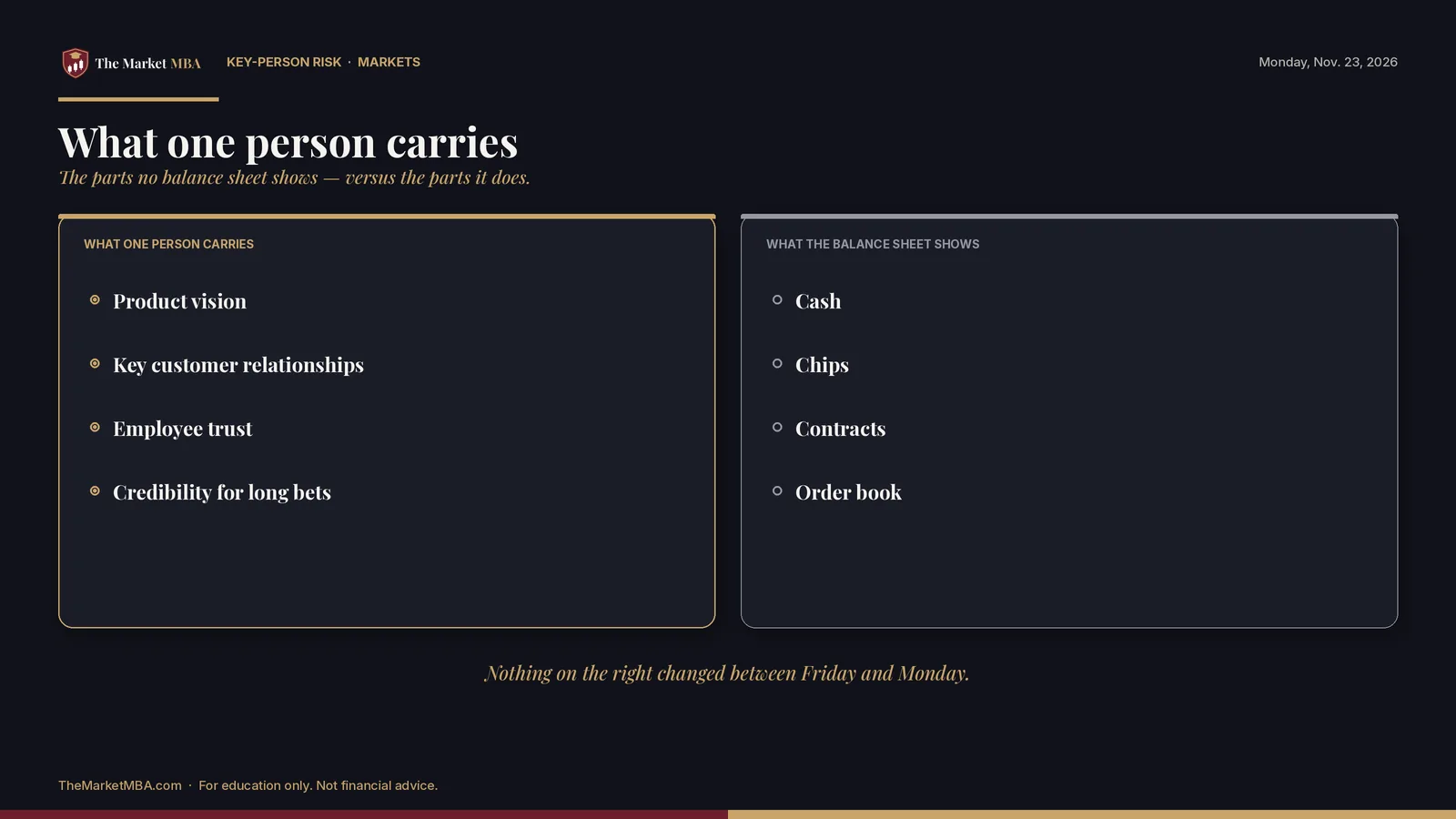
Key-person risk is the chance that a business loses much of its value because it loses one specific person. It gets large when one person carries things no balance sheet shows: the product vision, key customer relationships, employee trust and the credibility to make long, expensive bets.
Founders who are still CEO are the classic case. Huang co-founded Nvidia and ran it for 33 years. When he left without warning, investors had no successor plan to price, only an interim CEO and a search. That uncertainty lands on the valuation even if the next quarter is fine. Nvidia proved that point itself on Nov. 17 by reporting a strong quarter without him, and it still did not stop the slide.
Today ran the same lesson in reverse. Nothing about Nvidia’s chips, customers or order book changed between Friday’s close and this morning. What changed was who runs the company. A move of 31.48% in a single session is the market putting a price on one person.
Why one company can move the whole index
Most index funds weight each company by its market value, so the more a company is worth, the more of your fund it takes up. Nothing in the S&P 500 rules caps a single stock, so its share simply rises and falls with its price.
That is why Nvidia’s weight has swung so hard. Based on State Street’s daily holdings for its S&P 500 fund, Nvidia was about 8.19% of the index on Sept. 24 and about 6.30% on Nov. 10 (CalculatorAI, from SPY holdings). As of Friday, Nov. 20, iShares’ S&P 500 fund held it at about 5.10%, behind Apple and Microsoft (Equibles, from IVV holdings). No fund sold a share to get there. The price did all of it.
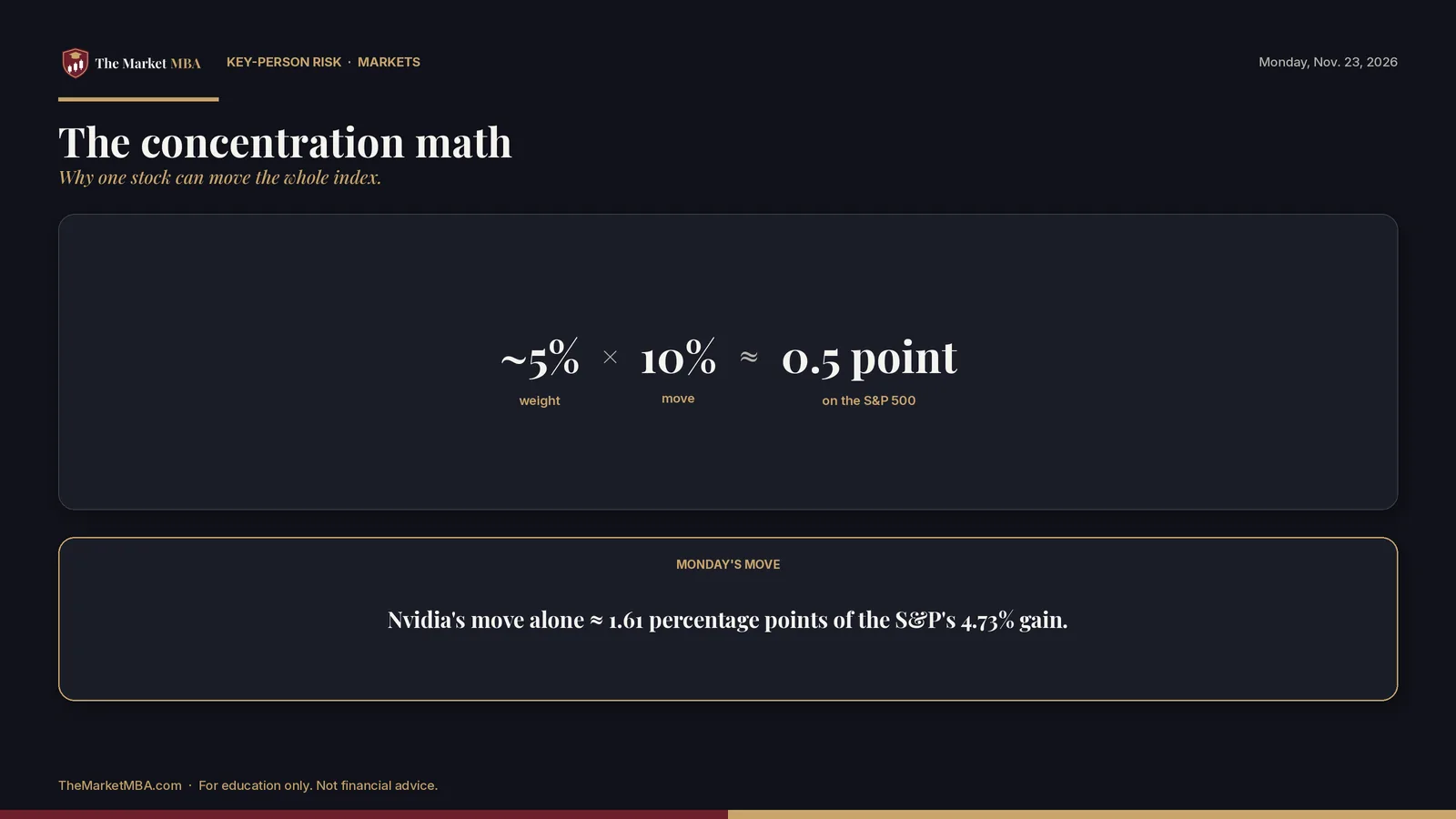
The math works the same way going up. At about a 5% weight, every 10% move in Nvidia is worth roughly half a percentage point on the S&P 500 all by itself, before you count the chip suppliers, cloud companies and power names that trade with it. Today Nvidia’s move alone was worth about 1.61 percentage points of the index’s 4.73% gain.
This is concentration risk, and it goes both ways. If you own a plain S&P 500 or Nasdaq fund, you own a real slice of Nvidia’s key-person risk whether you meant to or not. The same thing that dragged on your fund for 11 days carried it today.
Why a relief bounce doesn’t settle anything
A relief rally is the market pricing out the worst case. On Friday the worst case looked like a founder-less Nvidia with no permanent CEO and an open national-security question. This morning the first half of that went away. The second half did not.
Read the board’s wording closely. It says it is confident Huang poses no national security risk, and it bases that on government input. It also says the investigation keeps going, that it is building a new committee to oversee export and national-security risk, and that it is hiring a chief compliance officer. Nvidia also says it “will continue to cooperate with ongoing government investigations and inquiries.” Companies do not build all of that around a question they consider closed.
A rally this sharp also leaves less room for error. If a later finding cuts the other way, the stock falls from a higher price and a bigger index weight.
What to watch from here
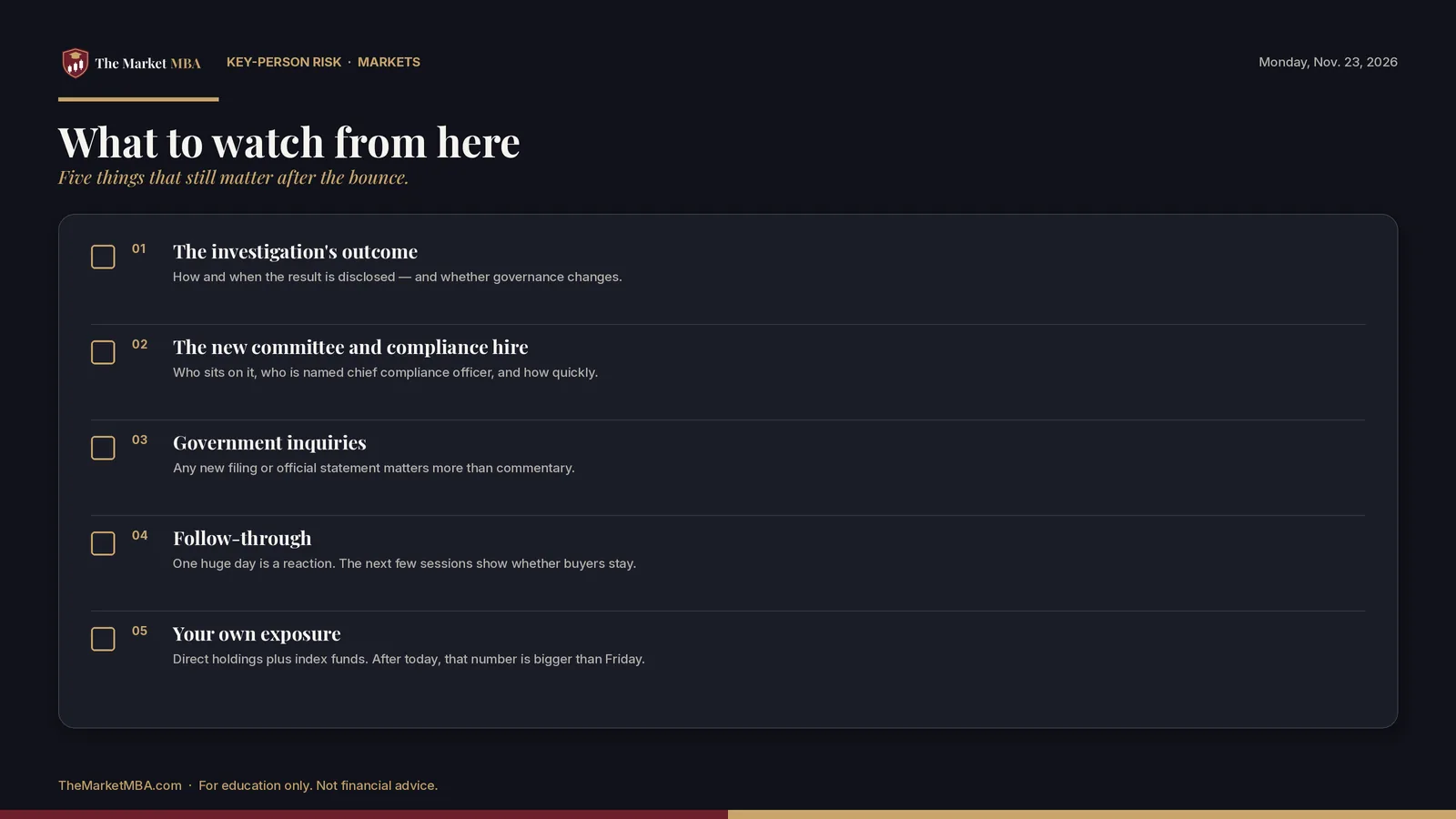
- The investigation’s outcome. The board says it will run to conclusion. Watch for how and when the result is disclosed, and whether it comes with any change in governance.
- The new committee and compliance hire. Who sits on the National Security and Export Control Committee, who is named chief compliance officer, and how quickly. Fast, credible appointments would lower the risk premium.
- Government inquiries. Nvidia says it is still cooperating with them. Any new filing or official statement matters more than commentary on either side.
- Follow-through. One huge day is a reaction, and the next few sessions show whether buyers stay.
- Your own exposure. Add up how much Nvidia you hold directly and through index funds. After today, that number is bigger than it was on Friday.
The takeaway
Nvidia spent 11 days showing how much one person can be worth to a company, and how far that value reaches into the indexes almost everyone owns. Today’s rally priced the return of the founder. It did not price an answer to the investigation, because there isn’t one yet. Keep those two things separate when the next headline lands.
Sources
- Nvidia, “NVIDIA Board Reinstates Jensen Huang as President, CEO and Board Director,” Nov. 23, 2026
- Nvidia, “NVIDIA Announces CEO Transition,” Nov. 12, 2026
- Reuters via Investing.com, Nov. 23, 2026 (intraday market moves)
- CNBC live updates, Nov. 23, 2026 (President Trump’s remarks)
- CalculatorAI, “How Much of the S&P 500 Is Nvidia?” (SPY holdings, Sept. 24 and Nov. 10, 2026)
- Equibles, S&P 500 constituents (IVV holdings, Nov. 20, 2026)
- CNBC, “Stock market news for Nov. 23, 2026” (S&P 500, Nasdaq Composite and Dow official closes), cross-checked with Yahoo Finance, Fox Business and RTT News; Nvidia official close from Yahoo Finance and Nvidia investor relations; Philadelphia Semiconductor Index official close from CNBC and Yahoo Finance
For education only. Not financial advice.
For education and entertainment only. Not financial advice.