 The Market
MrFlourish Invests | The Market MBA | Article 1 | Wednesday, Nov. 4, 2026
Overnight, traders treated the Democratic sweep like a wrecking ball aimed at the AI trade. By sunrise, the same traders were buying. The swing says more about how markets price fear than about politics.
Watch the lesson
The setup: a market braced for one night
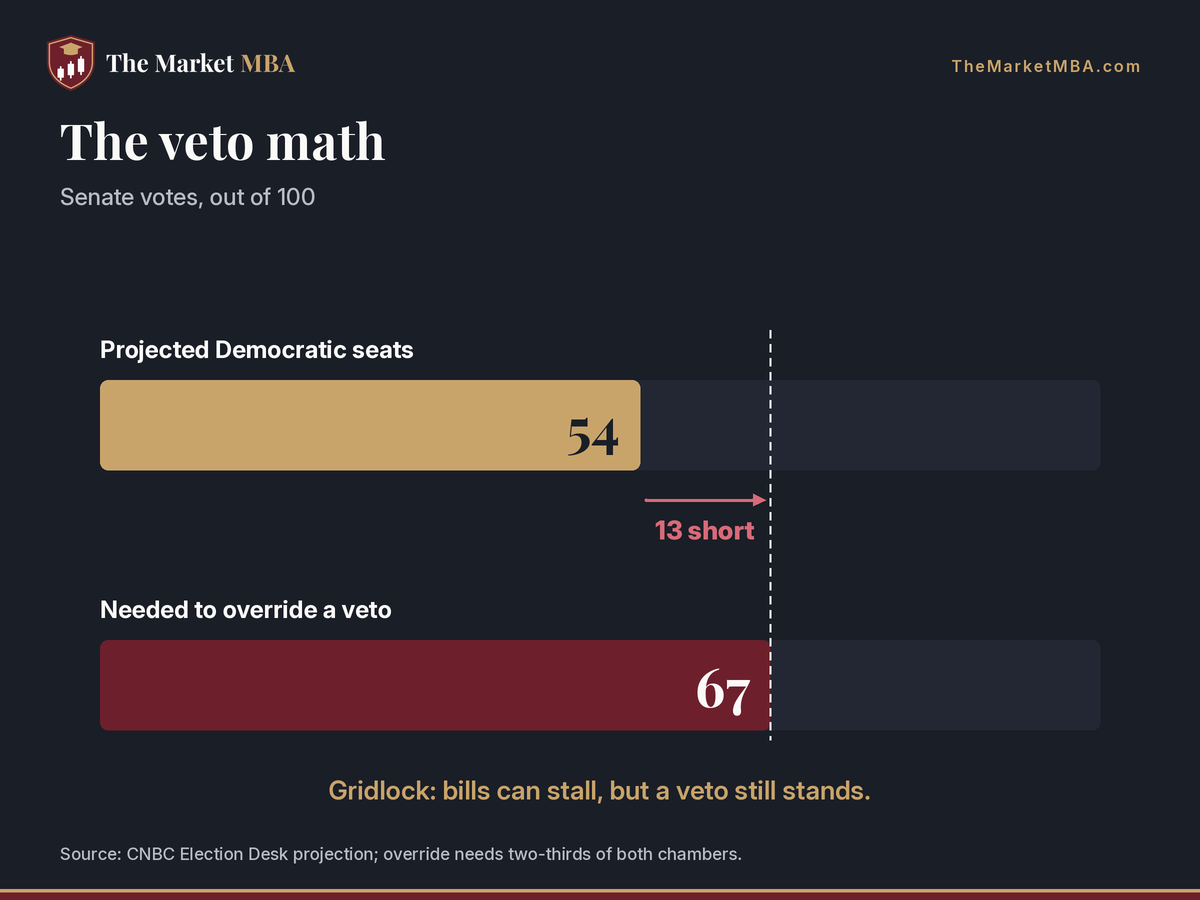
On Tuesday, voters handed Democrats control of the House and the Senate. CNBC’s Election Desk had the party on track for at least 250 House seats and 54 Senate seats early Wednesday. In Texas, Democrat Gina Hinojosa unseated Gov. Greg Abbott.
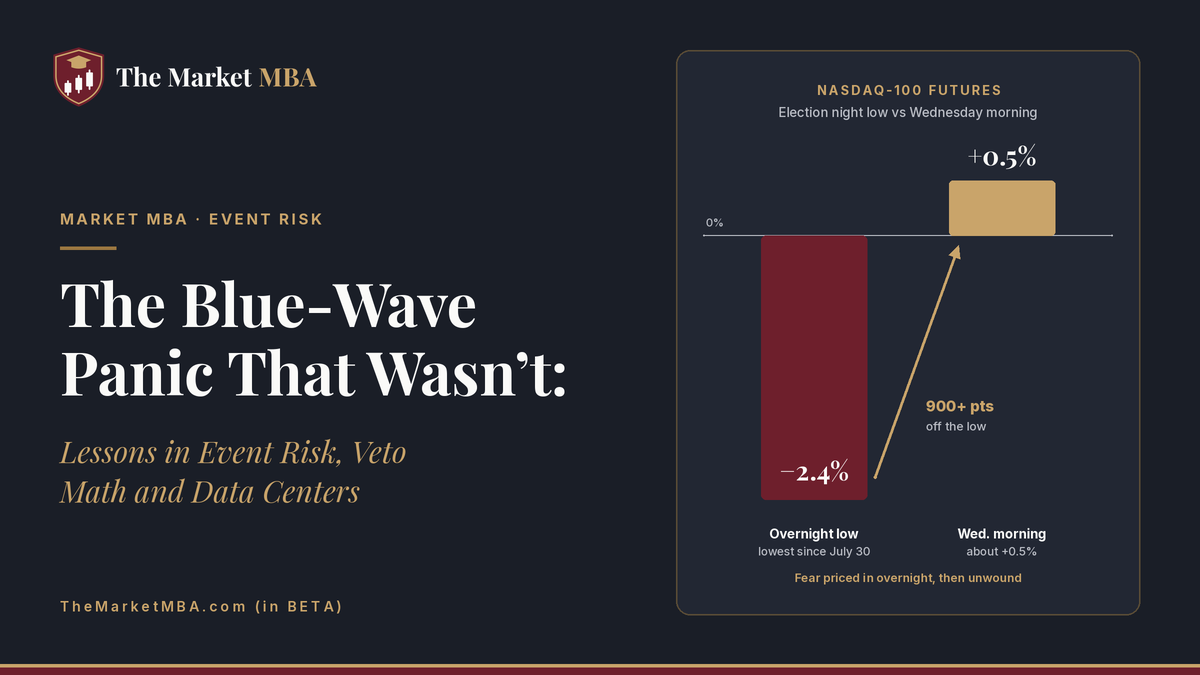
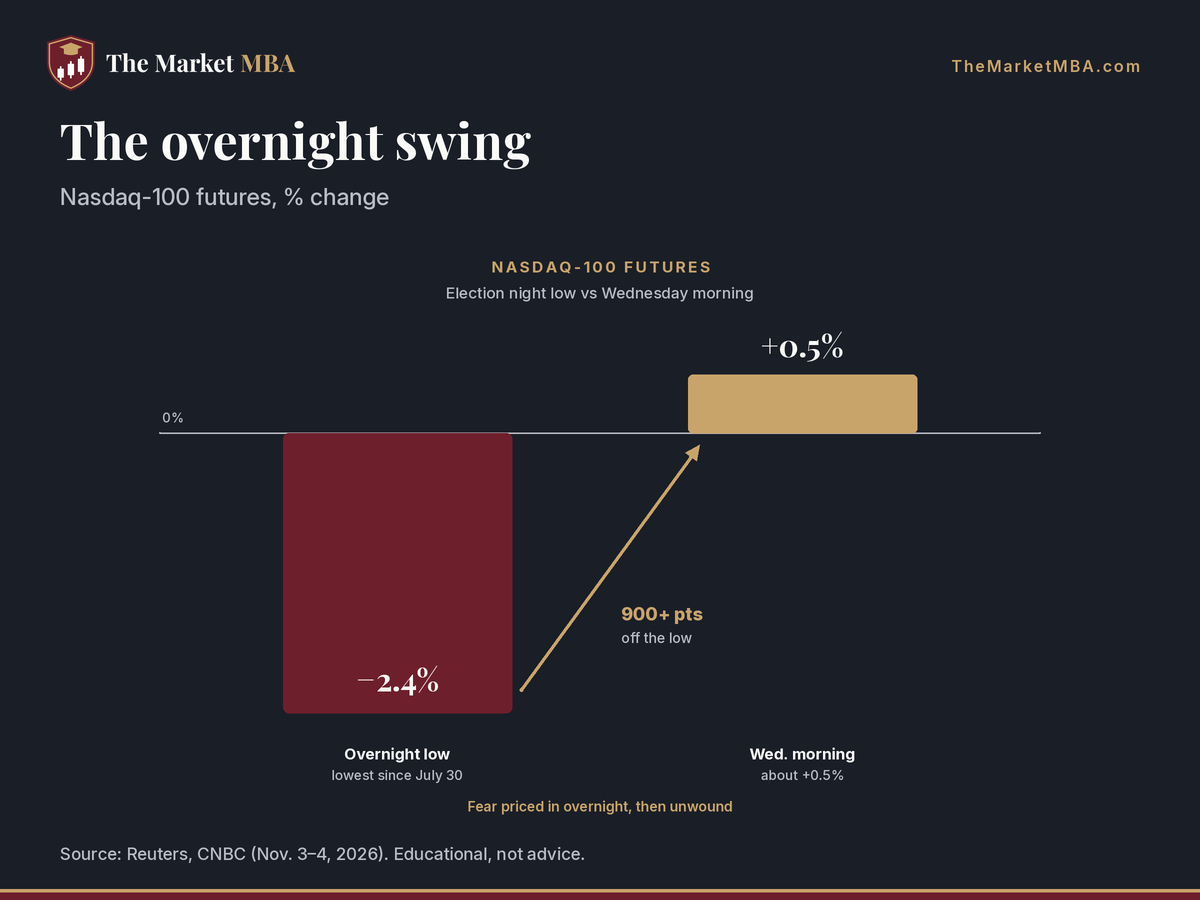
Texas matters to tech investors because Wells Fargo estimates the state accounts for about 27% of the nation’s data center gigawatts, as CNBC noted. Hinojosa campaigned on pausing new data centers until state lawmakers write rules. So when results rolled in, Nasdaq-100 futures fell as much as 2.4%, per Reuters, sinking to their lowest point since July 30, according to CNBC. Japan’s Nikkei dropped more than 4% at one stage, and Korean chip giants slid, hitting the KOSPI and $EWY.
What happened: the reversal
By early Wednesday, the picture had flipped. CNBC reported Dow futures up nearly 900 points, with S&P 500 futures near +1% and Nasdaq-100 futures about +0.5%. Nasdaq-100 futures had climbed more than 900 points off their overnight low. That puts $DIA, $SPY and $QQQ on track for a green open.
The larger rebound figures Bull Theory shared on X measure the bounce from the lows, not the daily change.
Lesson 1: Insurance gets cheap once the event is over
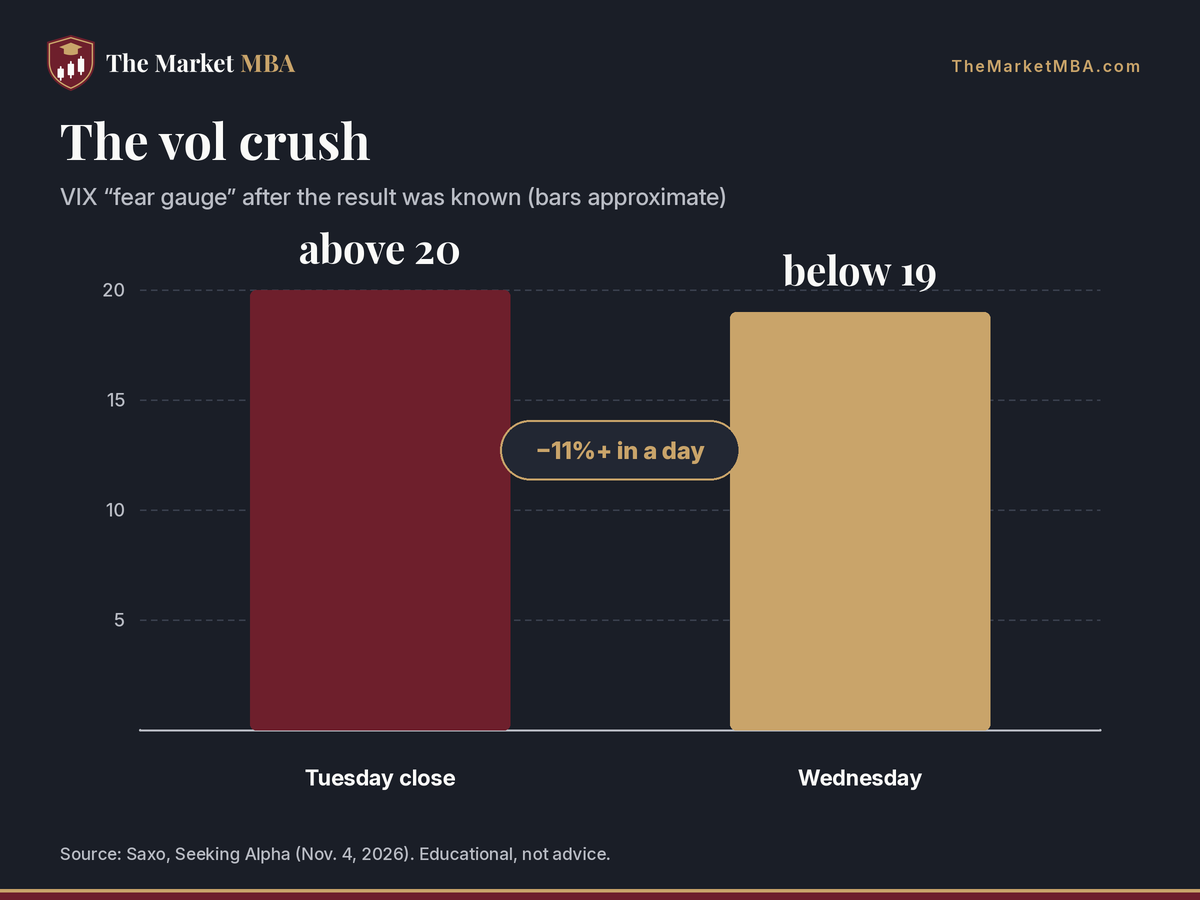
Gordon Johnson made a sharp point on X: much of the morning rally was mechanical. Before a known event, investors buy options as insurance, and that demand lifts the VIX, Wall Street’s “fear gauge.” Once the result is known, the insurance loses its value no matter who won. Traders call this a “vol crush.”
The data back him up. The VIX finished Tuesday above 20, according to Saxo, then fell more than 11% to below 19 on Wednesday, per Seeking Alpha. As hedges come off, the dealers who sold them buy back stock futures they had shorted, and that buying lifts prices. In Johnson’s words, it is “plumbing, not conviction.”
Lesson 2: Count the votes it takes to override a veto
Bull Theory’s other point is basic civics. Republicans keep control of Congress until Jan. 3, 2027. From then on, the new Democratic majorities can stall bills and open investigations, but President Trump still holds the veto. Overriding one takes two-thirds of both chambers, and 54 senators is well short of 67. Trump also struck a friendly tone overnight, telling the Wall Street Journal, “We’ll work with the Democrats, and we’ll get along very well with them,” as CNBC reported.
Gridlock means neither side can push through big changes. “Markets like gridlock,” Morgan Stanley’s Andrew Slimmon told CNBC.
Lesson 3: Read the fine print before you sell
Wall St Engine argued on X that Hinojosa’s data center plan may be milder than it sounds. Her published priorities call for union labor, no subsidies, no NDAs (nondisclosure agreements that keep a project’s details secret) and evidence that families’ electricity and water bills won’t go up.
A good chunk of this is already in motion. In March, $AMZN, $GOOGL, $META, $MSFT, OpenAI, $ORCL and xAI signed a White House pledge to build or buy the electricity they need and cover grid upgrade costs. Microsoft said in January that it would stop seeking property tax breaks. $NVDA is working with $VST, $NEE and $CEG on data centers that can throttle back electricity use during grid stress. Texas regulators have also added rules requiring data centers to pay for transmission.
One caution: Hinojosa has also floated charging sales tax on data center electricity, which would raise costs. “Milder than feared” still means some extra cost.
Why it matters, and what to watch
The fear hasn’t fully cleared. CNBC reported $CRWV down 3.6% and $NBIS lower premarket, and Jim Cramer flagged neoclouds like $NBIS and $IREN as names to be careful with. Separately, the Financial Times reported that $ORCL canceled a roughly $7 billion chip leasing deal with $TCEHY under U.S. pressure. Reuters noted it hadn’t been able to confirm the report independently.
Watch for three things:
- Price action after the vol crush. If gains hold once the hedging unwind is done, real buyers are behind them.
- Texas policy. Watch whether a moratorium needs a special session and what it would cover.
- Neocloud stocks. They are the most exposed to any slowdown in data center construction.
The Market MBA takeaway
Learn to tell a mechanical move from a fundamental one. Prices that move because hedges are coming off can reverse just as quickly. Prices that move on earnings, cash flow and policy that actually becomes law tend to stick. Last night’s selloff priced in a worst-case Texas. This morning’s rally priced in gridlock. The truth for the AI build-out is likely in between: higher costs and slower permits, but no outright stop. That’s analysis, not advice. NFA.
Sources
- CNBC, “Dow futures surge 800 points after decisive win by Democrats in U.S. midterms: Live updates”: https://www.cnbc.com/2026/11/03/stock-market-today-live-updates.html
- CNBC, “2026 midterm election results: House, Senate live updates”: https://www.cnbc.com/2026/11/04/2026-midterm-election-results-live-updates.html
- CNBC, “Midterm elections: What a Democratic sweep means for stocks”: https://www.cnbc.com/2026/11/03/midterm-election-stock-market.html
- Reuters via USA Today, “US stock futures rise as investors weigh Democrats’ midterm sweep”: https://www.usatoday.com/story/money/markets/2026/11/04/stocks-wednesday-democrats-midterms/92607023007/
- Reuters via StreetInsider, “Oracle abandons $7 billion Tencent AI deal under Trump pressure, FT reports”: https://www.streetinsider.com/Reuters/Oracle+abandons+%247+billion+Tencent+AI+deal+under+Trump+pressure%2C+FT+reports/27284249.html
- Saxo, Options Brief, Nov. 4, 2026: https://www.home.saxo/en-gb/content/articles/options/blue-wave-meets-a-one-day-premium—options-brief—4-november-2026-04112026
- Seeking Alpha, “Volatility Index drops over 11%, breaks below 19”: https://seekingalpha.com/news/4664536-volatility-index-drops-over-11-breaks-below-19-after-us-midterm-elections
- Hinojosa campaign, data center priorities: https://ginafortexas.com/2026/07/new-hinojosa-calls-on-greg-abbott-to-put-moratorium-on-data-centers-until-a-legislative-session-that-puts-texans-first/
- FOX 7 Austin, on Texas PUC/ERCOT data center rules: https://www.fox7austin.com/news/hinojosa-urges-gov-abbott-pause-new-data-centers-until-lawmakers-act
- KPRC Click2Houston, Hinojosa on data center electricity sales tax: https://www.click2houston.com/news/local/2026/11/04/gina-hinojosas-plans-for-texas-dollar1500-checks-data-centers-medicaid/
- White House, Ratepayer Protection Pledge (March 4, 2026): https://www.whitehouse.gov/releases/2026/03/ratepayer-protection-pledge/
- Reuters, tech giants sign energy pledge: https://www.reuters.com/sustainability/climate-energy/trump-meet-tech-giants-energy-pledge-ahead-midterms-2026-03-04/
- Microsoft, Community-First AI Infrastructure: https://blogs.microsoft.com/on-the-issues/2026/01/13/community-first-ai-infrastructure/
- NVIDIA Newsroom, flexible AI factories with Vistra, NextEra, Constellation: https://nvidianews.nvidia.com/news/nvidia-and-emerald-ai-join-leading-energy-companies-to-pioneer-flexible-ai-factories-as-grid-assets
- X posts: Bull Theory https://x.com/bulltheoryio/status/2117937514766012821 and https://x.com/bulltheoryio/status/2117876771215585540 ; Gordon Johnson https://x.com/gordonjohnson19/status/2117935958972625042 ; Wall St Engine https://x.com/wallstengine/status/2117840893147562036 ; Jim Cramer https://x.com/jimcramer/status/2117918299829010907
🌐 MrFlourishinvests.com (in BETA) – Daily market moves, stock ideas, and money flow from MrFlourish and Team.
🌐 TheMarketMBA.com (in BETA) – Plain-English lessons on how markets, investing, and money really work crafted by MrFlourish and Team.
NFA
For education only. Not financial, investment, legal or tax advice.
For education and entertainment only. Not financial advice.