 The Market
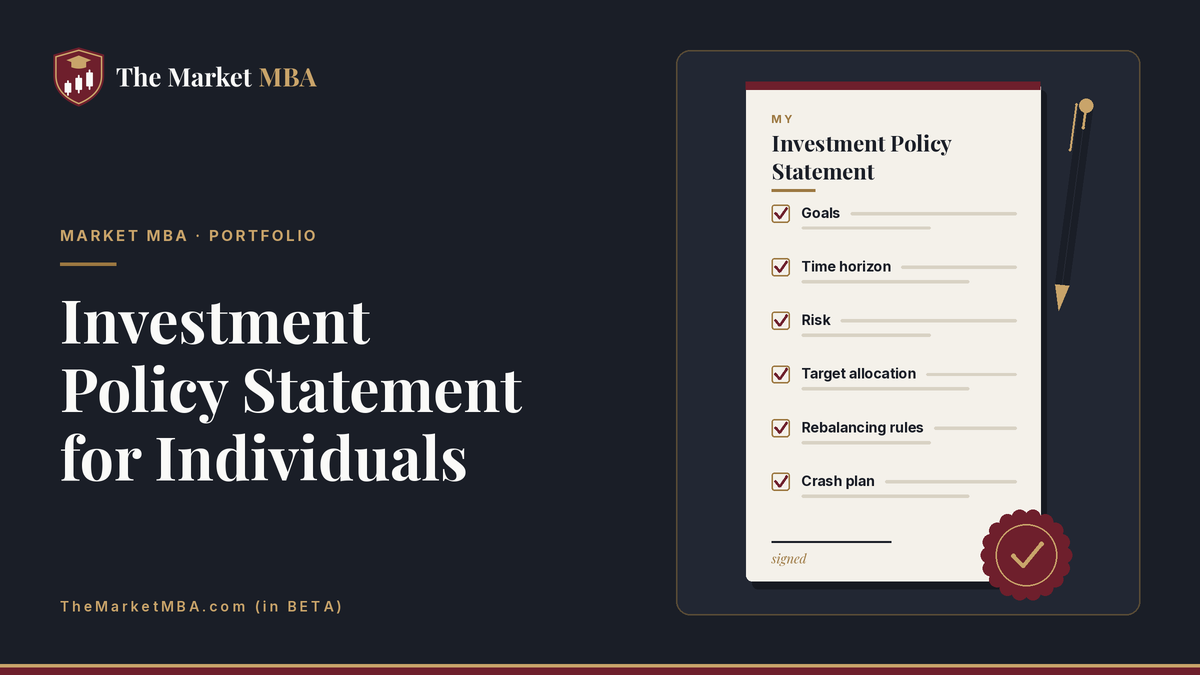
An investment policy statement (IPS) is a short written plan for your money. It states your goals, time horizon, risk tolerance, target asset allocation, which investments you will and won’t use, how you’ll rebalance and what you’ll do when markets fall. Writing it in calm times gives you rules to follow when emotions run high.
Most investors have a plan in their heads. An IPS puts it on paper, where it’s harder to rewrite on a bad day. This lesson covers what goes in one, shows a filled-in example for a made-up investor, and flags the mistakes that make an IPS useless.
What an investment policy statement is
An IPS is a policy document: it sets the rules for how your portfolio will be managed. They’re common in professional settings: the Department of Labor’s investment-duties regulation for ERISA retirement plans refers to them, and CFA Institute’s guide describes advisers using them with clients. CFA Institute has also published a guide specifically for individual investors, “Elements of an Investment Policy Statement for Individual Investors” (May 2010).
Its case for why individuals benefit is direct. The IPS “serves as a policy guide that can offer an objective course of action to be followed during periods of market disruption when emotional or instinctive responses might otherwise motivate less prudent actions.”
An IPS doesn’t make returns higher. What it can do is make your behavior more consistent, so that decisions come from rules you set in advance rather than from the day’s headlines.
The 8 sections of a personal IPS
CFA Institute’s guide organizes an IPS around scope and purpose, governance, investment, return and risk objectives, and risk management, including rebalancing. For a do-it-yourself investor, those ideas fit into eight practical sections.
1. Goals and time horizon
What is the money for, and when will you need it? The SEC defines time horizon as the expected number of months, years or decades you’ll be investing to reach a goal. Different goals can have different horizons and even separate sections.
2. Risk tolerance and capacity
Tolerance is emotional: the SEC calls it your ability and willingness to lose some or all of your investment in exchange for greater potential returns. Capacity is financial: how much of a loss your situation can absorb. Write down both, and consider stating the largest decline you could sit through without selling.
3. Target asset allocation and ranges
State your target mix and an acceptable range around each piece. For how allocation often changes over a lifetime, see asset allocation by age.
4. What you will and won’t invest in
CFA Institute’s guide says an IPS should set out all permissible asset classes. Listing what’s off-limits, such as leverage, individual options trades or anything you don’t understand, matters just as much.
5. How you choose investments
Describe your criteria: for example, low costs, broad diversification, or a valuation rule if you buy individual stocks (see how to calculate the intrinsic value of a stock). The point is to make choices repeatable.
6. Rebalancing rules
Say when you’ll check and what triggers a trade. CFA Institute lists the rebalancing process as part of an IPS’s risk management. For methods and research, see how often to rebalance your portfolio.
7. What you’ll do in a market decline (your “crash plan”)
This section is often missing, and it’s the one many investors find matters most in a downturn. Spell out, in advance, what you will and won’t do if your portfolio falls sharply, such as “rebalance according to section 6” and “no changes to the target allocation for [X] days.”
8. Review schedule and when to change the IPS
CFA Institute’s guide calls for a process for reviewing and updating the IPS, and its example sets a review “no less frequently than annually.” Also list the life events that justify a change, such as marriage, a new job, an inheritance or a new goal. A market drop isn’t on that list.
A filled-in one-page example (hypothetical)
This IPS belongs to a made-up investor. The brackets and figures are placeholders and illustrations, not suggestions for you.
Investment Policy Statement: “Jordan,” age [38]
Date: [Month Year] · Next review: [Month Year + 1]1. Goals and time horizon. Retirement savings, needed starting around age [65], so a horizon of about [27] years. A house down payment fund is kept separately in cash and isn’t covered here.
2. Risk tolerance and capacity. I have a stable salary and an emergency reserve of [6] months of expenses. I expect my portfolio could fall [X]% or more in a bad year, and I commit to not selling because of a decline.
3. Target allocation. Stocks [X]% (range [X−5] to [X+5]%); bonds [Y]% (range [Y−5] to [Y+5]%); cash [Z]%.
4. Permitted and prohibited. Permitted: broadly diversified, low-cost stock and bond funds. Prohibited: margin, options, leveraged or inverse funds, and any single stock above [5]% of the portfolio.
5. Selection criteria. Expense ratio below [X]%; broad diversification; I can explain what it holds in one sentence.
6. Rebalancing. I’ll review each [January]. If any asset class is outside its range, I’ll rebalance, using new contributions and dividends first.
7. Crash plan. If my portfolio falls [20]% or more from its high, I will: reread this IPS; rebalance only per section 6; make no change to my target allocation for at least [90] days; and talk with [a licensed professional / my partner] before any change.
8. Review. Annually, and after a major life event. I’ll write down the reason for any change.
Signed: [Jordan] · [Date]
Signing it is symbolic; it simply marks your commitment.
Common IPS mistakes
- Too vague. “Invest for the long term” isn’t a rule. Numbers, ranges and dates are.
- No decline plan. An IPS without section 7 is silent at exactly the moment you’ll want guidance.
- Rewriting it after every drop. Changing the rules mid-decline defeats the purpose. Tie changes to life events, not markets.
- Copying someone else’s. CFA Institute warns that templates “almost inevitably sacrifice consideration of factors that are highly relevant to the investor.” Use the example above for structure, not content.
- Never reviewing it. Your life changes. Your IPS should too, on a schedule.
Is an IPS legally binding? Is it required?
This is general information, not legal advice.
For an individual managing their own money, an IPS is generally a personal planning document, not a contract, and individuals generally aren’t required to have one. The picture is different in professional settings. When an adviser and client agree on an IPS, it may describe the adviser’s role; CFA Institute’s guide includes language about an adviser acting as a fiduciary. For retirement plans covered by ERISA, the Department of Labor’s investment-duties regulation refers to investment policy statements that plan investment managers may use. If you’re working with an adviser or overseeing a plan, ask an attorney or the professional involved what the document means in your case.
FAQ
What should an investment policy statement include?
At minimum: goals and time horizon, risk tolerance, target allocation with ranges, permitted and prohibited investments, how you choose investments, rebalancing rules, a market-decline plan and a review schedule.
Is an investment policy statement legally binding?
For individuals managing their own money, generally not; it’s a self-imposed plan. In adviser relationships and retirement plans, it can carry more weight. This is general information, not legal advice; ask an attorney about your situation.
Do I need an investment policy statement if I only own index funds?
It isn’t required, but many index investors find it useful. Even a simple portfolio needs rules for allocation, rebalancing and what to do in a decline. Index funds still fall in downturns.
How often should I update my investment policy statement?
CFA Institute’s example calls for a review at least annually. Many investors also update after a major life event. Avoid updating because of recent market moves.
What’s the purpose of an investment policy statement?
To give you clear rules, set in calm times, for managing your money, especially during “periods of market disruption when emotional or instinctive responses might otherwise motivate less prudent actions,” as CFA Institute puts it. It helps with consistency; it doesn’t promise better returns.
Sources
- CFA Institute, Elements of an Investment Policy Statement for Individual Investors (May 2010): https://rpc.cfainstitute.org/sites/default/files/-/media/documents/article/position-paper/investment-policy-statement-individual-investors.pdf
- Investor.gov (SEC), Beginners’ Guide to Asset Allocation, Diversification, and Rebalancing: https://www.investor.gov/additional-resources/general-resources/publications-research/info-sheets/beginners-guide-asset
- U.S. Department of Labor regulation, Fiduciary duties regarding plan investments and investment courses of action (29 CFR 2550.404a-1): https://www.ecfr.gov/current/title-29/section-2550.404a-1
- Investor.gov (SEC), Mutual Funds (funds can lose money): https://www.investor.gov/introduction-investing/investing-basics/investment-products/mutual-funds-and-exchange-traded-1
- Example IPS: hypothetical, written by The Market MBA
Keep going. The Market MBA ends with you writing and defending your own IPS. This article is part of 420 Capstone in Level 400 Portfolio management of The Market MBA, a 4-level, 12-course program that ends with you writing your own investment policy statement.
For education only. Not financial, investment, legal or tax advice.
For education and entertainment only. Not financial advice.