 The Market
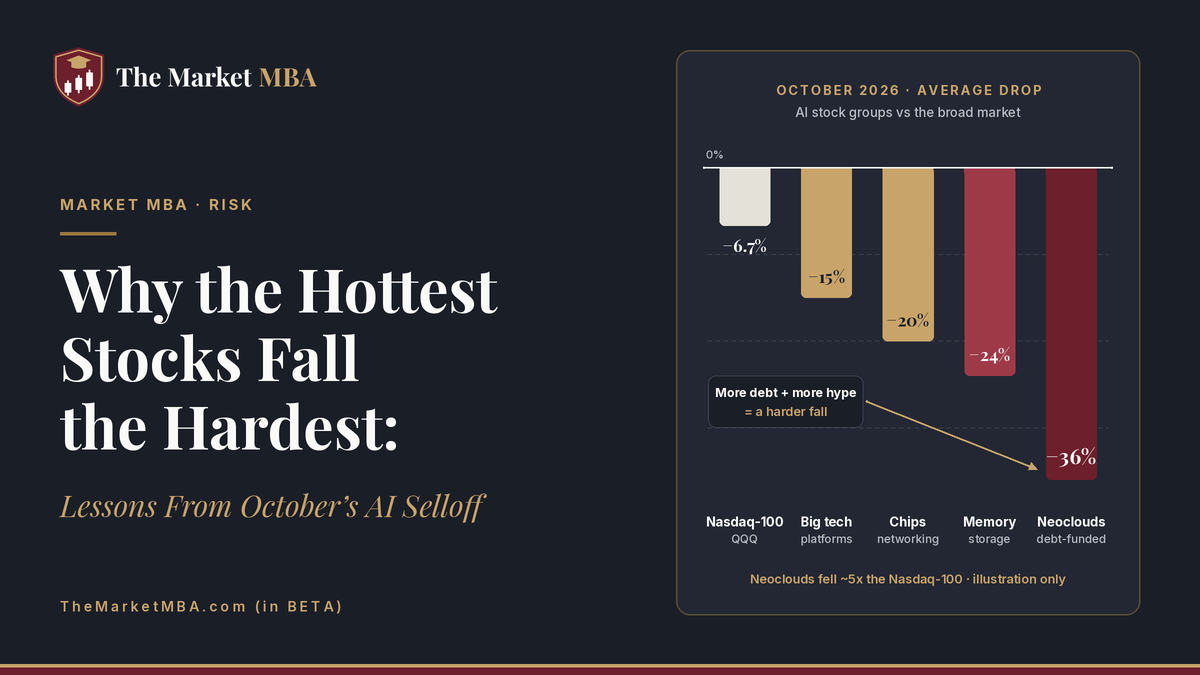
Summary: The hottest stocks tend to fall the hardest because they combine high expectations, borrowed money and cyclical demand, so bad news hits them twice. October 2026’s AI selloff showed it: debt-funded AI cloud companies fell about 36%, while the Nasdaq-100 fell under 7%.
In October 2026, a group of 18 major AI stocks lost roughly $3.5 trillion in market value in a single month. That’s not the interesting part. The interesting part is how unevenly they fell. Oracle slipped about 5%. Intel lost about 45%. Same theme, same month, wildly different outcomes.
This lesson uses that month to explain three ideas every investor should understand.
Lesson 1: Not all “AI stocks” are the same bet
People say “AI stocks” as if they were one thing. October showed they’re not. Here are the simple average drops by group:
- Companies that rent out AI computing power (neoclouds like CoreWeave and Nebius): about -36%
- Memory and storage makers: about -24%
- Chip and networking companies: about -20%
- Giant tech platforms: about -15%
- For comparison, the broad Nasdaq-100 (QQQ): -6.7%
The takeaway: A theme is a story. A stock is a business with its own debt, customers and cycle. Owning five “AI stocks” can still mean owning five very different risks, or the same risk five times.
Lesson 2: Borrowed money makes everything swing harder
Why did the neoclouds fall the most? Much of their growth is paid for with debt. When inflation came in hot and interest rates rose, two things happened at once. Their borrowing got more expensive, and lenders got nervous. Some of CoreWeave’s bonds traded at distressed prices.
This is called leverage. It boosts gains on the way up and losses on the way down. Companies that build expensive things (like data centers) with borrowed money are especially sensitive to interest rates.
The takeaway: When you look at a fast-growing company, ask how it’s paying for that growth. Cash from its business is sturdier than borrowed money.
Lesson 3: Answers beat hype
The two names that held up best, Oracle and Broadcom, didn’t have better stories in October. They had better answers. Oracle laid out when its cash flow should turn positive and capped how much new money it would raise. Broadcom got a large, bank-backed financing deal for its AI chip customers.
Markets hate uncertainty. When the big fear is “who pays for all this?”, the companies that answer that question tend to get rewarded first.
The takeaway: In a selloff, look at which companies are reducing uncertainty, not just which ones dropped the most.
A word on “buying the dip”
A big drop doesn’t automatically make a stock cheap. A stock that falls 50% has to gain 100% just to get back to where it started. Before treating a selloff as a sale, ask whether the business changed or only the price did.
Key terms
- Market value (market cap): share price × number of shares
- Leverage: using borrowed money to grow, which magnifies gains and losses
- Capex (capital expenditures): money spent on long-lasting things like data centers and chips
- Drawdown: how far an investment falls from a peak
For education only. Not financial, investment, legal or tax advice.
For education and entertainment only. Not financial advice.