 The Market
Wednesday morning, the Bureau of Economic Analysis will release October’s inflation reading and a revised look at third-quarter growth — the last major inflation print before the Federal Reserve meets on Dec. 8–9. It lands in a holiday-shortened week, with markets closed Thursday and stocks finished at 12:00 p.m. CT on Friday. Here is how to read the data, and the tape around it.
By Cooper · The Market MBA · Tuesday, Nov. 24, 2026
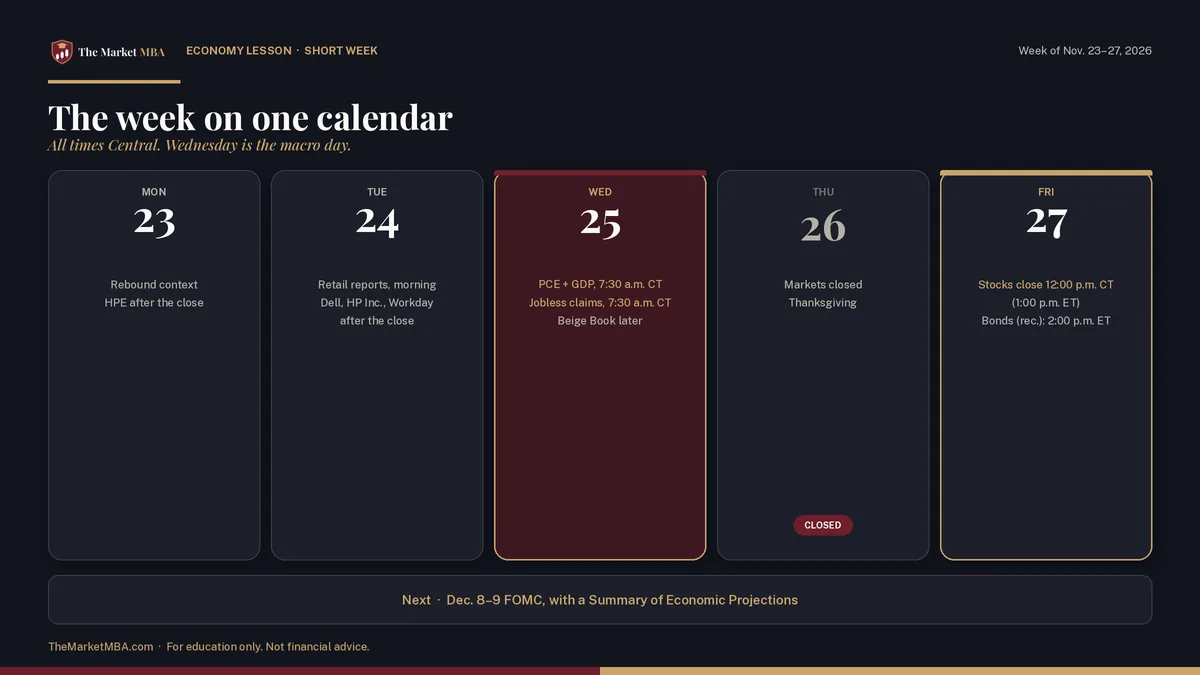
The week on one calendar
After Monday’s rebound in Nvidia and the broader market — a story we cover separately — the calendar tightens quickly.
Wednesday is the day that matters for the macro. At 8:30 a.m. ET (7:30 a.m. CT), the BEA is scheduled to publish two reports at once: the second estimate of third-quarter gross domestic product, including corporate profits, and Personal Income and Outlays for October, which includes the personal consumption expenditures, or PCE, price index.
The same morning, the Labor Department will publish weekly jobless claims at 8:30 a.m. ET. That report usually comes out on Thursday. Because Thanksgiving falls on Thursday this year, the Department of Labor moved the release to Wednesday.
The Federal Reserve’s Beige Book is also on Wednesday’s calendar. It is a qualitative survey of conditions across the 12 Fed districts, not a data print like PCE or GDP.
U.S. stock markets are closed Thursday, Nov. 26, for Thanksgiving, and they close early at 1:00 p.m. ET (12:00 p.m. CT) on Friday, Nov. 27, the day after. The U.S. bond market is also closed Thursday. The Securities Industry and Financial Markets Association recommends a 2:00 p.m. ET early close for fixed-income trading on Friday. That is a recommendation to member firms, and it does not change settlement times.
Earnings are bunched in front of the holiday. Hewlett Packard Enterprise was scheduled to report after the close on Monday. Dell Technologies, HP Inc., and Workday are due after the close on Tuesday. A cluster of retailers is on the calendar Tuesday morning, before the open: Best Buy, Dick’s Sporting Goods, Abercrombie & Fitch, Dollar Tree, Burlington, and Kohl’s. Those prints are useful for a read on demand heading into the holiday weekend. They are not a substitute for Wednesday’s inflation data.
What PCE is, and how it differs from CPI
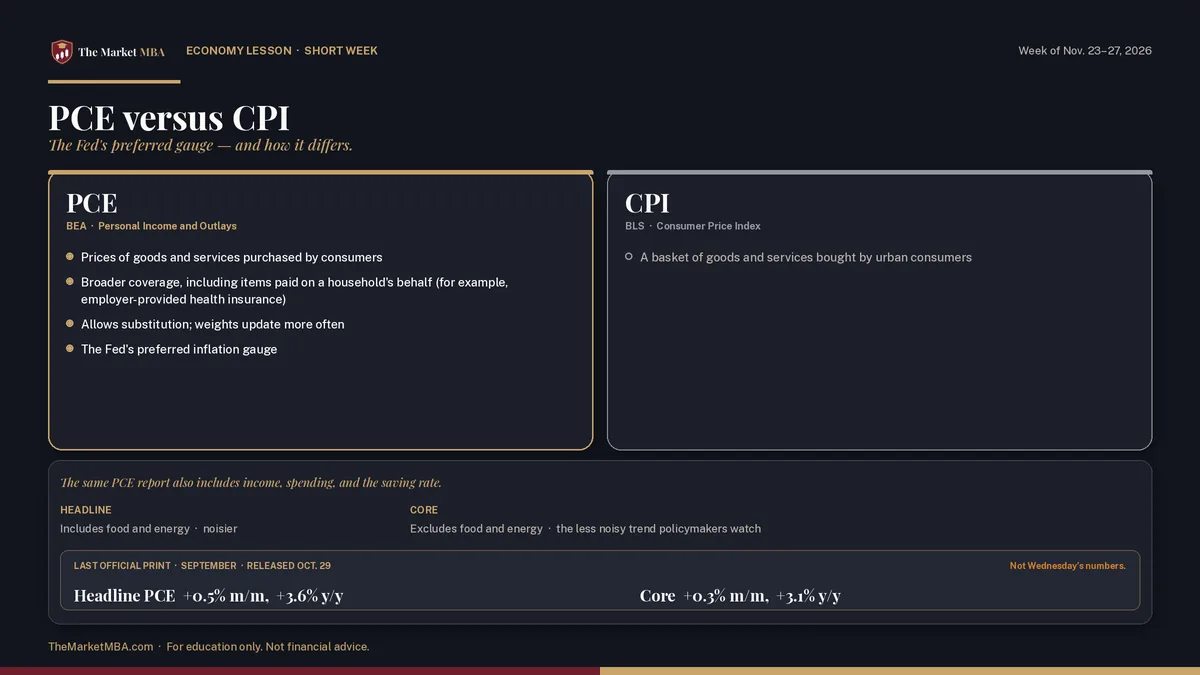
PCE stands for personal consumption expenditures. The PCE price index, which comes out in the monthly Personal Income and Outlays report, measures changes in the prices of goods and services purchased by consumers in the United States.
CPI, the consumer price index, is a different report from the Bureau of Labor Statistics. It tracks a basket of goods and services bought by urban consumers.
The two often move together, but they are not the same number. PCE covers a broader set of spending, including items paid on a household’s behalf, such as employer-provided health insurance. It also uses a formula that allows for substitution as people shift from one good to another, and its spending weights update more often than CPI’s. Those differences are a big reason the Federal Reserve treats PCE, not CPI, as its preferred inflation gauge.
When Wednesday’s report lands, you will see more than a price index. The same release covers personal income, consumer spending, and the personal saving rate. The inflation number is the one markets will headline. The income and spending figures help you judge whether households are still carrying the expansion.
Headline versus core
Headline PCE includes food and energy. Those categories can jump around with oil prices, grocery bills, and the weather, so a single month can look hotter or cooler than the underlying trend.
Core PCE leaves food and energy out. Policymakers lean on the core reading because it is less noisy. Households, of course, still buy groceries and gasoline, which is why the headline number is not something to ignore. A clean read looks at both: does the headline move trace back to food and energy, or is the core still running hot?
The last official print, for September, came out on Oct. 29 with the advance GDP report. The BEA said the PCE price index rose 0.5% from August and 3.6% from a year earlier. Excluding food and energy, it rose 0.3% on the month and 3.1% from a year earlier. Personal income was up 0.2% in September, and current-dollar consumer spending was up 0.5%; after prices, real spending was essentially flat. Wednesday’s release is the October update of those same figures.
Why a GDP revision is not a rerun
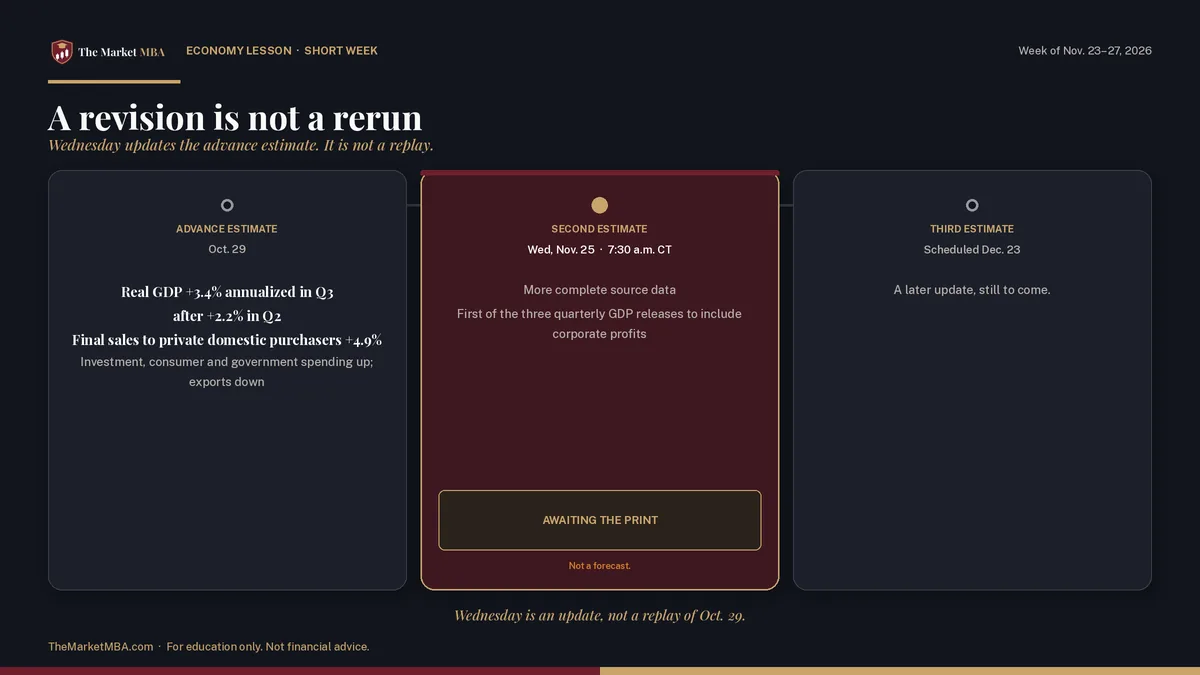
On Oct. 29, the BEA’s advance estimate said real GDP increased at a 3.4% annual rate in the third quarter, after 2.2% in the second quarter. The contributors were increases in investment, consumer spending, and government spending, partly offset by a decrease in exports. Real final sales to private domestic purchasers — consumer spending plus private fixed investment — rose 4.9%.
That first GDP number is called an advance estimate because the source data are incomplete. The BEA fills some gaps with assumptions and early reports. The second estimate, due Wednesday, folds in more complete data. It is also the first of the three quarterly GDP releases to include corporate profits.
A revision can confirm the first read, or it can change the story — for example, if inventory investment or trade is revised enough to move the headline growth rate. Either way, treat Wednesday as an update, not a replay of Oct. 29. A third estimate is still scheduled later, on Dec. 23.
Why a short week can make the tape look louder than it is
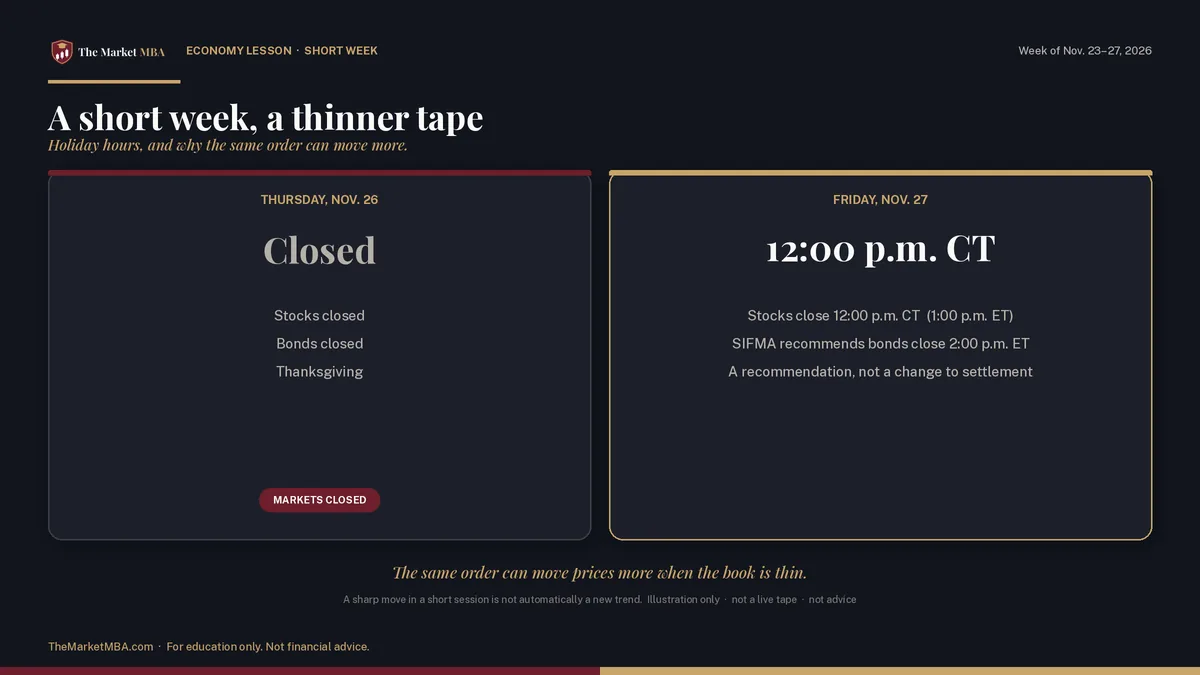
Holiday weeks are thinner. Many desks lighten up ahead of Thanksgiving, and Friday’s session is shorter. The same order can move prices more when there is less liquidity on the other side of the trade. Spreads can widen. A mid-afternoon move that would be routine on a full session can look dramatic when the close is at noon Central Time.
That is a reason to be careful with Friday’s tape, especially after a heavy data morning on Wednesday and a full day off on Thursday. A sharp move in a short session is not automatically a new trend. It can just be a thin market.
What to watch between Wednesday and the December Fed
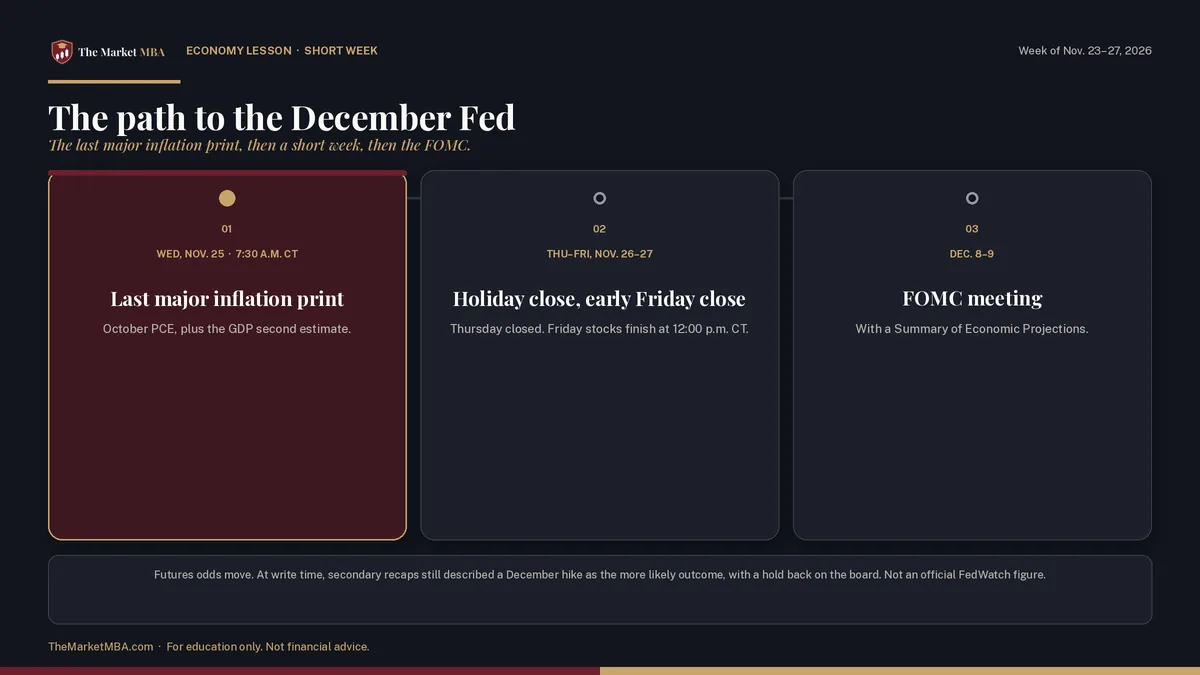
Wednesday’s PCE reading is the last major inflation report before the Federal Open Market Committee’s Dec. 8–9 meeting. That meeting is also one of the four each year that comes with a Summary of Economic Projections.
Futures markets will reprice around the print, as they always do. At the time this article was written, the official CME FedWatch tool was not available to quote a live probability. After last week’s selloff, secondary reports still described a December rate hike as the more likely outcome priced in futures, with a chance of a hold back on the board. Those implied odds move. Do not treat a stale percentage as a forecast, and check the tool itself if you want the current number.
Monday’s rebound in Nvidia does not settle the inflation question, and it does not change what Wednesday’s reports will show. It is useful context only: the market can move a lot, quickly, when positioning and a short calendar line up. The lesson this week is how to read the data, and how not to over-read a holiday tape.
For education only. Not financial advice.
For education and entertainment only. Not financial advice.