 The Market
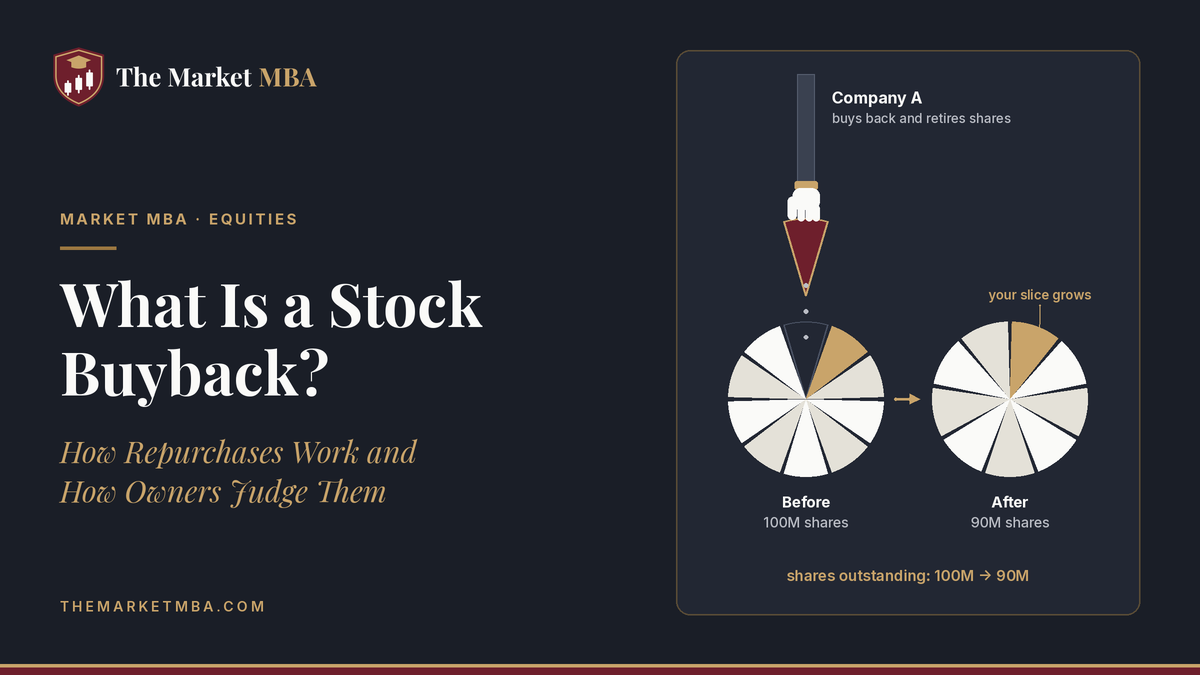
A stock buyback is when a company uses cash to repurchase its own shares, reducing the number of shares outstanding. Each remaining share then owns a slightly bigger slice of the business. A buyback helps long-term owners when the company pays less than the shares are worth and actually shrinks the share count after employee stock grants.
Buyback headlines tend to arrive with a big dollar figure and an implied cheer. Owners should be less impressed by the number and more interested in two questions: what price is the company paying, and is the share count really going down?
Stock buybacks in one minute
A company that earns more cash than it needs to run and grow the business has a few choices: keep it, pay down debt, buy another company, pay a dividend, or buy back its own stock. A buyback (also called a share repurchase) is that last option.
When a company buys its own shares, it usually retires them or holds them as “treasury stock.” Either way, fewer shares are left in public hands. If the business is unchanged, each remaining share represents a slightly larger piece of it.
That’s the whole mechanism. Whether it’s a good deal for you depends on the details.
How a buyback works
The SEC describes several methods, including open-market purchases, tender offers and accelerated share repurchases, and notes that most repurchases happen over time through open-market purchases.
Open-market programs. The board authorizes a dollar amount, say “up to $500 million,” and the company buys shares on the open market over months or years, through a broker, like any other buyer. An authorization is permission, not a promise; companies can slow, pause or never finish a program. In the US, SEC Rule 10b-18 offers a voluntary “safe harbor” from market-manipulation liability if the company’s daily purchases meet conditions on manner, timing, price and volume (for example, generally no more than 25% of average daily trading volume).
Tender offers. The company offers to buy a set number of shares directly from shareholders at a fixed price, often above the current market price, for a limited time. Each shareholder decides whether to sell.
Accelerated share repurchases (ASRs). Typically, the company pays an investment bank upfront, and the bank delivers a large block of shares right away, then buys shares in the market over the following months to cover its position. The final price is usually settled at the end.
Why companies buy back stock
- Return cash to owners. If a company can’t reinvest all its cash at good returns, handing it back may be the best use.
- Offset dilution. Many companies pay employees partly in stock. Buybacks can soak up those new shares so existing owners don’t get diluted.
- Signal confidence. Management may believe the shares are undervalued. That’s a claim, not a fact.
- Flexibility. A buyback authorization sets a maximum, not a schedule, and the SEC notes repurchases’ “greater perceived flexibility” compared with dividends.
A worked example: 100 million shares, $500M buyback
Take hypothetical Company A:
- 100 million shares outstanding, trading at $50 (a $5 billion market value)
- Net income of $400 million a year, so earnings per share (EPS) of $4.00
- You own 10,000 shares, or 0.0100% of the company
Company A spends $500 million buying back shares at $50. That retires 10 million shares, leaving 90 million.
| Before | After | |
|---|---|---|
| Shares outstanding | 100M | 90M |
| Net income (ignoring interest lost on the cash) | $400M | $400M |
| EPS | $4.00 | about $4.44 |
| Your ownership | 0.0100% | about 0.0111% |
EPS rose about 11% and your slice grew, without you doing anything. But notice what also happened: $500 million of cash left the company. EPS going up doesn’t automatically mean each share is worth more.
Here’s the part that matters to owners. Suppose Company A’s whole business, cash included, is really worth $6 billion ($60 a share). After paying $500 million to retire 10 million shares, it’s worth $5.5 billion spread over 90 million shares: about $61.11 a share. Remaining owners gained.
Now suppose it’s really worth only $4 billion ($40 a share). After the buyback: $3.5 billion over 90 million shares, about $38.89 a share. Remaining owners lost, even though EPS still went up.
Same buyback, same EPS bump, opposite results. The price paid relative to value decides whether a buyback helps you.
Buybacks vs dividends: the same cash, different results
Imagine Company A paid that $500 million as a dividend instead: $5 a share to every holder.
| Dividend | Buyback | |
|---|---|---|
| Who gets cash | Every shareholder, pro rata | Only shareholders who sell |
| Taxes (taxable accounts) | Holders generally owe tax on dividends in the year received | Only selling holders realize a gain or loss; others defer |
| Flexibility for the company | Board declares each payment | Authorized as a maximum; pace can vary |
| Effect on share count | None | Falls, if purchases exceed new issuance |
| Depends on price paid? | No | Yes, heavily |
Neither is automatically better. Dividends put cash in your hands to reinvest as you choose. The SEC notes buybacks may carry tax advantages for some investors, but as Warren Buffett wrote in 2011, “Continuing shareholders are hurt unless shares are purchased below intrinsic value.” Tax treatment depends on your account and situation, so consider a tax professional.
When buybacks hurt owners
- Overpaying. Buying shares above their value transfers wealth from remaining owners to sellers, as the $4 billion example shows.
- Debt-funded buybacks. Borrowing to buy back stock can make sense for a stable business, but it adds risk. If earnings stumble, the debt is still there.
- Crowding out investment. Cash spent on buybacks isn’t spent on products, people or maintenance. If a business is starving itself to boost EPS, that’s a warning sign.
- Only offsetting stock compensation. A company can spend billions on “buybacks” and still see its share count flat or rising because it keeps issuing stock to employees. That’s not returning cash to owners; it’s paying employees in a roundabout way.
How to check a company’s buybacks yourself
You don’t need anyone’s opinion to judge a buyback. The filings tell you most of it. (For a full primer, see our walkthrough on how to read financial statements.)
- Share count trend. Find weighted-average diluted shares on the income statement in the annual report (10-K) for the last five years. Is the number actually falling?
- Cash spent. In the cash flow statement, under financing activities, look for a line like “repurchase of common stock.” Compare it with net income and free cash flow.
- Stock issued. Look for stock-based compensation in the cash flow statement and shares issued in the equity statement. Net buybacks = shares bought minus shares issued.
- Price paid. US companies must report a monthly table of repurchases, including average price paid per share, in their 10-Q and 10-K. Compare those prices with your own estimate of value (see how to calculate the intrinsic value of a stock).
- Funding source. Did debt rise at the same time? If so, the buyback was at least partly borrowed.
The 1% buyback excise tax (US, since 2023)
The Inflation Reduction Act of 2022 (Public Law 117-169, signed August 16, 2022) added Section 4501 to the Internal Revenue Code. It imposes a 1% excise tax on the fair market value of stock repurchased by publicly traded US corporations, for repurchases after December 31, 2022.
Key points for owners:
- The company pays it, not shareholders. It isn’t deductible for the company.
- It’s netted. The taxable amount is reduced by the value of new stock the company issues during the year, including stock given to employees. In our example, if Company A repurchased $500 million but issued $200 million of stock to employees, the tax base would be roughly $300 million, for a tax of about $3 million (simplified).
- There are exceptions, including companies repurchasing $1 million or less in a year, certain reorganizations, stock contributed to employee retirement plans, and repurchases by regulated investment companies and REITs.
- The Treasury Department and IRS issued final regulations on how the tax is calculated in November 2025.
Proposals to raise the rate have been introduced in Congress. For example, S. 4796, introduced in the Senate in June 2026, would raise it to 4%. As of November 3, 2026, that bill was still with the Senate Finance Committee, no increase has been enacted, and the rate set in law remains 1%.
At 1%, the tax is a small cost next to the question that really matters: the price paid.
FAQ
Are stock buybacks good for shareholders?
They can be. Buybacks help remaining owners when the company pays less than the shares are worth and the share count actually falls after employee stock grants. They hurt when the company overpays, borrows heavily to fund them or uses them only to offset dilution.
Do stock buybacks raise the stock price?
Not necessarily. A buyback reduces the share count and raises EPS, and company buying adds demand for the shares. But the price still depends on what investors think the business is worth, and cash leaving the company reduces its value too.
What’s the difference between a buyback and a dividend?
A dividend pays cash to every shareholder. A buyback pays cash only to shareholders who sell, while remaining owners get a bigger slice of the company. Their tax treatment and flexibility differ.
Why would a company buy back its own shares?
To return excess cash, offset shares issued to employees, signal that management thinks the stock is undervalued, or keep flexibility that a regular dividend wouldn’t allow.
Do I have to sell my shares in a buyback?
No. In an open-market program, the company buys from whoever is selling on the market. In a tender offer, each shareholder decides whether to tender shares before the offer expires.
Sources
- SEC Rule 10b-18, safe harbor for issuer repurchases (17 CFR 240.10b-18): https://www.ecfr.gov/current/title-17/chapter-II/part-240/subpart-A/subject-group-ECFRbda83517ce4377f/section-240.10b-18
- SEC, Answers to Frequently Asked Questions Concerning Rule 10b-18: https://www.sec.gov/rules-regulations/staff-guidance/trading-markets-frequently-asked-questions/division-trading-markets-answers-frequently-asked-questions-concerning-rule-10b-18-safe-harbor
- Investor.gov (SEC), Tender Offer (glossary): https://www.investor.gov/introduction-investing/investing-basics/glossary/tender-offer
- SEC Rule 13e-4, issuer tender offers (17 CFR 240.13e-4): https://www.ecfr.gov/current/title-17/chapter-II/part-240/subject-group-ECFRb8a264d3a4d1c48/section-240.13e-4
- SEC, Share Repurchase Disclosure Modernization, Federal Register (June 1, 2023; rule later vacated, background cited): https://www.federalregister.gov/documents/2023/06/01/2023-09965/share-repurchase-disclosure-modernization
- SEC, Further Announcement Regarding Share Repurchase Disclosure Modernization Rule: https://www.sec.gov/newsroom/whats-new/further-announcement-regarding-share-repurchase-disclosure-modernization-rule
- Wilson Sonsini, Accelerated Share Repurchase (ASR) Programs explainer: https://www.wsgr.com/en/insights/accelerated-share-repurchase-asr-programs-to-be-impacted-by-proposed-changes-to-rule-10b5-1-and-share-repurchase-disclosure-rules.html
- Regulation S-K Item 703, repurchase disclosure (17 CFR 229.703): https://www.ecfr.gov/current/title-17/chapter-II/part-229/subpart-229.700/section-229.703
- Berkshire Hathaway, 2011 Shareholder Letter: https://www.berkshirehathaway.com/letters/2011ltr.pdf
- IRS, Topic No. 404, Dividends: https://www.irs.gov/taxtopics/tc404
- 26 U.S.C. §4501, U.S. Code 2024 ed. (govinfo): https://www.govinfo.gov/content/pkg/USCODE-2024-title26/html/USCODE-2024-title26-subtitleD-chap37-sec4501.htm
- 26 U.S.C. §4501 (Cornell LII): https://www.law.cornell.edu/uscode/text/26/4501
- 26 U.S.C. §275 (Cornell LII): https://www.law.cornell.edu/uscode/text/26/275
- Treasury/IRS, Excise Tax on Repurchase of Corporate Stock, final regulations, Federal Register (Nov 24, 2025): https://www.federalregister.gov/documents/2025/11/24/2025-20721/excise-tax-on-repurchase-of-corporate-stock
- S. 4796, Stock Buyback Accountability Act of 2026 (text, GPO): https://www.govinfo.gov/content/pkg/BILLS-119s4796is/html/BILLS-119s4796is.htm
- S. 4796 status and actions (Congress.gov): https://www.congress.gov/bill/119th-congress/senate-bill/4796
Keep going. This article is part of 201 Equities in Level 200 Securities of The Market MBA, a 4-level, 12-course program that ends with you writing your own investment policy statement.
For education only. Not financial, investment, legal or tax advice.
For education and entertainment only. Not financial advice.