 The Market
The stock market is a network of exchanges and trading venues where investors buy and sell shares of public companies. Companies raise money by selling shares in an IPO; after that, investors trade those shares with each other. Prices move when buyers and sellers agree on a new price, based on supply, demand and expected future profits.
That’s the short answer. The longer one is worth knowing, because once you can picture what happens behind the “buy” button, a lot of market noise stops being mysterious.
What the stock market is (and isn’t)
The stock market isn’t one building or one computer. It’s a set of regulated exchanges, plus other trading venues and dealers, all connected and all quoting prices for the same shares. When people say “the market,” they usually mean that whole system.
A share is a slice of a business
A share of stock is a small ownership stake in a company. If Company A has 100 million shares outstanding and you own 1,000 of them, you own one-thousandth of one percent of Company A. That slice gives you a claim on the company’s future profits, usually voting rights, and any dividends the board decides to pay.
Primary market (IPOs) vs secondary market (everyday trading)
- The primary market is where a company sells new shares to investors, most famously in an initial public offering (IPO). Money from newly issued shares goes to the company, which can use it to grow or pay down debt.
- The secondary market is everything after that: investors trading existing shares with each other. When you buy shares in an app on an ordinary Tuesday, the company doesn’t get your money. The seller does.
Who’s involved in a trade
You, your broker, exchanges and other trading venues
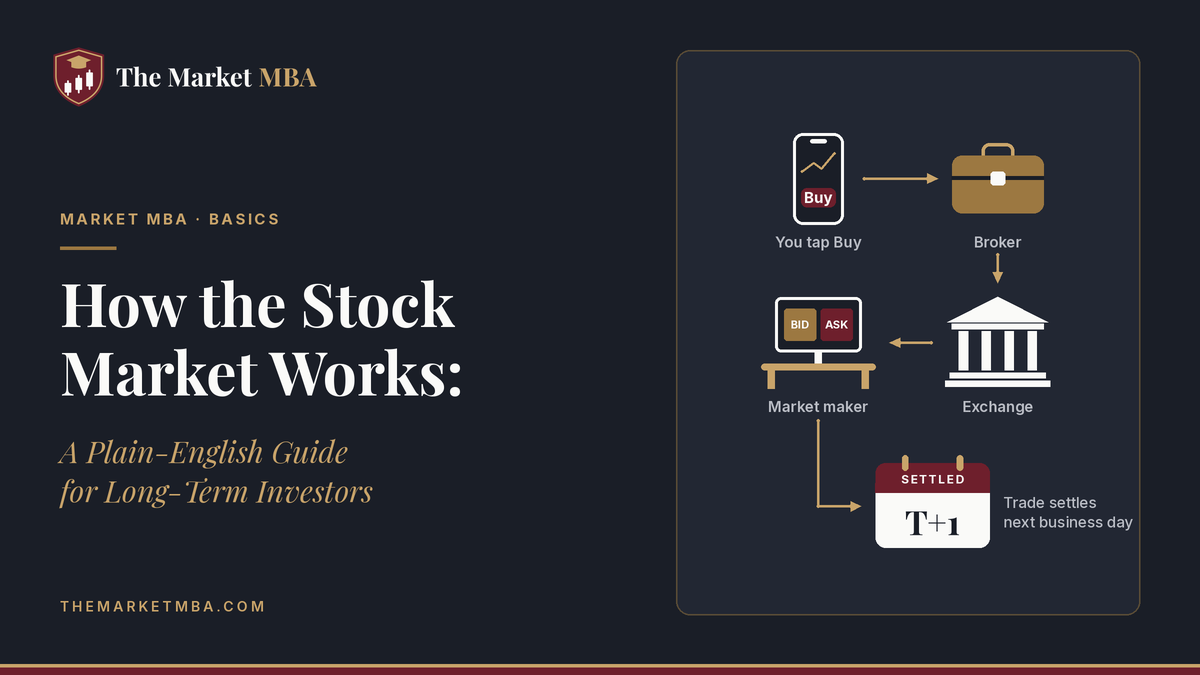
You don’t connect to an exchange directly. You place an order with a broker, a firm registered to handle trades for customers. Your broker then sends the order somewhere to be filled. That might be:
- An exchange, such as the New York Stock Exchange or Nasdaq, where buy and sell orders from many firms meet.
- A market maker (more on these below).
- An electronic network or alternative trading system that matches buyers and sellers automatically.
- Your broker’s own inventory, a practice called internalization.
Brokers have a legal duty of best execution: they must use reasonable diligence to get you the most favorable terms reasonably available, and they must periodically review which venues offer the best terms.
Market makers and who’s on the other side of your trade
Every trade needs a buyer and a seller. Sometimes the other side is another investor. Often it’s a market maker, a firm that stands ready to buy or sell a stock at publicly quoted prices all day. Market makers can earn money from the small gap between the price they buy at and the price they sell at.
Some market makers pay brokers to send them customer orders, a practice called payment for order flow. It’s legal, but brokers must tell you their payment-for-order-flow policies when you open an account and every year after, and publish quarterly reports showing where they route orders.
What happens when you tap “buy”: one order from start to finish
- You open your app and enter an order for 10 shares of Company A.
- Your broker checks that you have the cash or buying power.
- The broker routes the order to a venue it believes offers good execution.
- The order is matched with a seller, and you get a confirmation, usually within a fraction of a second.
- One business day later, the trade settles: the cash officially leaves your account and the shares are officially yours.
Bid, ask and the spread
At any moment, a stock has two prices:
- The bid: the highest price someone is currently willing to pay.
- The ask (or offer): the lowest price someone is currently willing to sell for.
The gap between them is the spread. Say Company A shows a bid of $49.98 and an ask of $50.02. If you buy right away, you’ll typically pay around $50.02. If you sell right away, you’ll typically get around $49.98. Heavily traded stocks tend to have narrow spreads; thinly traded stocks often have much wider ones, which is a real cost.
How you place the order matters here. A market order takes whatever price is available; a limit order sets your price. We cover the difference in detail in our lesson on market orders vs limit orders.
Order routing, execution and settlement (T+1)
Execution is the moment your order is matched and the price is locked in. Settlement is when ownership and money actually change hands in the official records.
Since May 28, 2024, the standard settlement cycle for most US stock trades has been T+1, meaning one business day after the trade date, under an SEC rule (Exchange Act Rule 15c6-1, as amended in 2023). Before that it was T+2. So if you buy shares on a Monday, the trade typically settles Tuesday. If Tuesday is a market holiday, it settles the next business day.
How stock prices are set
Supply and demand, minute to minute
Nobody “sets” a stock’s price. There’s no official who decides Company A is worth $50 today. The price is simply the level at which the most recent buyer and seller agreed to trade.
If more people want to buy than sell at $50, buyers have to offer more, and the price ticks up. If sellers outnumber buyers, they have to accept less, and it ticks down. News, earnings, interest rates and plain mood all shift that balance, sometimes sharply within a single day.
Over years: earnings, cash flow and expectations
Here’s the part most beginner guides skip. Over short periods, prices reflect whatever people feel like paying. Over long periods, many investors expect prices to be pulled toward what the business actually produces: revenue, profit and, above all, the cash it generates for owners. Benjamin Graham put it this way, as Warren Buffett quoted him in Berkshire Hathaway’s 1987 shareholder letter: “In the short run, the market is a voting machine but in the long run it is a weighing machine.”
Think of it as two clocks:
- The minute clock runs on order flow, headlines and emotion.
- The year clock runs on business results and what investors reasonably expect those results to be in the future.
A stock can drift far from its business results for a while. In the same letter, Buffett wrote that the market “may ignore business success for a while, but eventually will confirm it.” That’s a view from experience, not a guarantee. To learn how to read those business results yourself, see our walkthrough on how to read financial statements.
What “the market is up” means (indexes like the S&P 500)
When a newscaster says “the market was up 1% today,” they almost always mean an index, a basket of stocks tracked as a single number.
The S&P 500, published by S&P Dow Jones Indices, tracks 500 leading US companies and covers roughly 80% of the available US stock market value. It’s weighted by company size, so the largest companies move it the most.
So “the market is up” really means “this basket rose.” Your own holdings may have done something different. Many investors buy funds that track an index rather than picking individual stocks; we compare the two main ways to do that in our guide to index funds vs ETFs.
Trading vs owning: why holding period changes what matters
The same market serves two very different activities.
Traders live on the minute clock. Spreads, speed, order type and short-term news dominate, and small costs add up fast.
Owners live on the year clock. If you plan to hold for a decade or more, a few cents of spread barely registers. What matters is whether the business grows its earnings and cash flow, what you paid relative to that, and whether you can sit through the inevitable drops without selling at the worst moment.
Knowing which clock you’re on tells you what to watch and what to ignore. The Market MBA is built for owners.
Key terms recap (glossary box)
| Term | Plain-English meaning |
|---|---|
| Share (stock) | A small ownership stake in a company |
| IPO | A company’s first sale of shares to the public (primary market) |
| Secondary market | Investors trading existing shares with each other |
| Broker | The firm that takes your order and gets it executed |
| Exchange | A regulated marketplace where buy and sell orders meet |
| Market maker | A firm that continuously quotes prices to buy and sell |
| Bid / ask | Best price buyers will pay / best price sellers will accept |
| Spread | The gap between the bid and the ask |
| Settlement (T+1) | Official transfer of cash and shares, one business day after the trade |
FAQ
Who decides the price of a stock?
No single person or body. A stock’s price is the level where a buyer and a seller most recently agreed to trade. Over time, many investors believe prices are pulled toward what the company is expected to earn.
What happens when you buy a stock?
Your broker routes your order to an exchange, market maker or other venue, where it’s matched with a seller. You get a confirmation almost immediately, and the trade settles one business day later (T+1).
Where does the money go when I buy a stock?
To the seller, not the company. The only time a company receives your money is when it sells new shares, such as in an IPO or a later stock offering.
What are stock market hours?
Regular trading on major US exchanges runs 9:30 a.m. to 4:00 p.m. Eastern Time (8:30 a.m. to 3:00 p.m. Central), Monday through Friday, except market holidays. Some exchanges and brokers also offer early and late sessions, which usually have less trading activity, wider spreads and extra risks.
Can a stock go to zero?
Yes. If a company fails, shareholders are last in line behind lenders, suppliers and other creditors. In many bankruptcies the existing shares end up worth little or nothing.
Sources
- Investor.gov (SEC), Stocks – FAQs: https://www.investor.gov/introduction-investing/investing-basics/investment-products/stocks
- Investor.gov (SEC), Investing in an IPO: https://www.investor.gov/introduction-investing/general-resources/news-alerts/alerts-bulletins/investor-bulletins-17
- Investor.gov (SEC), Executing an Order: https://www.investor.gov/introduction-investing/investing-basics/how-stock-markets-work/executing-order
- FINRA Rule 5310, Best Execution and Interpositioning: https://www.finra.org/rules-guidance/rulebooks/finra-rules/5310
- SEC Regulation NMS Rule 606, Disclosure of order routing information (17 CFR 242.606): https://www.ecfr.gov/current/title-17/section-242.606
- SEC Regulation NMS Rule 607, Customer account statements (17 CFR 242.607): https://www.ecfr.gov/current/title-17/section-242.607
- FINRA, Understanding Market Liquidity and Your Investments: https://www.finra.org/investors/insights/market-liquidity-risk
- Investor.gov (SEC), New “T+1” Settlement Cycle – What Investors Need to Know: https://www.investor.gov/introduction-investing/general-resources/news-alerts/alerts-bulletins/investor-bulletins/new-t1-settlement-cycle-what-investors-need-know-investor-bulletin
- Federal Register, Shortening the Securities Transaction Settlement Cycle (Mar 6, 2023): https://www.federalregister.gov/documents/2023/03/06/2023-03566/shortening-the-securities-transaction-settlement-cycle
- Berkshire Hathaway, 1987 Chairman’s Letter: https://www.berkshirehathaway.com/letters/1987.html
- S&P Dow Jones Indices, S&P 500: https://www.spglobal.com/spdji/en/indices/equity/sp-500/
- NYSE, Holidays and Trading Hours: https://www.nyse.com/trade/hours-calendars
- FINRA, Extended-Hours Trading: https://www.finra.org/investors/insights/extended-hours-trading
- Investor.gov (SEC), Investor Bulletin: Bankruptcy for a Public Company: https://www.investor.gov/introduction-investing/general-resources/news-alerts/alerts-bulletins/investor-bulletins-84
Keep going. This article is part of 101 How markets work in Level 100 Foundations of The Market MBA, a 4-level, 12-course program that ends with you writing your own investment policy statement.
For education only. Not financial, investment, legal or tax advice.
For education and entertainment only. Not financial advice.