 The Market
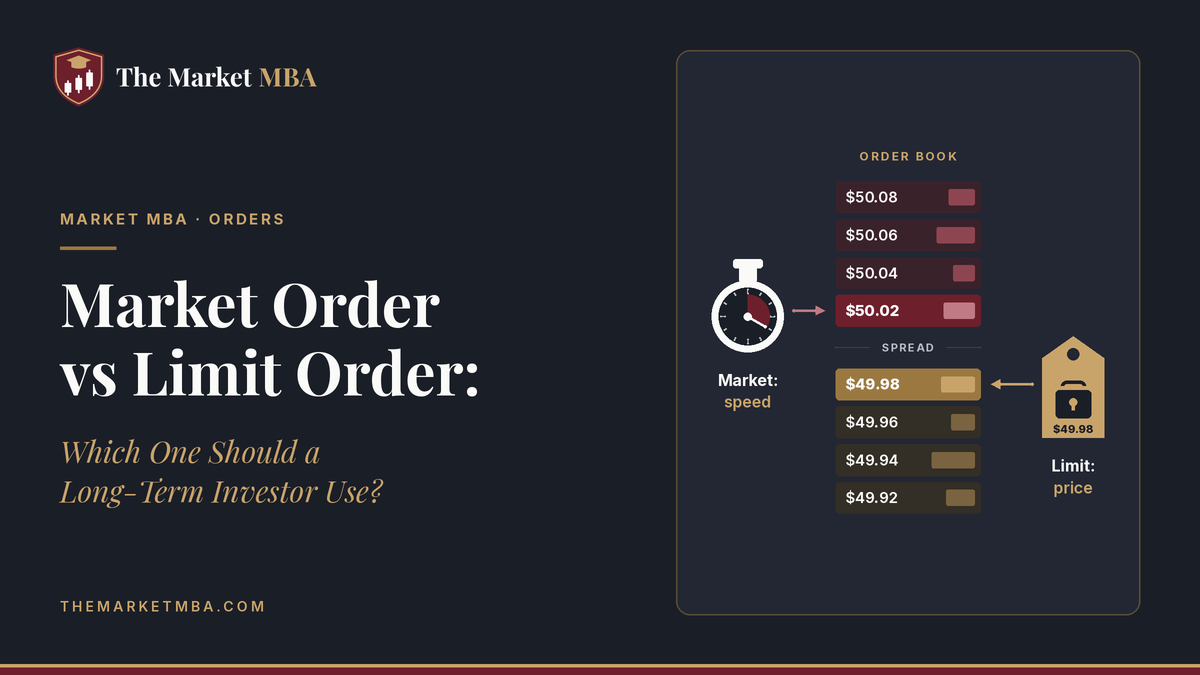
A market order buys or sells right away at the best price available, so it almost always fills but the price isn’t guaranteed. A limit order sets the worst price you’ll accept, so you control the price but the order may never fill. Market orders favor speed; limit orders favor price.
Every time you buy or sell a stock or ETF, your broker asks you to pick an order type. Most people tap “market” without thinking. Most of the time that’s fine. Some of the time it quietly costs real money. Here’s how to tell the difference.
The one-sentence difference
A market order says “fill me now at whatever the price is”; a limit order says “fill me only at this price or better.”
Everything else follows from that trade-off between certainty of execution and certainty of price. You can have a lot of one, but you can’t be guaranteed both.
How a market order works (with a worked example)
A market order is an instruction to buy or sell immediately at the best price currently available. FINRA calls it the most common type of investor order, and brokerage firms typically enter your order as a market order unless you specify otherwise.
Example. Company A, a hypothetical large company, is quoted at:
- Bid: $49.98 (the best price buyers are offering)
- Ask: $50.02 (the best price sellers are asking)
You place a market order to buy 100 shares. In normal conditions it fills almost instantly at or near $50.02, about $5,002 total. Simple.
The catch: the price you see on screen isn’t a promise. Quotes are good only for a certain number of shares, and prices can move between the moment you tap and the moment your order reaches the market.
Slippage and partial fills
Slippage is the difference between the price you expected and the price you got.
Now imagine Company B, a hypothetical small company that trades thinly:
- Ask: $10.20 for 200 shares
- Next ask: $10.35 for 300 shares
You place a market order to buy 500 shares. The first 200 fill at $10.20 and the next 300 at $10.35. Your average price is $10.29, not the $10.20 you saw. That’s slippage, and it happened because there weren’t enough shares offered at the first price.
The same order can also fill in pieces at different prices, called partial fills. With a market order, they usually all complete, just not all at one price.
How a limit order works (with a worked example)
A limit order is an instruction to buy or sell at a specific price or better. A buy limit can fill only at your limit price or lower. A sell limit can fill only at your limit price or higher.
Example. Back to Company A at $49.98 / $50.02. You place a buy limit order for 100 shares at $49.75.
- If sellers drop their ask to $49.75 or below while your order is active, it can fill at $49.75 or better.
- If the price never comes down that far, nothing happens. You don’t buy the shares.
That’s the whole deal. You’ve protected yourself from overpaying, but you’ve accepted that you might miss the trade entirely. If you set a buy limit at or above the current ask, say $50.05, it will usually fill right away, but never above $50.05.
Limit orders can also fill partially. If only 60 shares are offered at your price, you might get 60 now and the remaining 40 later, or never.
Day vs good-’til-canceled
Limit orders come with a time instruction:
- Day order: expires at the end of the regular trading session if it hasn’t filled. At many brokers, this is the default.
- Good-’til-canceled (GTC): stays open until it fills or you cancel it. Brokers usually cap how long a GTC order can stay open, so check yours.
A forgotten GTC order is a classic beginner trap. If the price finally hits your limit weeks later, after the news has changed, you’ll get filled whether you still want the shares or not.
Side-by-side comparison table
| Market order | Limit order | |
|---|---|---|
| Fill certainty | High: almost always fills when the market is open | Not guaranteed: fills only if the price reaches your limit |
| Price certainty | None: you get the best available price at execution | High: your limit price or better, if it fills |
| Best use | Heavily traded stocks and ETFs during regular hours, when speed matters more than a few cents | Thinly traded securities, wide spreads, volatile moments, extended hours, or when you have a firm price in mind |
| Main risk | Slippage, especially in fast markets or thin trading | Missing the trade, or a stale order filling later |
One thing order type doesn’t change: settlement. Once either order fills, the trade settles one business day later (T+1), the standard for most US stock trades since May 28, 2024 under the SEC’s amended Rule 15c6-1.
When the order type barely matters, and when it matters a lot
Liquid large-company stocks and big ETFs during regular hours
For a heavily traded large company or a big, popular ETF during regular hours, the spread is usually narrow and there are plenty of shares at each price. A market order for an ordinary amount will typically fill very close to the quoted price.
For a long-term investor buying a few thousand dollars’ worth to hold for years, the difference between a market and a limit order here is often just cents. Some investors use a limit order anyway, set at or slightly above the current ask, to cap the price they’ll pay if the quote moves.
Wide spreads, thin trading, the opening minutes, after-hours
The order type starts to matter a lot when:
- The spread is wide. Small companies, thinly traded ETFs and other low-volume securities often have wide spreads. A market order pays the full spread.
- Trading is thin. Few shares at each price means bigger slippage on larger orders.
- It’s the open. If news broke overnight, prices can move significantly when trading starts at 9:30 a.m. ET (8:30 a.m. CT).
- It’s outside regular hours. Early and late sessions usually have less trading and wider spreads, and many brokers accept only limit orders then.
In these situations, a limit order is how you avoid paying a price you’d never have agreed to if you’d seen it first.
Stop and stop-limit orders, briefly
These are often confused with limit orders, so here’s the short version.
- Stop order (stop-loss): sits dormant until the stock trades at your stop price, then becomes a market order. A sell stop at $45 on a stock trading at $50 triggers if the price falls to $45, and then sells at whatever price is available.
- Stop-limit order: when the stop price is hit, it becomes a limit order instead. A sell stop-limit with a $45 stop and $44 limit will sell only at $44 or better.
Gap risk is the big caveat. Say Company A closes at $48 and bad news comes out overnight. It opens at $40. A sell stop at $45 triggers and becomes a market order that fills somewhere around $40, not $45. A stop-limit at $45/$44 wouldn’t fill at all, and you’d still own the shares at $40. Neither order type can protect you from a price that jumps past your level. Brokers also differ on what triggers a stop (last trade vs quotes), so check the rules.
A simple checklist before you place an order
- Check the bid and ask, not just the last price. How wide is the spread?
- Check the time. Is it regular hours (9:30 a.m. to 4 p.m. ET, 8:30 a.m. to 3 p.m. CT), right at the open, or an extended session?
- Consider the size of your order relative to how much normally trades.
- Pick the order type that matches your priority: speed or price.
- If you use a limit, set the duration (day or GTC) and write down any open GTC orders.
- Read your broker’s rules. Order types, defaults and extended-hours handling vary by broker.
FAQ
Is a limit order better than a market order?
Neither is better in every case. A limit order protects your price but may not fill; a market order fills reliably but doesn’t guarantee a price. Many long-term investors use market orders for heavily traded securities in regular hours and limit orders when spreads are wide or prices are moving fast.
What happens if my limit order doesn’t fill?
Nothing is bought or sold. A day order expires at the end of the regular session; a good-’til-canceled order stays open until it fills, you cancel it or your broker’s time limit runs out. Check your broker’s fee schedule for any charges on unfilled or canceled orders.
Should I use a limit order when buying ETFs?
ETFs trade like stocks, with bids, asks and spreads. For large, heavily traded ETFs in regular hours, spreads are usually tight and order type matters less. For smaller or thinly traded ETFs, or right at the open, a limit order helps you avoid paying a wide spread. For how ETFs differ from traditional index mutual funds, see our guide to index funds vs ETFs.
What happens if I place a market order after the market closes?
It depends on your broker. If it’s held for the next regular session, it fills at whatever price is available then, which can differ sharply from the last close if news broke overnight. Some brokers accept only limit orders in extended-hours sessions.
What’s the difference between a stop order and a limit order?
A limit order sets the worst price you’ll accept and is active right away. A stop order waits until a trigger price is reached and then becomes a market order. A stop-limit combines the two: the trigger activates a limit order.
Sources
- Investor.gov (SEC), Investor Bulletin: Understanding Order Types: https://www.investor.gov/introduction-investing/general-resources/news-alerts/alerts-bulletins/investor-bulletins-14
- FINRA, Order Types: https://www.finra.org/investors/investing/investment-products/stocks/order-types
- FINRA, Understanding Market Liquidity and Your Investments: https://www.finra.org/investors/insights/market-liquidity-risk
- FINRA, Extended-Hours Trading: https://www.finra.org/investors/insights/extended-hours-trading
- Investor.gov (SEC), Investor Bulletin: Extended-Hours Trading: https://www.investor.gov/introduction-investing/general-resources/news-alerts/alerts-bulletins/investor-bulletins-42
- Investor.gov (SEC), Updated Investor Bulletin: Exchange-Traded Funds (ETFs): https://www.investor.gov/introduction-investing/general-resources/news-alerts/alerts-bulletins/investor-bulletins-24
- Investor.gov (SEC), New “T+1” Settlement Cycle – What Investors Need to Know: https://www.investor.gov/introduction-investing/general-resources/news-alerts/alerts-bulletins/investor-bulletins/new-t1-settlement-cycle-what-investors-need-know-investor-bulletin
- NYSE, Holidays and Trading Hours: https://www.nyse.com/trade/hours-calendars
Keep going. This article is part of 101 How markets work in Level 100 Foundations of The Market MBA, a 4-level, 12-course program that ends with you writing your own investment policy statement. For the bigger picture of what happens after you tap “buy,” see our guide to how the stock market works.
For education only. Not financial, investment, legal or tax advice.
For education and entertainment only. Not financial advice.