 The Market
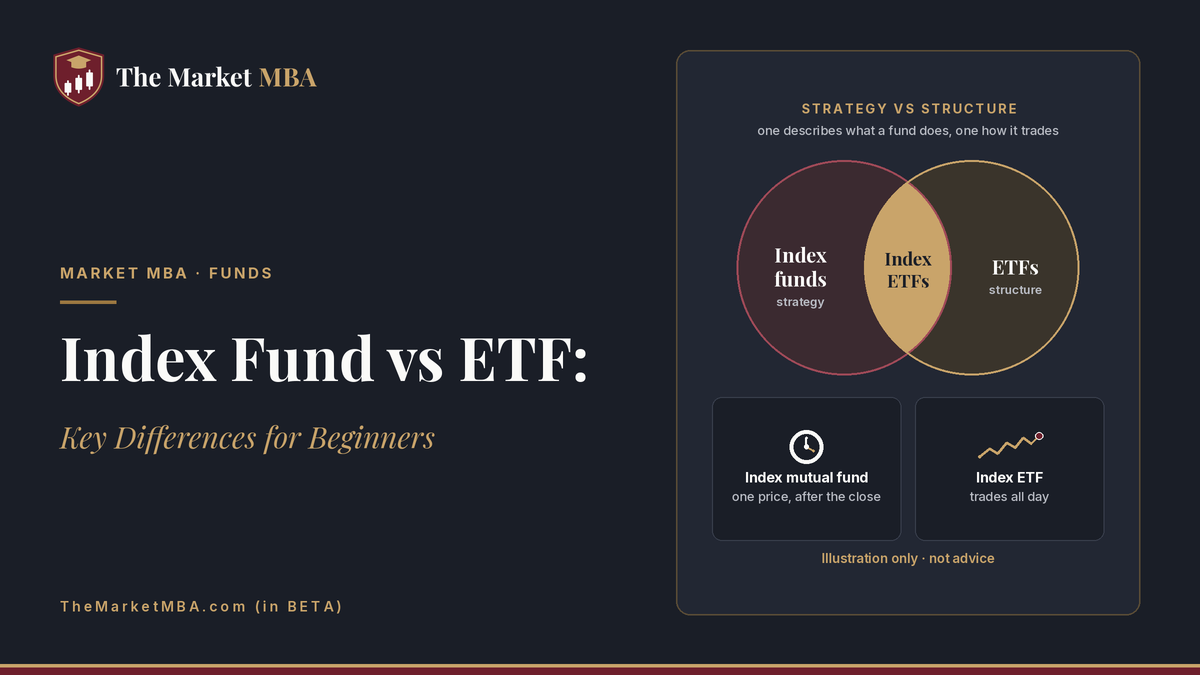
“Index fund” describes a strategy: tracking a market index. “ETF” describes a structure: a fund that trades on an exchange all day like a stock. Many ETFs are index funds. The real differences between an index ETF and an index mutual fund are how you trade them, minimums, automatic investing and, in taxable accounts, tax efficiency.
“Should I buy an index fund or an ETF?” sounds like a choice between two different things. Often it’s a choice between two versions of nearly the same thing. Once you separate the strategy from the structure, the decision gets much simpler.
Strategy vs structure: why “index fund vs ETF” is a false choice
An index fund is a fund that tries to match the returns of a market index, such as a broad US stock index, instead of trying to beat it. The SEC describes an index fund as “a type of mutual fund or exchange-traded fund” that seeks to track an index. That’s a strategy.
An ETF (exchange-traded fund) is a fund whose shares trade on a stock exchange throughout the day. That’s a structure. ETFs can be index-based or actively managed.
So you end up with four combinations:
| Mutual fund structure | ETF structure | |
|---|---|---|
| Index strategy | Index mutual fund | Index ETF |
| Active strategy | Active mutual fund | Active ETF |
For most beginners, the real question is the top row: index mutual fund or index ETF? Both can hold the same stocks and track the same index. The differences come from the wrapper.
How index mutual funds work
- One price per day. A mutual fund calculates its net asset value (NAV), the value of everything it holds minus liabilities, divided by shares, once each business day, usually after the market closes. Every order placed that day gets that next calculated price, whether you put it in at 9:45 a.m. or 3:55 p.m.
- You deal with the fund. You buy shares from the fund and sell them back to it, directly or through a broker.
- Dollar-based investing. You invest a dollar amount, say $250, and get whatever fractional number of shares that buys.
- Minimums. Some funds require a minimum initial investment, which can range from nothing to thousands of dollars, depending on the fund and the account. Many set a relatively low minimum, according to the SEC.
- Automatic investing. Because you buy in dollars, mutual funds suit investing a set amount on a set schedule (dollar-cost averaging). Whether automatic purchases are offered, and on what terms, varies by firm.
How ETFs work
- Trades all day. ETF shares trade on an exchange during market hours at prices set by buyers and sellers, which can move from minute to minute. You buy from and sell to other investors, through a broker.
- Bid and ask. Like a stock, an ETF has a bid (the highest price buyers are offering) and an ask (the lowest price sellers will take). The gap is the spread, a real cost each time you trade. For more on order types, see our guide to market orders vs limit orders.
- Price vs NAV. ETFs calculate a NAV daily too, but the market price can sit slightly above it (a premium) or below it (a discount).
- Creation and redemption. Large financial firms called authorized participants can create new ETF shares or redeem existing ones in big blocks, often by exchanging a basket of the underlying securities rather than cash. That process helps keep the market price close to NAV, and it’s the root of the ETF tax advantage covered below. For how exchanges work in general, see our guide to how the stock market works.
Index mutual fund vs index ETF: side-by-side comparison
| Feature | Index mutual fund | Index ETF |
|---|---|---|
| Trading | Once a day at the next NAV | Throughout market hours at market price |
| Price you get | NAV (no spread) | Market price, plus or minus the bid/ask spread |
| Minimums | Set by the fund; may be $0 or more | Usually the price of one share, or less with fractional shares |
| Fractional shares | Standard (you invest dollar amounts) | Only if your broker offers them; availability varies by firm |
| Automatic investing | Commonly offered; varies by firm | Varies by broker |
| Tax efficiency (taxable accounts) | Can distribute more capital gains | Typically fewer capital gain distributions |
| Availability in 401(k) plans | The main vehicle in most plans | Less common; depends on your plan’s menu |
On the last row: according to the Investment Company Institute, mutual funds held 58% of 401(k) plan assets at year-end 2025. Your workplace plan’s menu, not your preference, usually decides this one.
Costs beyond the expense ratio
The expense ratio, the annual fee as a percentage of your investment, gets the headlines, and for index funds it’s often low. But it’s not the only cost:
- Bid/ask spreads (ETFs). The SEC’s own example: an ETF with a bid of $59.50 and an ask of $60 has a 50-cent spread. If you bought 200 shares and sold them right away, you’d lose $100 to the spread. More liquid, heavily traded ETFs typically have tighter spreads, and an ETF’s median bid-ask spread is posted on its website.
- Commissions and transaction fees. Some brokers charge to trade ETFs or to buy certain mutual funds. Check your broker’s fee schedule.
- Sales loads (mutual funds). Some mutual funds charge a sales commission when you buy (a front-end load, which reduces the amount invested) or when you sell (a back-end or deferred load, which often shrinks the longer you hold). Funds that don’t charge a sales load may call themselves “no-load,” but the SEC notes that no-load doesn’t mean no fees. Check the prospectus fee table.
- Tracking error. No index fund matches its index perfectly. Fees, trading costs and sampling (holding only some of the index’s securities) can make it lag. Compare a fund’s returns with its index over several years.
Tax efficiency: taxable accounts vs IRAs
When a fund sells holdings at a gain, it generally has to pass those capital gains to shareholders, who owe tax on them in a taxable account, even if they never sold a share themselves.
The SEC notes that ETFs “typically have fewer capital gain distributions than mutual funds,” which can mean lower taxes. The reason is the creation/redemption process: when large holders cash out, an ETF can often hand them securities instead of selling them for cash. Under the tax code, a fund that pays out a redemption in securities generally doesn’t recognize a gain on them (Internal Revenue Code section 852(b)(6)), so it realizes fewer gains. A mutual fund meeting redemptions in cash may need to sell holdings and realize gains. How big the difference is varies by fund, and ETFs can still distribute gains; the SEC says they “typically” have fewer, not none.
In an IRA or 401(k), this difference largely disappears. Gains inside these accounts aren’t taxed year by year, and qualified Roth IRA distributions are tax-free under IRS rules. Tax situations vary, so a tax professional is the right person for specifics.
How to decide: a 5-question checklist
Many investors land on one or the other by answering these:
- What account is it? In a 401(k), use what the plan offers. In an IRA, the tax difference is minor. In a taxable brokerage account, ETFs’ tax efficiency may matter more.
- How do you contribute? If you invest a set dollar amount every payday, a mutual fund’s dollar-based automatic investing is simple. Some brokers offer fractional ETF shares and recurring purchases, which narrows the gap; availability varies by firm.
- Will intraday trading tempt you? All-day pricing is convenient, but it also makes it easy to react to every headline. If that sounds like you, a once-a-day mutual fund can be a helpful speed bump.
- What will it really cost? Compare expense ratios, then add spreads, commissions, loads and minimums for your actual broker and amounts.
- Where do you already hold your money? Keeping things in one place makes rebalancing easier. See our guide to how often to rebalance your portfolio.
If two funds track the same index at similar cost, the structure matters far less than how consistently you invest.
FAQ
Is an ETF an index fund?
Not necessarily. Many ETFs are index funds, but “ETF” describes how a fund trades, not what it holds. Some ETFs are actively managed, and many index funds are mutual funds.
Which is better for beginners, an ETF or an index fund?
Neither is better in general. Many beginners compare a specific index mutual fund and a specific index ETF on cost, minimums, automatic investing and account type, then pick the one that makes consistent investing easiest.
Are ETFs more tax efficient than index mutual funds?
Typically, yes, in taxable accounts. According to the SEC, ETFs typically have fewer capital gain distributions than mutual funds, largely because of how shares are created and redeemed. In IRAs and 401(k)s, the difference largely doesn’t matter.
Can you lose all your money in an index fund?
A broad index fund would lose everything only if every company it holds became worthless. But it can lose a large share of its value in a downturn; the SEC warns fund investors can lose some or all of their money, and funds aren’t insured by the FDIC. A narrow index (one sector or country) carries more risk than a broad one.
Should I hold an ETF or an index fund in a Roth IRA?
Inside a Roth IRA, ETFs’ tax-efficiency edge doesn’t apply, because gains aren’t taxed year to year and qualified withdrawals are tax-free. Many investors decide on cost, minimums and how easily they can automate contributions. A tax professional can address your specific situation.
Sources
- Investor.gov (SEC), Investor Bulletin: Index Funds: https://www.investor.gov/introduction-investing/general-resources/news-alerts/alerts-bulletins/investor-bulletins-26
- Investor.gov (SEC), Mutual Funds: https://www.investor.gov/introduction-investing/investing-basics/investment-products/mutual-funds-and-exchange-traded-1
- Investor.gov (SEC), Updated Investor Bulletin: Exchange-Traded Funds (ETFs): https://www.investor.gov/introduction-investing/general-resources/news-alerts/alerts-bulletins/investor-bulletins-24
- Investor.gov (SEC), Mutual Fund and ETF Fees and Expenses – Investor Bulletin: https://www.investor.gov/introduction-investing/general-resources/news-alerts/alerts-bulletins/investor-bulletins/mutual-fund-and-etf-fees-and-expenses-investor-bulletin
- Investor.gov (SEC), Dollar Cost Averaging (glossary): https://www.investor.gov/introduction-investing/investing-basics/glossary/dollar-cost-averaging
- FINRA, Investing in Fractional Shares: https://www.finra.org/investors/insights/investing-fractional-shares
- FINRA, What Is Micro-Investing?: https://www.finra.org/investors/insights/micro-investing
- Investment Company Institute, ETF FAQs: https://www.ici.org/faqs/faqs_etfs
- Investment Company Institute, The Economics of Providing 401(k) Plans: Services, Fees, and Expenses, 2025 (2026): https://www.ici.org/files/2026/per32-08.pdf
- 26 U.S.C. §852(b)(6), U.S. Code 2024 ed.: https://www.govinfo.gov/content/pkg/USCODE-2024-title26/html/USCODE-2024-title26-subtitleA-chap1-subchapM-partI-sec852.htm
- IRS, Roth IRAs: https://www.irs.gov/retirement-plans/roth-iras
- IRS, Traditional and Roth IRAs: https://www.irs.gov/retirement-plans/traditional-and-roth-iras
Keep going. This article is part of 220 Funds and indexes in Level 200 Securities of The Market MBA, a 4-level, 12-course program that ends with you writing your own investment policy statement.
For education only. Not financial, investment, legal or tax advice.
For education and entertainment only. Not financial advice.