 The Market
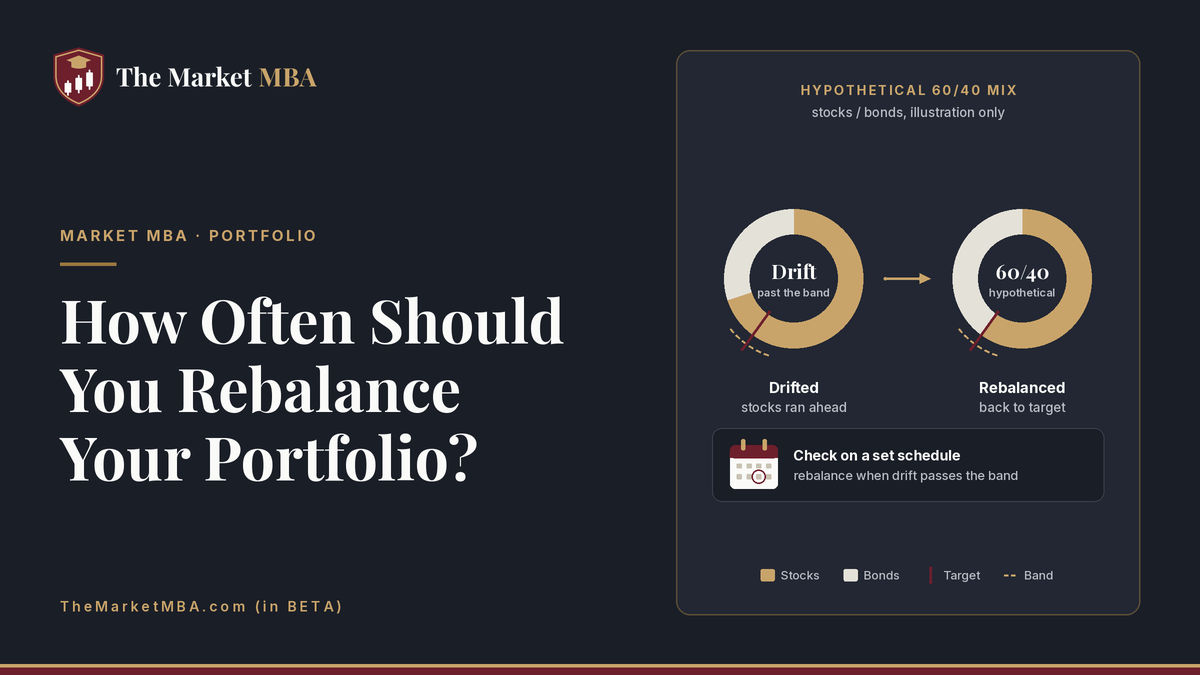
Many long-term investors check once or twice a year and rebalance only when an asset class drifts meaningfully from its target, often by about 5 percentage points. Research from fund companies finds that rebalancing more often adds cost without much benefit. In taxable accounts, using new contributions or dividends to rebalance can avoid selling and triggering taxes.
You picked a mix of stocks and bonds for a reason. Then markets moved, and the mix you own today probably isn’t the one you chose. Rebalancing is how you get back. This lesson covers how often to do it, the main methods, and the habits that keep it from becoming expensive or emotional.
What rebalancing is and why portfolios drift
Rebalancing means bringing your portfolio back to its target mix. The SEC’s beginners’ guide describes three ways to do it: sell some of what’s grown overweight and buy what’s underweight, buy more of the underweight category with new money, or direct new contributions toward it until the mix is back on target.
Portfolios drift because asset classes earn different returns. When stocks outpace bonds, stocks become a bigger share of the whole, and the portfolio takes on more risk than you planned. Vanguard puts the purpose plainly: rebalancing is meant “to manage risk, not maximize returns.”
If you haven’t set a target yet, start with our guide to asset allocation by age.
A worked example: a 60/40 portfolio after strong stock years
Here’s a hypothetical $100,000 portfolio with a 60% stock / 40% bond target. The returns are made up for illustration; they aren’t historical or expected returns.
| Start | After year 1 (stocks +20%, bonds +2%) | After year 2 (same returns again) | |
|---|---|---|---|
| Stocks | $60,000 (60%) | $72,000 (63.8%) | $86,400 (67.5%) |
| Bonds | $40,000 (40%) | $40,800 (36.2%) | $41,616 (32.5%) |
| Total | $100,000 | $112,800 | $128,016 |
After one year, stocks are 3.8 points above target. After two, they’re 7.5 points above. To return to 60/40 at the end of year 2, you’d sell about $9,590 of stocks and buy the same amount of bonds, leaving about $76,810 in stocks and $51,206 in bonds.
Whether you’d act after year 1 depends on your method.
Three approaches: calendar, threshold and combined
- Calendar. Rebalance on a set schedule, such as once a year, no matter how far the mix has drifted. The SEC’s guide mentions a schedule such as every six or twelve months.
- Threshold (bands). Rebalance only when an asset class drifts past a set band, such as 5 percentage points from target. In our example, a 5-point band does nothing after year 1 (63.8%) and triggers after year 2 (67.5%).
- Combined. Check on a schedule, but trade only if the drift exceeds the band. Vanguard describes this as a third option alongside the other two.
| Method | Effort | Trading and tax cost | Risk control |
|---|---|---|---|
| Calendar | Low: one date to remember | Can trade even when drift is tiny | Drift can build between dates |
| Threshold | Higher: you have to monitor | Trades only when drift is meaningful | Tighter, depending on band size |
| Combined | Moderate: periodic check | Trades only when needed | Balanced between the two |
How often is too often? What the research says
A Vanguard research paper, “Best practices for portfolio rebalancing” (Jaconetti, Kinniry and Zilbering, July 2010), tested strategies on a hypothetical 60/40 stock and bond portfolio using market data from 1926 through 2009. Its main findings:
- There’s “no optimal frequency or threshold.” Risk-adjusted returns weren’t meaningfully different whether the portfolio was rebalanced monthly, quarterly or annually.
- Costs rise with frequency. Monthly rebalancing with no threshold meant 1,008 rebalancing events over the period, compared with 15 for annual checks with a 10% threshold.
- Never rebalancing let risk creep up. In the paper’s 60/40 test, a never-rebalanced portfolio averaged about 84% in stocks over the period, with higher volatility (14.4% vs about 12% for the rebalanced versions).
- Its conclusion: for most broadly diversified stock and bond portfolios, “annual or semiannual monitoring, with rebalancing at 5% thresholds, is likely to produce a reasonable balance between risk control and cost minimization,” and “annual rebalancing is likely to be preferred when taxes or substantial time/costs are involved.”
Vanguard’s current investor page says something similar: “For many investors, implementing an annual rebalance is optimal,” with monthly or quarterly schedules being too frequent and every two years too infrequent. The SEC’s guide adds that rebalancing “tends to work best when done on a relatively infrequent basis.”
These results come from one firm’s research on historical data. Past performance doesn’t guarantee future results, and they describe common practice, not a recommendation for you.
Rebalancing in a down market: the behavioral side
Rebalancing feels easy after a strong stock year. It’s harder after a crash. Take the same $100,000, 60/40 portfolio in a hypothetical year when stocks fall 25% and bonds gain 3%:
- Stocks: $45,000 (52.2%)
- Bonds: $41,200 (47.8%)
Returning to 60/40 means buying about $6,720 of stocks at exactly the moment they’ve fallen. That’s the point of the method: it adds to what’s down and trims what’s up, according to a rule rather than a feeling. The SEC notes that savvy investors “typically do not change their asset allocation based on the relative performance of asset categories.”
This is where a written rule helps most. CFA Institute describes an investment policy statement as a guide that can offer “an objective course of action to be followed during periods of market disruption when emotional or instinctive responses might otherwise motivate less prudent actions.”
Taxes and costs
The SEC’s guide reminds investors to consider transaction fees and tax consequences before rebalancing. A few common practices:
- Rebalance with cash flows. Vanguard suggests sending dividends and interest to underweight asset classes and taking withdrawals from overweight ones. New contributions work the same way. In our year-1 example, adding about $7,200 of new money entirely to bonds would restore 60/40 without selling anything.
- Partial rebalancing. Moving only part of the way back to target can limit taxes and costs, Vanguard notes, as can focusing on shares with a higher cost basis in taxable accounts.
- Tax-advantaged accounts. Under IRS rules, earnings in a traditional 401(k) are generally taxed when distributed rather than when trades happen inside the account, so rebalancing there doesn’t usually create a current tax bill. Qualified Roth distributions are tax-free.
Selling at a gain in a taxable account can create a tax bill. Tax situations vary, so a tax professional can help with your specifics. If you use funds, how they’re built can also affect taxes (see our comparison of index funds and ETFs).
Put your rebalancing rule in your IPS
CFA Institute’s guide to investment policy statements lists the rebalancing process as part of an IPS’s risk management section. Writing yours down turns a judgment call into a routine. Sample wording, as an illustration only:
“I will review my portfolio each [month name]. If any asset class is more than [X] percentage points from its target, I will rebalance, using new contributions and dividends first and selling only if needed. I will not change my target allocation because of recent market performance.”
The brackets are placeholders, not suggestions. See our guide to writing an investment policy statement for a full example.
FAQ
Should I rebalance my portfolio when the market is down?
If your rule says so, many investors follow it, because rebalancing after a decline means buying the asset that fell and bringing risk back to target. The method is meant to manage risk, not to time the market. Whether to act is your decision.
Can I rebalance without paying taxes?
Often, yes, at least partly. Rebalancing inside tax-advantaged accounts such as a 401(k) or IRA generally doesn’t create a current tax bill, and steering new contributions, dividends and interest toward underweight assets avoids selling. A tax professional can address your situation.
Is it better to rebalance annually or quarterly?
Vanguard’s 2010 research found risk-adjusted returns weren’t meaningfully different between monthly, quarterly and annual rebalancing, while costs rose with frequency. Its investor page says annual rebalancing is optimal for many investors.
What is threshold rebalancing?
It means rebalancing only when an asset class drifts past a set band around its target, such as 5 percentage points. Small drifts are ignored, which keeps trading down.
Should I rebalance my 401(k)?
The same logic applies: a 401(k) drifts like any portfolio. Check your plan’s options for changing how your balance and new contributions are invested. If you hold a target-date fund, the SEC notes it rebalances its own mix over time.
Sources
- Investor.gov (SEC), Beginners’ Guide to Asset Allocation, Diversification, and Rebalancing: https://www.investor.gov/additional-resources/general-resources/publications-research/info-sheets/beginners-guide-asset
- Vanguard, Rebalancing your portfolio: How to rebalance: https://investor.vanguard.com/investor-resources-education/portfolio-management/rebalancing-your-portfolio
- Jaconetti, Kinniry and Zilbering, Best practices for portfolio rebalancing, Vanguard research (July 2010), summary via AAII: https://www.aaii.com/journal/article/best-practices-for-portfolio-rebalancing (full paper read at https://cdn.indexacapital.com/bundles/unaiadvisor/docs/papers/2010-Vanguard-Best-practices-for-portfolio-rebalancing.pdf)
- CFA Institute, Elements of an Investment Policy Statement for Individual Investors (May 2010): https://rpc.cfainstitute.org/sites/default/files/-/media/documents/article/position-paper/investment-policy-statement-individual-investors.pdf
- IRS, 401(k) Plans: https://www.irs.gov/retirement-plans/401k-plans
- IRS, Roth IRAs: https://www.irs.gov/retirement-plans/roth-iras
- Investor.gov (SEC), Target Date Funds – Investor Bulletin (Mar 25, 2025): https://www.investor.gov/introduction-investing/general-resources/news-alerts/alerts-bulletins/investor-bulletins/target-date-funds-investor-bulletin
- Worked examples: hypothetical returns, calculated by The Market MBA
Keep going. This article is part of 410 Risk and behavior in Level 400 Portfolio management of The Market MBA, a 4-level, 12-course program that ends with you writing your own investment policy statement.
For education only. Not financial, investment, legal or tax advice.
For education and entertainment only. Not financial advice.