 The Market
If you looked only at the headline indexes on Wednesday, you’d think the AI boom had a great day. The S&P 500 rose 1.6% to 7,688.62, the Nasdaq Composite gained 1.4%, and the Dow jumped 1,569 points, or 3%, according to Reuters and the AP. This came after Democrats won control of both the House and Senate.
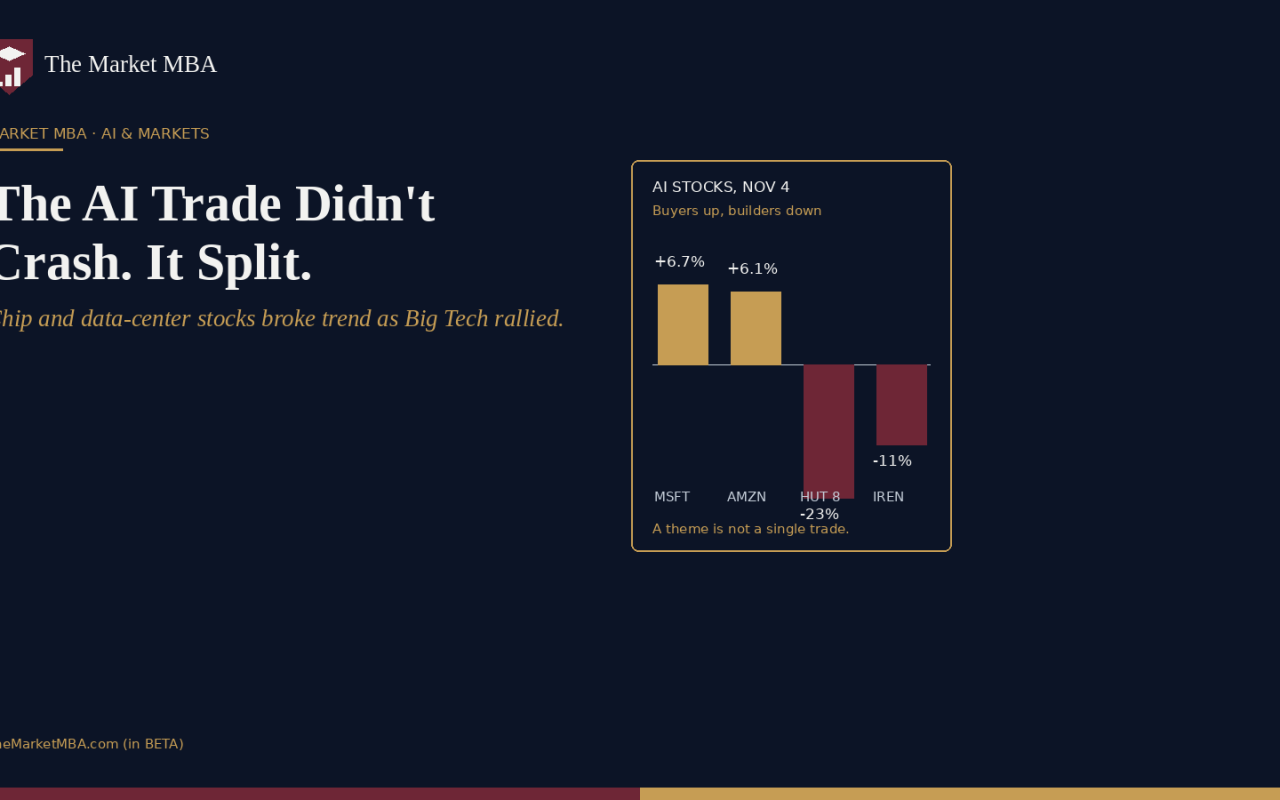
Underneath those numbers, the AI trade broke in two. The companies that pay for AI went up, and many of the companies that build it went down. The lesson for this morning is the same one that holds in any market: a theme is not a single trade, and how you’re positioned inside it matters as much as whether you believe in it.
The split, in numbers
Reuters described it plainly: “AI stocks were split.” Microsoft rose 6.7%, Amazon 6.1%, Alphabet 3.2% and Meta 1.4%. Data-center operators fell hard: Hut 8 dropped 23%, IREN 11%, Core Scientific 10% and Applied Digital 6.7%. The Philadelphia Semiconductor Index (SOX) fell 3.1% and hit a six-month low.
The chart drew attention. Barchart noted that semiconductor stocks were “now falling decisively below their 200-day moving average.” On its chart, the iShares Semiconductor ETF (SOXX) closed at 450.41, under a 200-day average of 478.13, or about 6% below the line. These are Nov. 4 pre-split levels; SOXX’s three-for-one split takes effect Nov. 5, so the equivalent split-adjusted levels are about 150.14 and 159.38. The split changes the share count and price scale, not the trend signal. Data from Closelook puts the SOX index about 5% below its own 200-day and roughly 30% under its June high. It is still up around 45% for the year.
The 200-day moving average is the average closing price over about ten months of trading. Many large investors use it to judge a long-term trend. A move decisively below it tells you the market’s patience has changed, even if the long-term story hasn’t.
Why the builders fell while the buyers rose
Reuters tied the move to the election map. Democrats gained in key data-center states such as Texas and Georgia, where public opposition to rapid expansion has been growing. A slower build-out cuts both ways:
- Cash-rich platforms like Microsoft and Amazon could spend less cash, and a slower race could protect their lead.
- Suppliers and operators whose growth depends on a fast build-out lose their tailwind.
Citi’s Scott Chronert put it this way to Reuters: “If you push out the pace or change the pace of the data center buildout, you begin to change the fundamental trajectory for many of those suppliers.”
The amount of money involved explains why markets care. J.P. Morgan Global Research projects $900 billion of AI capital spending in 2026, and UBS’s CIO office has a similar forecast of about $900 billion, rising to about $1.2 trillion in 2027. These are spending forecasts, not guaranteed revenue. Every dollar of that capex is income for a chipmaker, a power supplier or a data-center operator. If the pace slips even a little, the suppliers feel it first and hardest.
Even the bulls want proof sooner
The day before the vote, before any results were in, Dan Ives appeared on Bloomberg Surveillance. Ives is one of Wall Street’s best-known tech bulls, and Bloomberg’s written caption identifies him as partner and senior managing director at Yorkville Ives & Co. He said he sees “another 10% to 12% down” for chips on the SOX before he’d go “suit shopping,” meaning before he would buy, in a clip shared by Milk Road Stocks.
His more lasting point was about time: “So maybe if these companies had 12 to 18 months to monetize, now it’s maybe six to nine months.” He called this a “gut-check period” and “the start of winners and losers.” When asked whether the bubble had burst, he said “No,” and added that he believes “the fundamentals will prove it out.”
Take two things from that. First, the “maybe” matters. Ives is describing how much patience investors have left, not setting a deadline. Second, when a committed bull talks about another double-digit drop and a shorter timeline, the market has started demanding returns instead of promises. Companies that can show AI revenue now get rewarded. Companies that need years of build-out to justify their valuations get marked down.
Why this matters even if you only own an index fund
The so-called Magnificent Seven make up roughly a third of the S&P 500: Palanor put it at 33.4% on Nov. 3, and the Motley Fool put it at 34.9% in October. If you own a broad index fund, you have a large and often hidden bet on how the AI cycle plays out.
On Wednesday, that concentration helped. The platform giants rallied, and they carry far more index weight than data-center operators do. The same math can work in reverse on a day when the platforms are the ones selling off. Knowing what’s inside your “diversified” fund is part of managing risk, not an extra.
The policy risk: real, but slower and narrower than the headlines
Some posts on social media suggest Washington is about to shut AI down. The Macro Paper warned that “Democrats could trigger an even bigger crash,” pointing to the Sanders/Casar AI bill. Rep. Yassamin Ansari posted that a pause on advanced AI development “needs to be” at the “top of the Democratic agenda on day 1.”
The bill is real, and its wording is aggressive. The Senate version, S.5493, would require a pause on advanced AI systems, defined as those trained on at least 10^25 operations. The pause would last until a new Department of Artificial Intelligence is fully staffed and has issued rules. The bill would also ban artificial superintelligence outright. Its maximum penalty is up to 20 years in prison, and that applies only to reckless violations by company policymakers or “rogue actors.”
What matters for investors is the bill’s status. Both S.5493 and the House companion, H.R.10538, are listed as “Introduced.” They were referred to committee in September and have seen no action since. Bills that don’t pass expire when this Congress ends in early January. The new Democratic majorities don’t take office until January 2027. Reuters puts the Senate at at least 54–44, which is short of the 60 votes needed to break a filibuster, and the President can still veto a bill. Ansari’s post speaks for one member, not for the party’s leadership.
The more realistic risk is quieter: oversight hearings, chip export policy, and the local fights over power, permits and electricity bills that J.P. Morgan already lists as a growing constraint on build-outs. None would end AI. Each could slow it, and the market is already pricing in a slower build-out against the suppliers.
The lesson
The AI story didn’t end on Election Day. Investors started sorting it. The useful questions now are specific. Who earns money from AI today, and who needs the build-out to keep accelerating? How much of your portfolio depends on the answer? A trend line breaking, a bull asking for faster proof, and a new political map all point the same way: the AI trade is now about telling winners from losers, not buying everything with an AI label.
This is for education only, not financial advice.
For education and entertainment only. Not financial advice.