 The Market
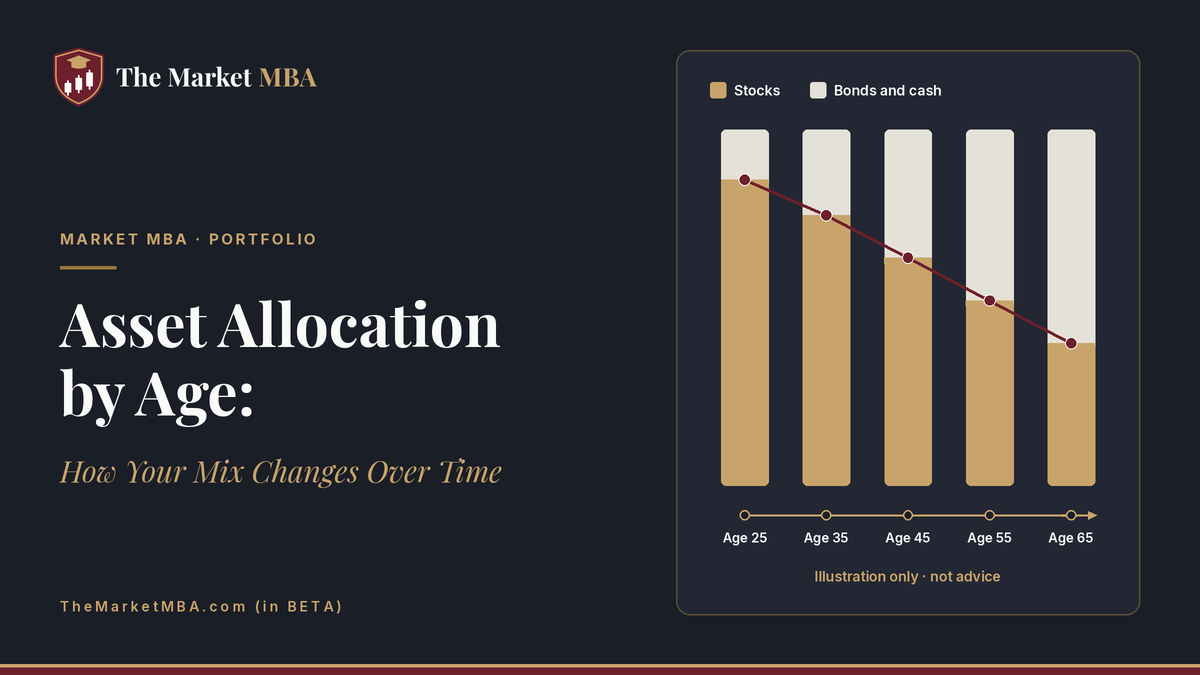
Age is a shortcut for time horizon. Investors with decades ahead usually hold more stocks because they have time to recover from drops; as a goal gets closer, many shift toward bonds and cash to reduce swings. Rules like “110 minus your age” and target-date glide paths are starting points, not prescriptions. Risk tolerance and goals matter more.
Search “asset allocation by age” and you’ll find tidy charts telling a 40-year-old exactly what to own. This lesson takes a different approach. It explains why age matters, lays the common rules of thumb side by side, and then covers the factors that can matter more than your birthday. Your situation may differ; consider a licensed professional for advice about your own mix.
What asset allocation is and why it shapes your experience
Asset allocation is how you divide a portfolio among broad categories, mainly stocks, bonds and cash. The SEC’s beginners’ guide says the right mix for you “will depend largely on your time horizon and your ability to tolerate risk,” and that asset allocation “has a major impact on whether you will meet your financial goal.”
Each category behaves differently. According to the SEC, stocks have historically had the greatest risk and highest returns of the three, though past performance doesn’t guarantee future results. Bonds are generally less volatile. Cash equivalents are the safest and offer the lowest return. Too little risk, and your money may not grow enough to reach a long-term goal. Too much, and the money may not be there when you need it.
Why age matters: time horizon, human capital and capacity for risk
Age shows up in allocation advice for three reasons.
- Time horizon. The SEC’s target-date fund bulletin puts it simply: the longer investors have to invest, “the more risk they can generally afford to take because their investments have more time to recover.” A 25-year-old saving for retirement has decades; a 63-year-old may need the money soon.
- Human capital. Your future earnings are an asset too. Research from the CFA Institute Research Foundation (Ibbotson, Milevsky, Chen and Zhu, 2007) argues that individuals should consider human capital, the value of future work income, when setting their financial asset allocation. Early in a career, most of your wealth is future paychecks. The authors’ framework implies that younger investors hold more in stocks than older investors, and that people with safe, steady labor income can hold more of their financial portfolio in stocks.
- Capacity for risk. Even if you’re comfortable with swings, a short horizon limits how long you can wait for a recovery. That’s capacity, and it’s separate from your emotional tolerance.
The SEC notes the practical result: “most people investing for retirement hold less stock and more bonds and cash equivalents as they get closer to retirement age.”
The common rules of thumb, compared
The best-known shortcuts subtract your age from a fixed number to get a stock percentage, with the rest in bonds and cash. “100 minus your age” is the traditional version; “110” and “120” are more stock-heavy variants that some writers favor because people now live longer. Here’s the arithmetic, for illustration only:
| Age | 100 minus age (stocks) | 110 minus age (stocks) | 120 minus age (stocks) |
|---|---|---|---|
| 25 | 75% | 85% | 95% |
| 35 | 65% | 75% | 85% |
| 45 | 55% | 65% | 75% |
| 55 | 45% | 55% | 65% |
| 65 | 35% | 45% | 55% |
These aren’t recommendations. They’re arithmetic, and the 20-point spread between the first and last columns at every age shows how arbitrary the starting number is. The rules ignore everything except age.
How target-date glide paths handle it
Target-date funds (also called lifecycle funds) do the age-based shift automatically. The SEC explains that each fund follows a “glide path,” the planned change in its mix of stocks, bonds and cash over time, generally becoming more conservative as the target date nears.
Three points from the SEC’s bulletin matter for anyone comparing glide paths:
- Funds with the same target date can differ in strategy, investments, glide path and fees.
- “To” vs “through.” A “to” glide path stops shifting at the target date; a “through” glide path keeps shifting past it.
- No guarantee. A target-date fund doesn’t guarantee you’ll have enough income in retirement. And like any mutual fund or ETF, it isn’t FDIC-insured and can lose money.
So rather than copy any one fund’s published mix, read the glide path in a fund’s prospectus and compare it with your own horizon. We don’t reproduce specific funds’ figures here.
What should override age
Two people the same age can sensibly hold very different mixes. Factors that can matter more than age include:
- Other income sources. A pension or expected Social Security benefits can cover part of your spending. The SEC’s bulletin suggests considering other investments and sources of retirement income, not just one fund.
- Job stability. In the human capital research, investors whose earnings are highly correlated with the stock market hold less risky financial assets, while those with safe labor income hold more stocks.
- Other goals. Money for a house in three years has a short horizon even if you’re 28. Each goal can have its own allocation.
- Emotional risk tolerance. The SEC defines risk tolerance as your ability and willingness to lose some or all of your investment in exchange for greater potential returns. A mix you’ll abandon in a downturn isn’t a good mix for you.
- Longevity. The same research stresses longevity risk: a longer retirement means the money has to last longer.
The SEC also notes you may need to change your allocation when your risk tolerance, financial situation or goal changes, not just your age.
How to move along the path
Shifting your mix as you age doesn’t have to mean large, sudden trades.
- Direct new contributions. The SEC lists adding new money to underweighted categories as one way to adjust.
- Rebalance on a schedule. Periodic rebalancing brings a drifting portfolio back to target (see how often to rebalance your portfolio).
- Change your target gradually. Many investors adjust a few percentage points at a time rather than all at once.
- Don’t chase performance. The SEC observes that savvy investors “typically do not change their asset allocation based on the relative performance of asset categories,” such as adding stocks when the market is hot.
If you hold bonds, know how much rate risk they carry (see why bond prices fall when interest rates rise). Taxes and trading costs can affect how you adjust in taxable accounts; a tax professional can help with specifics.
Write it down: put your allocation in your IPS
An investment policy statement (IPS) turns your allocation into a rule you can follow. CFA Institute’s guide for individual investors includes return and risk objectives, time horizon and constraints among its core elements. For allocation, many investors write down:
- A target mix (for example, “[X]% stocks / [Y]% bonds and cash”; placeholders, not suggestions).
- An acceptable range around each target.
- How and when the target will change as the goal approaches.
- When they’ll review it, such as once a year or after a major life change.
See our guide to writing an investment policy statement for a full example.
FAQ
What is the 110 minus age rule?
It’s a rule of thumb: subtract your age from 110 to get a stock percentage, with the rest in bonds and cash. At 40, that’s 70% stocks. It’s a variant of the older “100 minus age” rule. It’s a starting point for thinking, not a recommendation, and it ignores everything about you except age.
How much of my portfolio should be in bonds at 40?
There’s no single answer. The rules of thumb give anywhere from 20% to 40% in bonds and cash at 40, which shows how much they disagree. Your horizon, income stability, other goals and risk tolerance matter more. Your situation may differ; consider a licensed professional.
Are target-date funds a good way to handle allocation by age?
They’re one way to automate it. Each follows a glide path that generally gets more conservative over time. But the SEC notes funds with the same date can differ, they don’t guarantee retirement income, and like other funds they can lose money. Read the prospectus and compare fees and the glide path with your own plans.
Should I hold any bonds in my 20s?
Some investors do and some don’t. A long horizon and steady income generally allow more stock risk, but bonds or cash can still make sense for shorter-term goals, an emergency reserve, or if large swings would lead you to sell. It depends on you.
Does asset allocation matter more than picking investments?
The SEC notes that some financial experts believe your asset allocation is the most important investment decision you’ll make, even more important than the individual investments you buy. Either way, it has a major impact on whether you reach your goal.
Sources
- Investor.gov (SEC), Beginners’ Guide to Asset Allocation, Diversification, and Rebalancing: https://www.investor.gov/additional-resources/general-resources/publications-research/info-sheets/beginners-guide-asset
- Investor.gov (SEC), Target Date Funds – Investor Bulletin (Mar 25, 2025): https://www.investor.gov/introduction-investing/general-resources/news-alerts/alerts-bulletins/investor-bulletins/target-date-funds-investor-bulletin
- CFA Institute Research Foundation, Lifetime Financial Advice: Human Capital, Asset Allocation, and Insurance (Ibbotson, Milevsky, Chen, Zhu, April 2007): https://rpc.cfainstitute.org/research/foundation/2007/lifetime-financial-advice-human-capital-asset-allocation-and-insurance (full PDF: https://rpc.cfainstitute.org/sites/default/files/-/media/documents/book/rf-publication/2007/rf-v2007-n1-4580-pdf.pdf)
- CFA Institute, Elements of an Investment Policy Statement for Individual Investors (May 2010): https://rpc.cfainstitute.org/sites/default/files/-/media/documents/article/position-paper/investment-policy-statement-individual-investors.pdf
- Investor.gov (SEC), Mutual Funds (risks, not FDIC-insured): https://www.investor.gov/introduction-investing/investing-basics/investment-products/mutual-funds-and-exchange-traded-1
- Investopedia, Stock Allocation Rules (100, 110 and 120 minus age; updated Feb 6, 2025): https://www.investopedia.com/articles/investing/062714/100-minus-your-age-outdated.asp
- Rules-of-thumb table: arithmetic by The Market MBA, illustrative only
Keep going. This article is part of 401 Portfolio construction in Level 400 Portfolio management of The Market MBA, a 4-level, 12-course program that ends with you writing your own investment policy statement.
For education only. Not financial, investment, legal or tax advice.
For education and entertainment only. Not financial advice.